


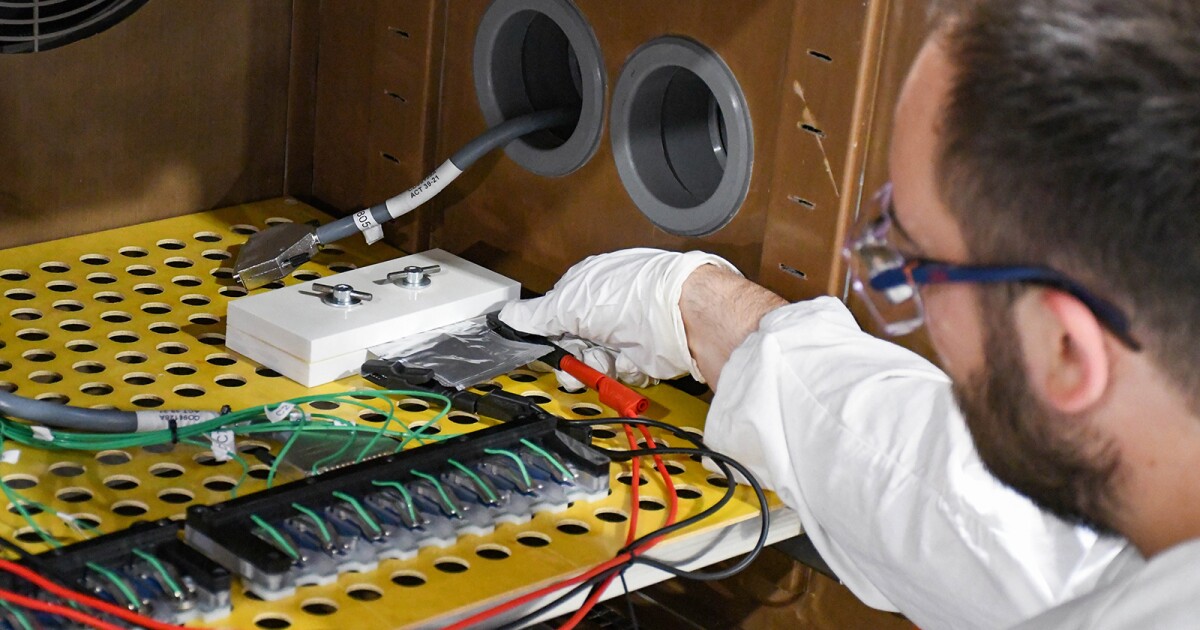
A team at Germany’s Fraunhofer Institute for Ceramic Technologies and Systems (IKTS) has developed a new type of sodium-ion battery that uses lignin as a key electrode material.
Lignin is a natural polymer found in trees. It basically acts like a glue, holding wood fibers together and giving the wood its strength. In the paper industry, however, it has little value and is usually burned to produce energy. The researchers saw potential in transforming this waste material into something far more valuable: a safe and cost-effective material for batteries.
While there have been previous attempts to use wood materials instead of mined minerals, this new research shows significant progress toward real-world applications. By heating lignin to very high temperatures, it is transformed into what scientists call hard carbon, which is then used to make the battery’s negative electrode, or anode.
Fraunhofer IKTS
One of the main advantages of using lignin is its availability. It can be sourced locally in many parts of the world. In fact, the lignin used for this research was harvested in the Thuringian Forest in central Germany, not far from the research center itself. From a cost perspective, lignin is definitely winning over critical metals such as lithium, cobalt, and nickel that are expensive, involve mining, and come with logistical challenges.
“We want to avoid critical metals in the battery value chain. We also aim to minimize the fluorine content in the electrodes and electrolytes, and we are testing to which degree we can eliminate it. However, the project mainly focuses on processing locally available, high-quality lignin into high-performance electrodes for our sodium-ion batteries,” explains Lukas Medenbach, a research scientist at Fraunhofer IKTS in Arnstadt.
Using lignin for batteries also helps reduce carbon emissions, as it’s no longer burned as waste, not to mention that this kind of battery is much safer and easier to recycle than lithium-based ones.
Meanwhile, the battery’s positive electrode relies on non-toxic, iron-based materials, such as Prussian Blue analogs, which are also widely available and environmentally friendly. Prussian Blue is a deep-blue pigment historically used in inks and dyes, but modern technologies have made it possible to modify its crystal structure into what’s called Prussian Blue analogs, which are suitable for storing sodium ions in batteries.
Hard carbon from lignin has undergone testing and showed strong suitability for storing sodium ions as well as great cycle stability.
“After 100 charging and discharging cycles, the lab cell shows no significant degradation. The aim is to demonstrate 200 charging and discharging cycles for the 1-Ah full cell by the end of the project,” says Medenbach.
Although still in development, lignin-based sodium-ion batteries could serve for stationary or mobile storage applications with lower power demands. They are ideal for microcars with speed limits of 45 km/h (28 mph) and warehouse vehicles such as forklifts, where fast charging is less critical.
Source: Fraunhofer

