


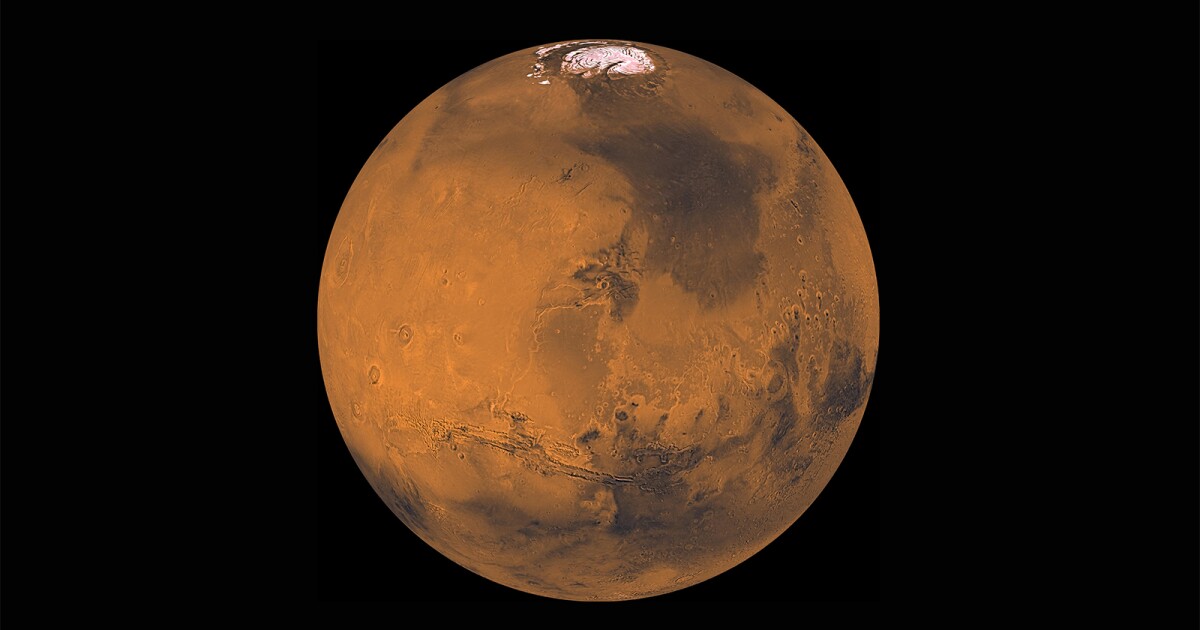
If you’re going to Mars you’d best take along a jar of anti-aging cream because while you’re there you’re going to age faster than on Earth thanks to the Theory of Relativity. It’s only 477 millionths of a second per day, but that tends to add up.
If you managed to stay awake during the more complicated lessons in physics class, you probably came across Albert Einstein’s Theory of Relativity that knocked the Newtonian model of the universe for six by relegating it from a universal description of how physics work to a mere special case.
Getting a clear understanding of Relativity is impossible without getting into some pretty dense mathematics, which I’ll spare you because I’m in a generous mood, but there have been many attempts over the years to explain the concept in everyday terms that are a reasonable, though oversimplified, approximation.
One popular subject of Relativity is the relationship between space and time, where time is a fourth dimension in which the three dimensions of space exist and how time passes depends entirely on your point of view.
AI-generated using Gemini
In 1956, Robert Heinlein published his juvenile novel Time for the Stars, which is about twin brothers, one of whom goes on a voyage to the stars while the other remains on Earth. The spacefaring brother travels at near the speed of light, causing time to pass more slowly, but it seems to be perfectly normal from his perspective. However, if he could see his brother back on Earth, it would look like terrestrial time has sped up dramatically.
The end of the story sees the traveling brother returning to Earth only about four years older, while his stay-at-home sibling is 71 years older, which proves to be rather aggravating for all concerned – not to mention putting any bookkeepers involved to tears.
This sort of thing, called time dilation, may seem like the province of science fiction or esoteric physics, but this effect has surprising everyday implications.
For example, when the first GPS satellites were sent into low Earth orbit, scientists didn’t think time dilation would have a measurable effect on them. GPS pioneer Neil Ashby pointed out that it would have a very large and unwelcome effect.
As a GPS satellite orbits the Earth, it’s traveling at about 17,500 mph (28,000 km/h). Applying Einstein’s equations, this means that time for the satellite is running at seven millionths of a second (7 microseconds) per day faster than at mean sea level on Earth.
Now things get tricky because what a lot of popular science articles tend to leave out is that, according to Relativity, it isn’t just speed that affects time, so does gravity. The closer you are to an object with very strong gravity, like a black hole, the slower time runs. However, and this is the irritating bit, it moves relatively faster as you move away from the object. That means when a satellite is in orbit, the lower gravity because it’s further from the Earth makes time speed up.

AI-generated using MS365
This means that our GPS satellite loses seven microseconds of time but it gains 45 microseconds per day, so time for the satellite runs 38 microseconds faster per day when the effects are tallied up.
What all this boils down to is that if a correction isn’t built into the GPS system, the position calculations would be off by several miles per day and we’d spend a lot of time pestering police officers, garage owners, and total strangers for directions.
With humanity moving farther and farther out into space on a regular basis, this becomes much more of a practical problem. Not only do satellite clocks need to be adjusted as they are placed in higher orbits, the Americans want the Moon to be given its own special time zone because time there runs 56 microseconds per day faster than on Earth.
And then there’s Mars. With plans for more frequent and more ambitious missions being sent to the Red Planet followed by human colonies, the time problem becomes even more difficult, which is what Ashby and Bijunath Patla at the National Institute of Standards and Technology (NIST) are trying to sort out.
What they found is that the time differences on Mars are more complex compared to the Moon because when doing the calculations for the Moon only the gravity of the Earth, Moon, and Sun needs to be included in the sums. However, for Mars it’s a four body problem with Mars itself thrown into the mix and making the calculations an order of magnitude harder to solve.
Worse, Mars moves in a more elliptical orbit than the Moon, so its speed around the Sun varies throughout the Martian year. There’s also a bit of a wobble in its orbit that screws things up. The result is that the team’s calculation predicts that time on Mars runs 477 microseconds per day faster, with a fluctuation of 266 microseconds that needs to be accounted for at any point in the year.
That won’t be easy. For GPS satellites, the discrepancy can be corrected by just slowing down the onboard clock. For Mars, it’s far more complex because you’re not only trying to correct against a GPS error of 89 miles (143 km) per day. You’re also dealing with an increasingly complex communications system – an internet of the Solar System – so you’ll need a dynamic, ever-changing correction to avoid screwing up the transmission and reception of data packets.
“It’s good to know for the first time what is happening on Mars timewise,” said Ashby. “Nobody knew that before. It improves our knowledge of the theory itself, the theory of how clocks tick and relativity. The passage of time is fundamental to the theory of relativity: how you realize it, how you calculate it, and what influences it. These may seem like simple concepts, but they can be quite complicated to calculate.”
The research was published in The Astronomical Journal.
Source: NIST

