


André Rhoden-Pauland
BBC Verify
 Reuters
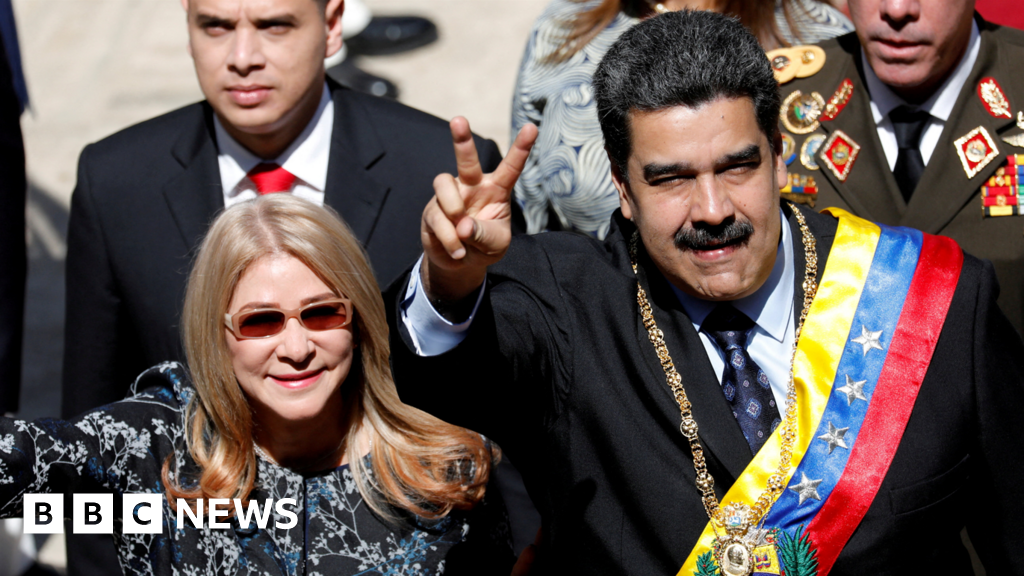
The US has captured Venezuela’s President Nicolas Maduro after a large scale strike on the South American country, US President Donald Trump has said.
Trump said Venezuela’s left-wing president and his wife were flown out of the country in a military operation in conjunction with US law enforcement. They have been charged with drug and weapons offences in New York.
It comes after explosions were reported across the capital Caracas in the early hours of Saturday morning, including at military bases.
The Venezuelan government has since demanded proof Maduro is alive. It has also deployed its armed forces and declared a national emergency.
Maduro’s capture comes after heightened tensions between the two countries, with Washington striking boats in the Caribbean it says are being used to carry drugs.
The US has accused the Venezuelan president of being personally involved in drug-smuggling and being an illegitimate leader, while Maduro has accused the US of intimidation.
Here is what we know so far.
What do we know about the operation?
Maduro was captured by the US army’s Delta force – the military’s top counter terrorism unit – according to the BBC’s US news partner CBS.
Trump told Fox and Friends on Saturday that Maduro and his wife were taken from “a house that was more like a fortress”. The president said US forces were prepared with “massive blowtorches” to cut through steel, but said Maduro “did not make it into that area of the house”.
Trump said no US forces were killed and there were “few” injuries in the operation, which he said he watched live.
Maduro and his wife were on a ship on their way to New York City, Trump said.
Trump is due to hold a news conference at his Mar-a-Lago residence in Florida at 11:00 EST (16:00 GMT) at which further details about the operation may be disclosed.
Republican Senator Mike Lee, who spoke to US Secretary of State Marco Rubio, said “he [Rubio] anticipates no further action in Venezuela now that Maduro is in US custody, adding that the strikes were “deployed to protect and defend those executing the arrest warrant”.
Around 02:00 local time (06:00 GMT), loud explosions were heard in Caracas, while plumes of smoke were seen rising over the city.
Videos of explosions and helicopters flying overhead have been circulating on social media, but they have not been verified yet.
Surrounding communities were also without power.
It is not known if there have been any casualties.
The Venezuelan government also said the states of Miranda, Aragua and La Guaira were also hit.

 AFP via Getty Images
Where were the strikes?
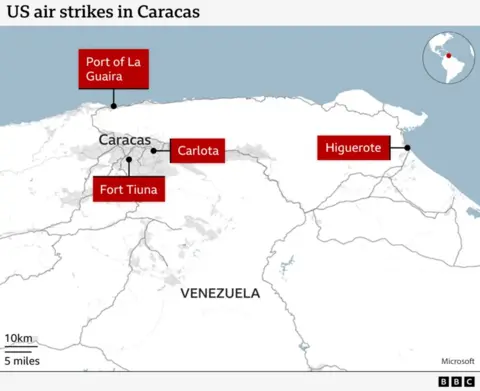
BBC Verify is working through a number of videos showing explosions, fire and smoke in locations around Caracas to identify exactly which sites were targeted.
It has confirmed three locations, so far:
- Generalissimo Francisco de Miranda Air Base, an airfield known as La Carlota
- Port La Guaira, Caracas’ main conduit to the Caribbean Sea, located in Miranda state
- Higuerote Airport, also located in Miranda state, just east of Caracas
What has Donald Trump said?
 Reuters
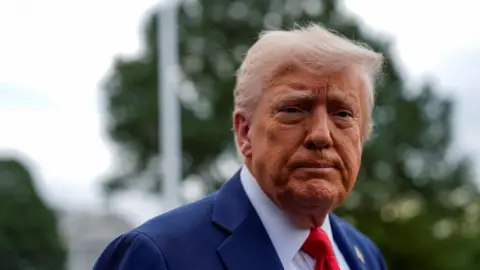
Trump took to his Truth Social platform to confirm the US was behind the strikes on Saturday morning.
“The United States of America has successfully carried out a large scale strike against Venezuela and its leader, President Nicolas Maduro, who has been, along with his wife, captured and flown out of the Country,” Trump wrote.
“This operation was done in conjunction with US Law Enforcement. Details to follow.”
The US president described it as a “brilliant operation” to the New York Times in a 50-second phone call.
In his interview with Fox and Friends later, he described the operation in more detail.
He said US forces had been “prepared for a second wave” but did not have to conduct one because the first was “so powerful”.
Trump said he spoke to Maduro a week ago, adding he had told him “basically I said you have to give up, you have to surrender”.
Trump said Maduro had wanted to negotiate.
What has Maduro been charged with?
US attorney General Pam Bondi said Maduro and his wife, First Lady Cilia Flores, had been indicted in the Southern District of New York.
They have been charged with conspiracy to commit narco-terrorism and import cocaine, possession of machine guns and destructive devices, and conspiracy to possess machine guns and destructive devices against the US.
“They will soon face the full wrath of American justice on American soil in American courts,” Bondi wrote on X.
It is unclear if the couple are now on US soil.
How has Venezuela reacted?
Venezuela’s Vice-President Delcy Rodríguez said the government did not know where Maduro and his wife were, and demanded “immediate proof of life” for them both.
The country’s defence minister Vladimir Padrino López claimed the strikes hit civilian areas and said the government was compiling information about dead and injured people.
He added that Venezuela would “resist” the presence of foreign troops.
Venezuela’s government issued an official statement denouncing the “extremely serious military aggression” by the US “against Venezuelan territory and population in civilian and military locations”.
It also accused the US of threatening international peace and stability and described the attack as an attempt to seize “Venezuela’s strategic resources, particularly its oil and minerals” in an attempt to “forcibly break the political independence of the nation”.
Who is Maduro and why has he been captured?
Nicolás Maduro rose to prominence under the leadership of left-wing President Hugo Chávez and his United Socialist Party of Venezuela (PSUV). He succeeded Chávez as president in 2013.
In 2024, Maduro was declared winner of the presidential election, even though voting tallies collected by the opposition suggested that its candidate, Edmundo González, had won by a landslide.
He has been at odds with Trump over the arrival of hundreds of thousands of Venezuelan migrants in the US and the movement of drugs into the US, in particular fentanyl and cocaine.
Trump has designated two Venezuelan drug gangs – Tren de Aragua and Cartel de los Soles – as Foreign Terrorist Organisations (FTOs) and has alleged that the latter was led by Maduro himself.
The US had offered a $50m (£37m) reward for information leading to Maduro’s arrest.
Maduro has vehemently denied being a cartel leader and has accused the US of using its “war on drugs” as an excuse to try to depose him and get its hands on Venezuela’s vast oil reserves.
In recent months, US forces have also carried out more than two dozen strikes in international waters on boats it alleges have been used to traffick drugs into the US. More than 100 people have been killed.
How have other countries reacted?
News of the strikes prompted the strongest reaction from Venezuela’s long-term allies.
Russia accused the US of committing “an act of armed aggression” that was “deeply concerning and condemnable”.
Iran’s foreign ministry called the strikes a “flagrant violation of the country’s national sovereignty”.
Colombian President Gustavo Petro called the strikes an “assault on the sovereignty” of Latin America, while Cuba’s President Miguel Diaz-Canel described it as a “criminal attack”.
The EU’s top diplomat Kaja Kallas reiterated the bloc’s position that Maduro lacks legitimacy and that there should be a peaceful transition of power, but said the principles of international law must be respected.
UK Prime Minister Sir Keir Starmer said he wanted to “establish facts” and speak to Trump first about the “fast moving situation”.

