


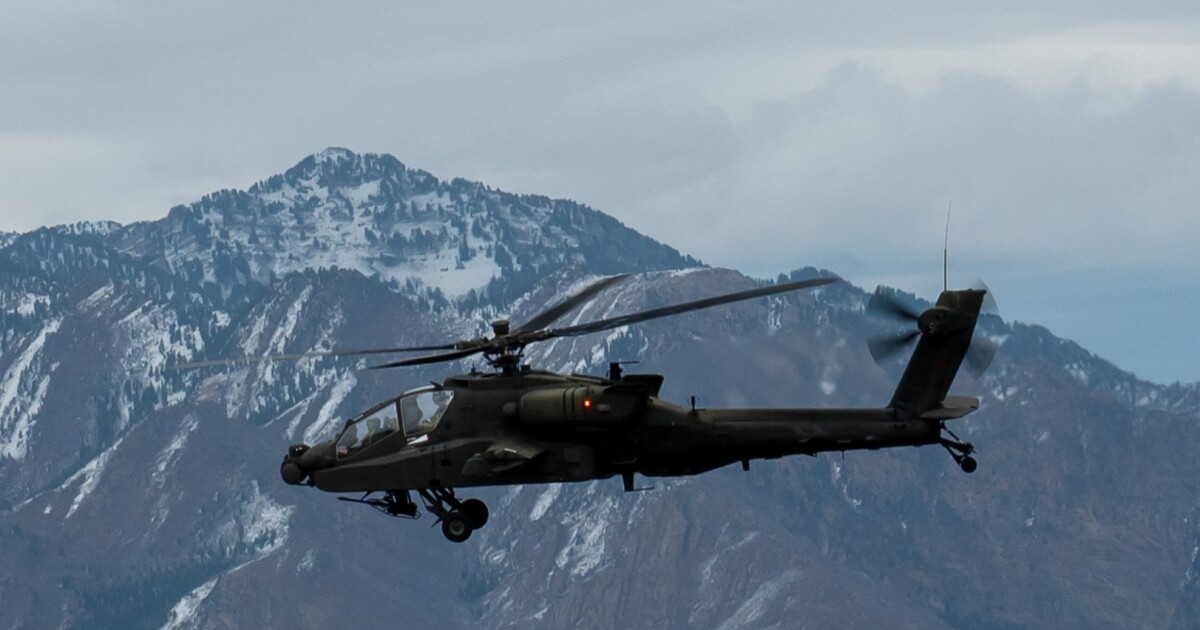
The US Army is turning its AH-64 Apache attack helicopter into a drone hunter thanks to a new 30-mm round for its M230 chain-gun that can take out Unmanned Aircraft Systems (UAS) using a proximity fuse that unleashes a blast of high-velocity shrapnel.
Serving with the US Army and others since 1986, the Boeing Apache AH-64 made its name as a tank-killing ground-attack helicopter notorious for its ability to penetrate enemy territory using terrain for cover, hover in wait, and then pop up to destroy its target without warning.
However, the one thing it’s never been known for is air-to-air combat – much less as an anti-drone platform. That would be like using a howitzer to hunt pigeons. It’s theoretically possible, but I wouldn’t set the table for pigeon pie just yet.
Unfortunately, with drone warfare evolving by leaps and bounds, that’s pretty much what the US Army’s Counter-Small Unmanned Aircraft Systems (C-sUAS) strategy wants the Apache to do.
Hunt drones, not make pigeon pie.
US Army
To achieve this, the Army has looked back eight decades to the Second World War. During the conflict, bombers posed a major strategic threat, so ways of shooting them down were filling the drawing boards. The biggest problem was how to destroy enemy aircraft with the primitive anti-aircraft guns of the day. Direct hits were often a matter of luck, and time-delay fuses only made sure the shells detonated at a given altitude – neither of which was satisfactory.
In 1939, Britain’s Telecommunications Research Establishment (TRE) came up with the concept of turning anti-aircraft shells into tiny radar sets. With built-in circuitry, they could transmit radio waves. When the shell came near an aircraft, this would distort the waves and detonate the shell. Put simply, the shell didn’t need to hit the aircraft, just get in the proximity of it. Hence the name, proximity fuse.
The concept was sound, but wartime Britain didn’t have the capacity to perfect the weapon or mass produce it. So the secret was shared with the United States in exchange for manufacturing power. Under conditions of extreme secrecy, the Johns Hopkins University Applied Physics Laboratory (APL) in Silver Spring, Maryland miniaturized the fuse to fit in a 5-inch (13-cm) shell, hardened it to withstand 20,000 g and the centrifugal force of 25,000 rpm, and incorporated a battery that wouldn’t activate until firing to prevent leakage or failure.
The proximity fuse became one of the key wartime technologies, alongside radar, the atomic bomb, the Leigh light, and the programmable computer, in helping the Allies win the war. Today, it’s being called into service again in the form of the XM1225 Aviation Proximity Explosive (APEX) chain-gun round to counter the growing drone threat.
US Army
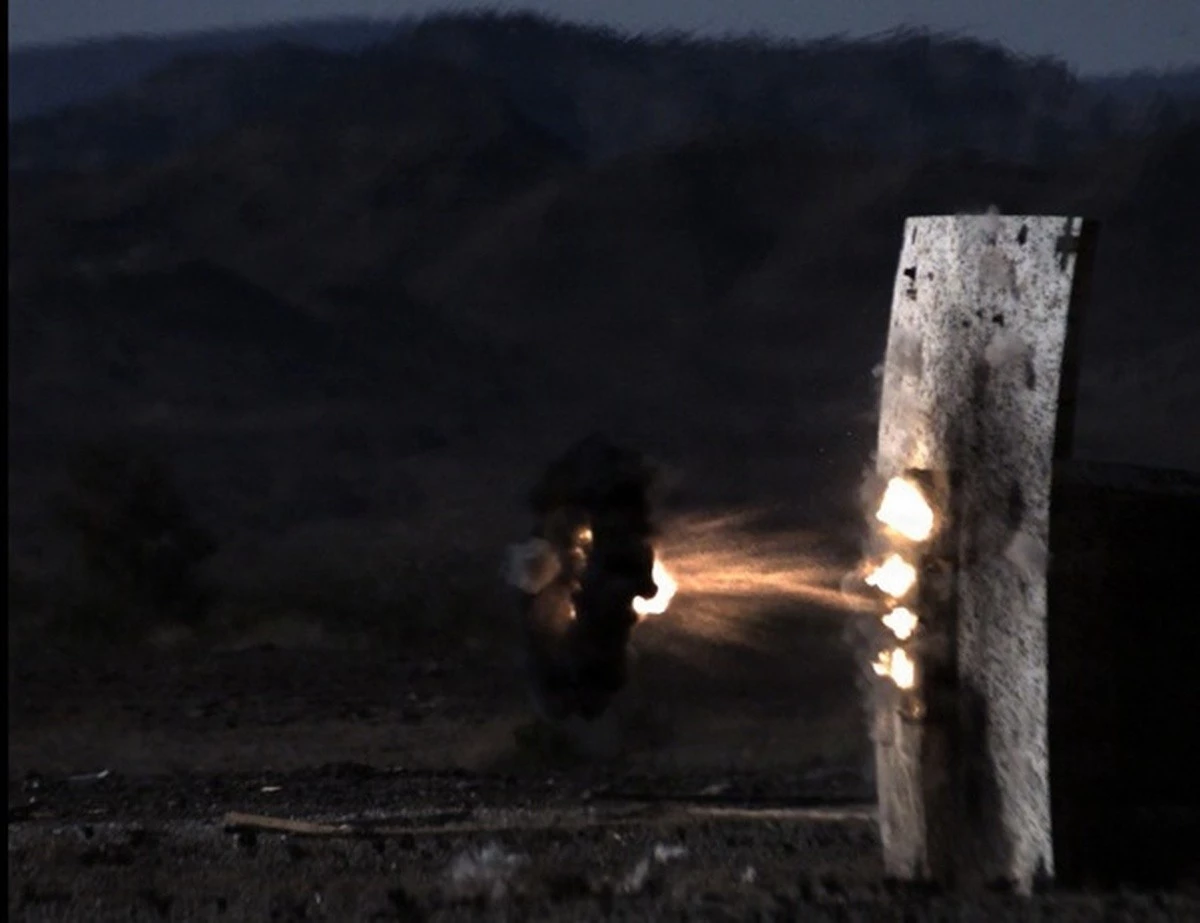
Originally developed for ground-based platforms, the ammunition, with its super-miniaturized proximity fuse, works on the same principle as its predecessors, using radio signals to detect its target’s proximity before detonating and spraying it with a destructive cloud of steel and tungsten-alloy shrapnel.
According to the Army, the XM1225 round has been thoroughly tested for safety and is fully compatible with both the Apache’s main gun and its fire control software, as well as the pilot’s Helmet Display and Sight System (HDSS), for the required accuracy. The round is rated against “soft-skinned” targets, including Group 1 and Group 2 UAS, exposed personnel, and small maritime craft, and is orders of magnitude cheaper than the Apache’s other main aerial weapon, the AGM-114 Hellfire missile. In addition, since the helicopter can carry up to 1,200 30-mm rounds, the probability of kill per burst is very high, as was demonstrated by live-fire exercises at the Yuma Proving Ground in Arizona in December 2025.
“The XM1225’s proximity fuse has the potential to increase soft skinned ground and aerial target vulnerability, providing the Attack community an additional capability so long as those targets are susceptible to detection, classification, and tracking,” said Major Vincent Franchino, test pilot and Attack Division chief at Redstone Test Center.
Source: US Army

