


The US Air Force is stomping on the accelerator to field advanced hypersonic missiles as the Air Force Research Laboratory (AFRL) and Ursa Major announce the successful completion of a flight test of the mass-producible Draper liquid rocket engine.
It can often appear as if the United States is lagging behind its competitors when it comes to hypersonic missiles. Russia has fielded systems like Zircon and Avangard, while China operates the DF-17. By comparison, the US has yet to deploy an operational hypersonic system, prompting talk of a “hypersonic gap.”
However, many of the hypersonic systems rushed into service elsewhere come with significant drawbacks that remain unresolved.
One of the main challenges is cost. Hypersonic missiles are estimated to cost around 33% more than comparable ballistic missiles with maneuverable warheads, with total life-cycle costs exceeding US$1 billion per unit. Production is another bottleneck, particularly for the solid rocket motors used to boost glide vehicles and cruise missiles to the necessary speed and altitude to reach Mach 5.
Ursa Major
These systems also require exotic materials to withstand the extreme temperatures generated at hypersonic speeds. On top of that, there are constraints in skilled labor and manufacturing infrastructure. To this you can stack on problems in storing and handling volatile and complex liquid fuels like liquid hydrogen, hydrazine, and other nasties.
What appears to be the US approach is similar to that of the Space Race days of the Cold War. During the 1960s, the Soviet Union seemed streets ahead of the US, chalking up one first after another while the Americans lagged far behind. This is because the Soviets had one goal when it came to the more public parts of the Space Race – to score every propaganda win possible in as short a time as possible.
As a result, the Soviets had the first satellite, the first animal in space, the first man in space, the first woman in space, the first two men in space, the first space walk, the first … you get the idea. Meanwhile, the Americans were focused on the ultimate prize of putting a man on the Moon, so they were much more concerned with developing the skills and technology required to master spaceflight. Long story short, after loads of firsts, the Soviets lost the race by the time Apollo 8 orbited the Moon.
Something similar may be playing out when it comes to hypersonics.

Ursa Major
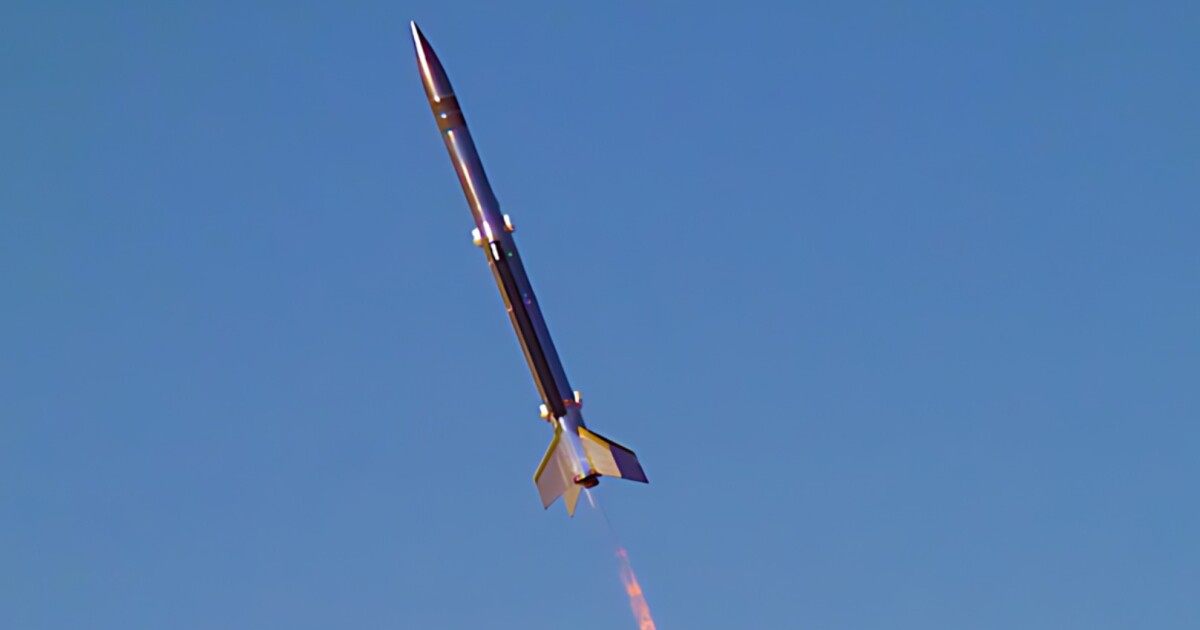
On January 27, 2026, AFRL and Ursa Major launched the Draper liquid rocket engine on a demonstrator flight. While many details remain classified, the company says the test vehicle reached supersonic speeds during its flight.
The test marked a transition from ground-based validation to in-flight evaluation, allowing engineers to study propellant stability, engine throttling performance, and how the system behaves under real flight conditions.
The Draper engine is designed to address key limitations of current hypersonic systems by making them cheaper, more scalable, and easier to operate. It runs on hydrogen peroxide and kerosene, fuels that are safer to store and handle compared to traditional alternatives.
Although hydrogen peroxide has a reputation for instability, much of that stems from early uses during the Second World War when it was used to fuel submarines and torpedoes. NASA and other organizations have learned a great deal since then about how to properly purify peroxide, so it’s much less explody and is routinely used today on space probes.
These characteristics, combined with the large number of 3D-printed components used in the engine, are expected to make future hypersonic missiles much more affordable and capable of being built in the numbers needed for defense needs.
“This flight proves that you can get a vehicle with a safe, storable and throttleable liquid engine in the air quickly and affordably,” said Chris Spagnoletti, CEO, Ursa Major. “We went from contract to flight-ready of an all up round and propulsion system in just eight months.”
Source: Ursa Major

