


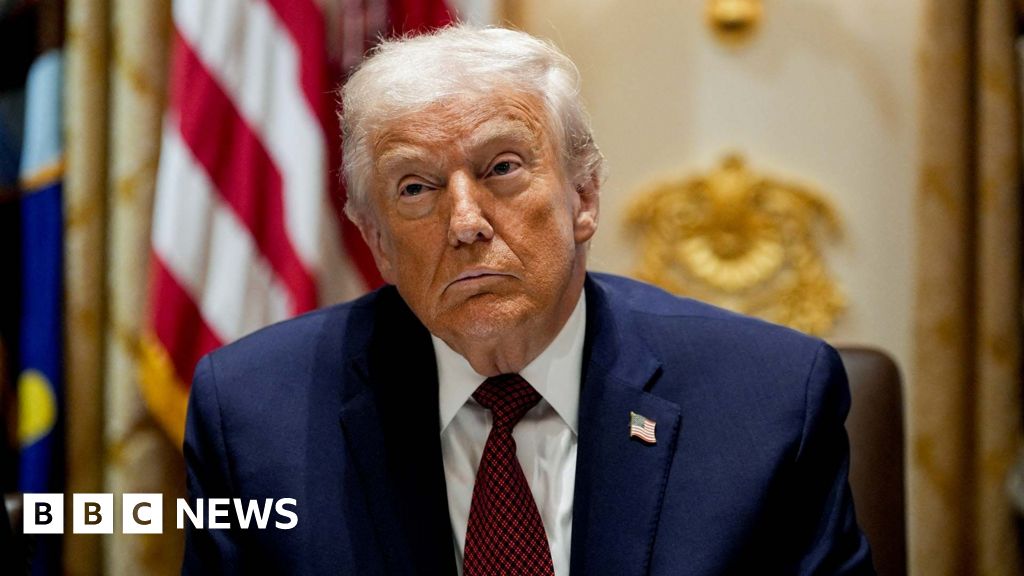
US President Donald Trump has criticised European leaders as “weak” and suggested the US could scale back support for Ukraine.
In a wide-ranging interview with Politico, he said “decaying” European countries had failed to control migration or take decisive action to end Ukraine’s war with Russia, accusing them of letting Kyiv fight “until they drop”.
European leaders have made attempts to carve out a role in the US-led efforts to end the war, which they fear will undercut the long-term interests of the continent in favour of a quick resolution.
In response, the UK’s Foreign Secretary Yvette Cooper said all she saw in Europe was “strength”, citing investment in defence as well as funding for Kyiv.
She added two presidents were “working for peace” – referring to Trump and Ukrainian President Volodymyr Zelensky – and “one president – President Putin – has so far simply sought to escalate the conflict with further drone and missile attacks”.
Trump continued to increase pressure on Zelensky to agree to a deal to end the conflict, and urged him to “play ball” by ceding territory to Moscow. Russia launched its full-scale invasion of Ukraine in February 2022.
Zelensky, writing on X later on Tuesday, said Ukraine and Europe were working actively on “all components of potential steps toward ending the war”, that the Ukrainian and European elements of the plan were now more developed and that Kyiv was ready to present them to “our partners in the US”.
Trump’s latest public criticism of Europe comes a day after European leaders came together in London to discuss their continued joint efforts to stop the fighting in Ukraine.
Asked whether Europe could help end the war, the US president said: “They talk but they don’t produce. And the war just keeps going on and on.”
US officials have held separate talks with Ukrainian and Russian officials in recent weeks in an attempt to broker an end to the war. So far, no agreement has been reached.
Ukraine’s president has pressed European and Nato leaders to help deter the US from backing a deal that Kyiv fears would leave it exposed to future attack.
On Sunday Trump suggested, without evidence, that Zelensky was the main obstacle to peace.
He told reporters that Russia was “fine” with the peace plan outlined to both sides by the US, that contained major concessions for Ukraine and which allies feared would leave it vulnerable to a future invasion.
In the Politico interview, he claimed Ukrainian negotiators “loved” the US-backed proposal and alleged Zelensky had not yet read it.
Trump also claimed ideological divisions now threatened to fracture Washington’s alliances with Europe.
Asked whether leaders he viewed as weak could still be allies, he replied: “It depends”, adding: “I think they’re weak, but I also think that they want to be so politically correct. I think they don’t know what to do.”
The president’s remarks came after his administration released its new 33-page National Security Strategy, which warned of Europe’s potential “civilisational erasure” and questioned whether some nations could remain reliable allies.
Russia welcomed that strategy – which did not cast Russia as a threat to the US – as “largely consistent” with Moscow’s vision.
Trump also warned on Tuesday many countries in Europe “will not be viable countries any longer” if they keep on the way they are going, adding: “What they’re doing with immigration is a disaster.”
He singled out Hungary and Poland as doing a “very good job” on immigration, but said most European nations were “decaying”.
Responding on Tuesday to the strategy, German chancellor Friedrich Merz said some parts were plausible and some understandable, but other elements were unacceptable from a European point of view.
He rejected the idea that the US needed to “save democracy” in Europe, saying Europeans could address such questions themselves.
The strategy also followed similar rhetoric to Trump’s speech to the UN earlier this year, where he had harsh criticism for western Europe and its approach to migration and clean energy.

