


Over the past year, United States President Donald Trump has unleashed a slew of policies that have upended businesses, supply chains and jobs.
Yet the US economy seems to be growing at a healthy clip, and the unemployment rate is in a safe zone.
Recommended Stories
list of 4 itemsend of list
The reality, experts say, is that the stock market boom has helped to mask deeper underlying problems in the economy.
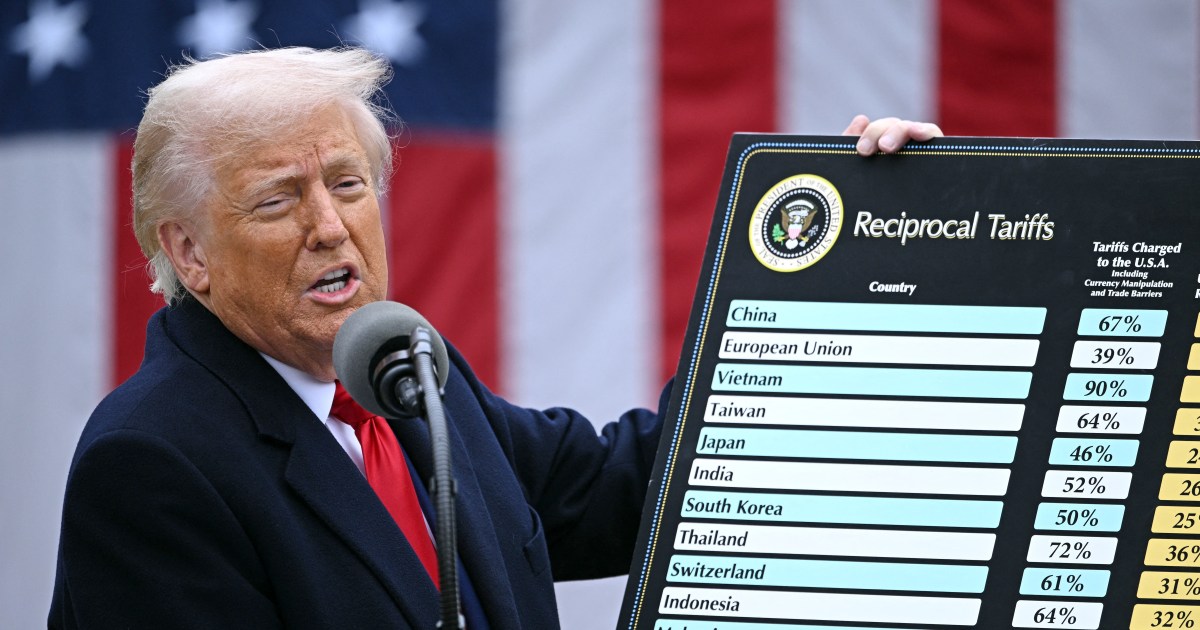
Since taking office, Trump has imposed a range of tariffs on countries, including key trading partners, leading to predictions of inflation skyrocketing, manufacturing screeching to a halt and unemployment soaring.
None of those scenarios came true.
Inflation, while above the Federal Reserve’s target, was a modest 2.7 percent in December.
The unemployment rate was relatively low, at 4.4 percent, last month. Gross domestic product (GDP) grew at 4.3 percent in the third quarter of 2025, the fastest in two years.
“The shock and awe we anticipated just didn’t materialise,” Bernard Yaros, lead US economist at Oxford Economics, told Al Jazeera.
Yaros said the limited fallout could be attributed to the relative lack of retaliation by other countries and the stock market rally that quickly followed Trump’s dialling back of the steepest tariffs announced on “liberation day“.
Since Trump’s April 2 announcement, the stock market, which is heavily weighted towards the “magnificent seven” tech companies, has risen nearly 30 percent, boosting Americans’ paper wealth and encouraging households to loosen their purse strings.
Gains in net wealth have driven almost one-third of the rise in consumer spending since the COVID-19 pandemic, Oxford Economics said in a research briefing in October.
At the same time, the gains have not been distributed evenly.
The top 10 percent of earners are now estimated to account for roughly half of all spending, the highest proportion since officials began compiling data in 1989, according to Moody’s Analytics.
“The gains are going a lot to people in higher income brackets – they are the ones who have the stock portfolios – and are going to people in sectors and occupations tied to AI,” Marcus Noland, executive vice president of the Peterson Institute for International Economics, told Al Jazeera.
“But, these numbers mask the unevenness in the growth in this economy.”
Net decline of workers
A careful parsing of the data reveals that unevenness. For instance, despite the impressive GDP numbers, that growth is not being accompanied by an increase in hiring.
While hospitality and healthcare added workers last year, retail, manufacturing and construction – sectors that rely heavily on migrants – all shed jobs.
As a result of the Trump administration’s mass deportation of undocumented immigrants and tightening of legal migration pathways, the US last year experienced negative net migration for the first time in at least half a century, according to a Brookings Institution analysis.
“And through this very public and brutal way of going about deportations, they have discouraged illegal immigration, but also intimidated immigrants in the US,” Noland said, adding that the US workforce is projected to see a net decline of two million workers this year.
The “bifurcation” in the US economy is also being felt across the business world, with smaller companies lacking the deep pockets to stockpile inventories or negotiate with suppliers in the face of increased tariffs.
“The surge in policy uncertainty this year has had an outsize effect on smaller firms,” Oxford Economics said in a November report.
These firms are also seeing little benefit from the boom in the artificial intelligence (AI) industry since revenues have been driven by capital-intensive chip manufacturing and cloud services.
While AI proponents believe the world is on the cusp of huge gains in productivity that could dramatically raise living standards, there are concerns about large numbers of people being put out of work.
“This could be the new norm – jobless growth. That’s one reason people are not feeling so great,” Yaros said.
“While a lot of hype about AI and productivity benefits from AI are still to come, we think that is a risk to the labour market if it continues to hold back hiring.”

