


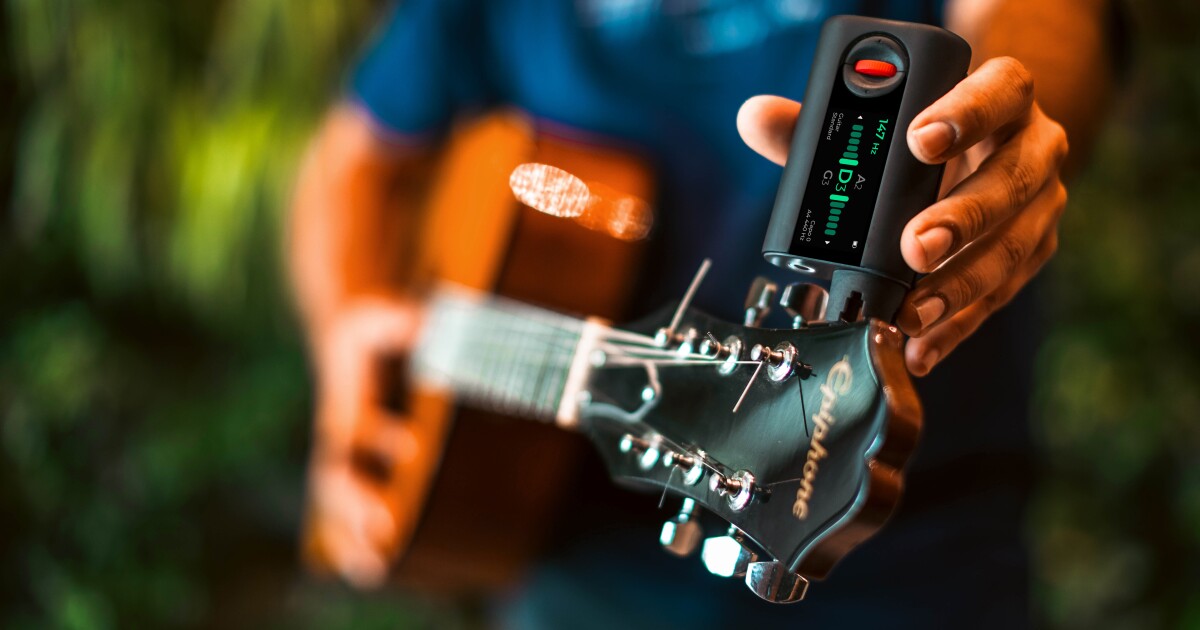
Following a successful Kickstarter last year, a combination tuner, string winder and metronome is now available to buy. There’s been a Roadie in my gig bag since the first iteration landed 10 years ago, and now I’ve been sent the fourth generation unit to try out.
At the time of the Kickstarter launch of the Roadie tuner in 2013, a stomp-shaped box was taking up valuable space on my pedal board. The result of at least 2 years of R&D, prototyping, testing and reworking the idea from Band Industries founders Hassane Slaibi and Bassam Jalgha, the concept intrigued me.
This was a little different to your average tuner. Sure, it promised to bring the strings of an instrument to pitch. But it also wound the tuning pegs, saving time and effort for the player or tech. Like having a roadie in your gig bag, in fact.
Paul Ridden/New Atlas
The first iteration worked with a smart device running a companion app, using the device’s microphone to pick up plucked acoustic guitar string sounds or via a supplied adapter for electrics. Having to use a smartphone microphone to tune up could leave an acoustic picker at the mercy of room noise, so the follow-up Roadie registered the vibration frequencies of each string to detect and adjust pitch – with the companion app then becoming a useful option rather than an absolute necessity. The design changed too, but the core functionality remained about the same.
By gen 3, the Roadie had gained rocker pad control and a small color screen, plus the peg gripper was moved to the end rather than at the side. As with the previous versions, I’ve used this one regularly since release – so often that my clip-on and pedal-based tuners have actually started to attract dust.
But now there’s a new robo-tech in town, and my Roadie 3 is looking very nervous indeed. “Roadie 4 is the smartest and most reliable Roadie we’ve ever built,” said company CEO and co-founder, Hassane Slaibi, at the latest Kickstarter launch. “It’s faster, more intuitive, and simply a joy to use. Whether you’re just picking up an instrument or a seasoned professional, Roadie 4 helps you sound your best, every time.”
Last year’s crowdfunding effort was successful, and the next-gen robo-tuner is now on general sale. The basic idea is the same as before, but everything has been wrapped up in improved ergonomics plus there are tasty nuggets like more accuracy, better battery, a bigger display, and new menu navigation.
Roadie 4 Automatic Guitar Tuner: Next-Level Precision
The Roadie 4 shapes up larger than its predecessor, measuring 4.13 x 2.2 x 1.18 in (10.5 x 5.6 x 3 cm), and adds a bit more than half an ounce to your between-gig carry (at 5.4 oz/153 g). The color LCD display comes in at 1.9 diagonal inches with a 170 x 320 resolution, and there’s a clicky disc nearby that sports a bright red scroll wheel in its middle. The back and sides of the housing are now anti-slip, to prevent sweaty hands losing purchase during a quick tune up at the venue.
I liked the click wheel on the Roadie 3, but the scroller here does allow for smoother and zippier navigation. I was advised to apply a firmware update out of the box, which required pairing with the mobile app. After that, the first instrument profile could be set up in the Tuning section of the device itself – you won’t be able to tune up until a profile is created.
This process involves choosing an instrument type, number of strings, assigning a name – all pretty intuitive. The system detects standard tuning by default, but more than 150 alternate tunings are built in and you can add your own custom tunings too. The detection range is 27.5 Hz to 668.94 Hz. Users can also change the reference pitch in 1-Hz increments, and opt to tune with a capo on.

Paul Ridden/New Atlas
As with all of the Roadie units past and present, the peg winder is placed on the instrument’s machine heads (tuning pegs or just tuners, if you prefer) – but the connector has been redesigned to accommodate a wider range of pegs. The audio circuitry and tuning algorithms have been completely reworked too, for the promise of “superior tuning accuracy and better performance in noisy environments.”
With the Roadie in position, the low/thick string of the grouping is plucked a few times and the device determines how flat or sharp the note is, and automatically turns the peg winder accordingly. When the string is brought to the desired pitch, the unit beeps and vibrates, and the player moves onto the next sting until the instrument is in tune. Players can change the tuning direction to start with the higher/thinner strings if desired.
I’ve been using Roadies since the first iteration so everything here was pretty familiar, and I breezed through my tune-ups with ease. Setup took a few minutes for each instrument (I have quite a few), but actual tuning was completed in mere seconds. For first use experience, I turned to a friendly strummer who detuned his guitar and ran through setup and tune from scratch. The first attempt took about 10 minutes of slow and careful plodding, but within a couple or three run throughs, the whole process proved quick and easy.
As for accuracy, I dusted off a previously retired polyphonic stomp for my pedal board and found Roadie’s fast setting pretty darn close to the wire – but for recording I switched to the High Accuracy mode, which proved to be exactly that. I tried tune-ups in quiet, moderately noisy and positively buzzing spaces and the Roadie seemed unfazed by whatever rowdiness was going on around me.

Band Industries
More than a nerdy tuner
But if you already have a decent tuner, why not just turn the pegs yourself? You could certainly do that, sure, though I’ve found automation makes such things much less of a chore. And the older I get, the less inclined I am to take the manual route. But there’s more to Roadie than just tuning.
In addition to the Tuning option in the main menu, there’s a Metronome and a String Winder as well as device settings. The former allows the player to set beats-per-minute, beats per bar, select different rhythms and whether a sound beeps and/or the device vibrates to the beat. I found the vibrate mode useful for keeping time when stuffed discreetly in my pocket.
Even for an infrequent flyer like myself, the String Winder is very useful for string changes, and turns at up to 110 RPM with a torque of 2.5 kg/cm. Not only does this make the laborious task of manually winding the pegs a whole lot easier and quicker, but if you start the process by pressing the right edge of the clicky disc when in tuning mode, you can wind the string until you feel tension and then release so that the Roadie automatically brings it to pitch. Nice.
Band Industries is also working on a feature that will give the Roadie 4 the power to auto detect which string has been plucked and bring it to the selected pitch. But though this function is listed in the main menu, it hasn’t been released at the time of writing. I can immediately think of a couple of my guitars that would benefit from this function, making regular G string slippage a little less of an annoyance. I’ll no longer have to manually select 196 Hz on my Roadie, which should make single string tweaks that much easier.

Band Industries
Other features of note include the ability to choose what appears onscreen at power on – such as a frequently used axe or the instrument list – instead of the main menu. You can also opt for high accuracy instead of the fast default, and have the Roadie slightly detune before tuning up for better stability. Roadie’s maker recommends frequent checking for firmware updates, as new or updated capabilities are expected to be added often. And that brings me nicely to the mobile app.
The Roadie has operated independently of the companion app since 2017, and this fourth outing is no different. But a few useful things in there just might have you pairing up and checking in occasionally. There are tutorials, the ability to add or rename instrument profiles using the phone’s onscreen keyboard rather than using the scroll wheel and click disc on the device. There’s a manual tuner in there too, and you can tweak tuning settings for each instrument or create custom tunings.
“With smarter tuning algorithms, upgraded hardware, and a more seamless user experience, it is the most polished and powerful Roadie we have ever created,” said CTO and cofounder Bassam Jalgha.
The bottom line
One of the absolute joys of my life is playing guitar. Whether it’s learning someone else’s creations or coming up with my own, or just noodling, there’s little I enjoy more. I’m also crazy for useful gadgetry, meaning the Roadie automatic guitar tuner ticks two of my passion boxes – and version 4 improves an already impressive formula.
So, to closing thoughts. Personally, I found the larger display a welcome upgrade – not only was it easier on my aging eyes, but it now features even more useful information. That includes such things as the reference pitch, the instrument name, a clearer multi-colored tuning bar, and battery status.
The textured housing and longer body are also worth an extra mention, making for more secure and comfortable use, while allowing a bigger battery to be crammed inside. That power source shapes up as an 800-mAh cell instead of 500 mAh of the Roadie 3, giving it enough juice for 80 guitar tune-ups per charge over USB-C – that’s 30 more than before.

Band Industries
Band Industries has cooked in a battery save feature that dims the display after 60 seconds of inactivity, and then turns it off completely after another couple of minutes. The unit can be awakened at any point during that time-out window by tapping the power button – which should return to the last used function. But if everything goes dark, the user will need to power on again. There’s currently no way for the user to adjust these timings.
As before, string gauges up to 0.075 inches are supported, which should be suitable for most stringed-instrument needs but you’ll need to plump for the still available Roadie Bass to tune your thunder monster. The power on button continues to pull double duty as a low-powered torch to light up the business end during operation, which is useful for darkened performance spaces or shadowy corners. Double-tapping the power button on this new model will now return the display to the main menu.
Earlier in this review I mentioned that my Roadie 3 was a little unnerved by the arrival of the new version, and it turns out that it had good reason to be. Though the basics are similar, the improvements and extras combine to bully its predecessor into storage, and the Roadie 4 now has pride of place in the accessories cubby of my guitar’s travel case.
Despite its utility, this supercharged robo-tuner is not going to be for every musician or satisfy every need – I still need to break out a regular tuner for at least one of my gitfiddles due to its irregular geared pegs, for example. And there are those who will argue that a US$10 clip-on and a bit of graft will do the job just fine, thank you very much.
That said, for folks with regular geared pegs looking for a genuinely handy helper with a bunch of useful functions beyond just tuning, I’d heartily recommend making room in your gear chest for the Roadie 4. It’s shipping now for US$139. A protective hard case can be optioned in if needed.
Product page: Roadie 4

