


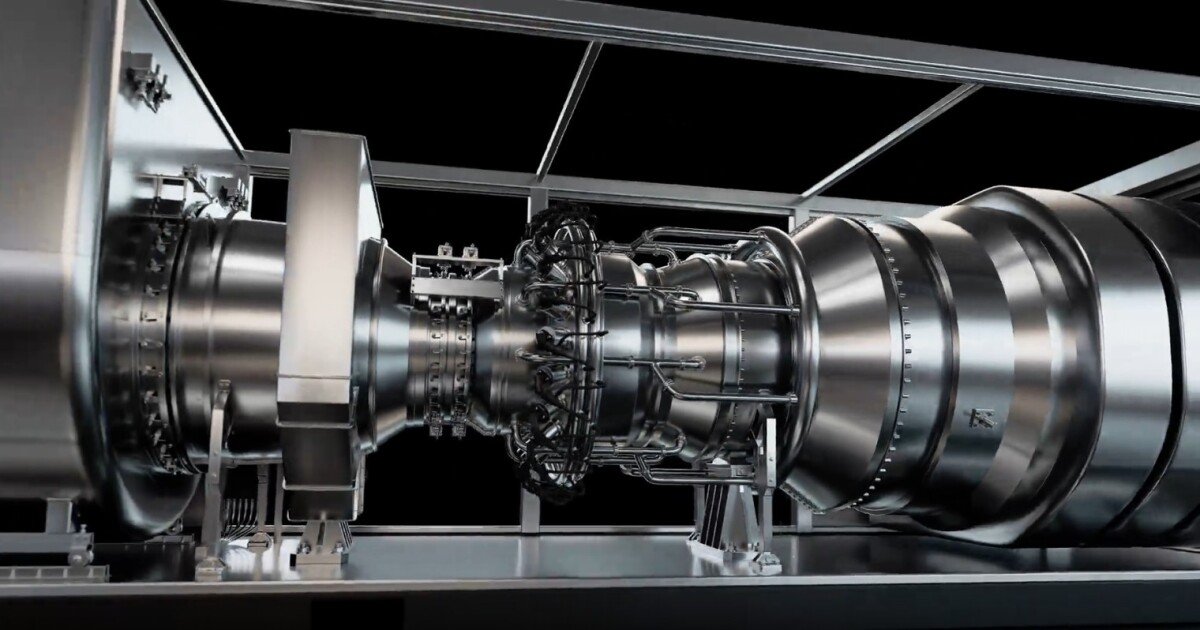
The hot trends of civilian supersonic flight and artificial intelligence collide as Boom Supersonic announces that, as a new revenue stream, the core technology of its Mach 1+ Symphony jet engine has been adapted to run power-hungry AI data centers.
Boom Supersonic has made great strides in recent years toward fulfilling its ambition to get its Overture supersonic airliner off the ground. The problem is that faster-than-sound aircraft aren’t cheap and there’s only so much investor money that a company can scratch up at any one time, so Plan B for Boom is to adapt its aircraft technology to make some earthbound lolly in the short term.
As luck would have it, another pioneering industry is badly in need of extra resources, only this time its raw power. AI data centers are springing up all over the place like dandelions on a poorly tended lawn. However, unlike dandelions, these centers are extremely power hungry both in terms of operating electricity and cooling. The amount of energy that data centers will need in the near future is estimated to at least double in the next few years and by 2035 they will be the single largest consumer of electricity in the United States.
Boom Supersonic
Small wonder then that many tech firms are scrambling to secure reliable sources of power that can run 24 hours a day, 365 days of the year without interruption, including going to such lengths as to reactivate decommissioned nuclear power plants and funding the construction of new ones.
Boom’s contribution to feeding this digital behemoth is to repurpose its Symphony engine to create a turbogenerator that runs on natural gas or, in an emergency, diesel fuel.
Called Superpower, the new engine shares 80% of its components with Symphony. The main difference is that Superpower dumps the turbofan used for thrust and replaces it with additional compressor stages. In addition, there’s a free power turbine attached to generate electricity.

Boom Supersonic
Along with this, the Superpower doesn’t need cooling and can operate happily at ambient temperatures of up to 110 °F (43 °C). In all, it can generate 42 MW with a volume no larger than a shipping container, and it is claimed that the turbogenerator can be installed in about a fortnight once the foundations are laid.
Boom says that it already has an order for 29 Superpowers to produce 1.21 GW from AI infrastructure company Crusoe. The company hopes to be manufacturing 4 GW of capacity a year by 2030.
With this additional revenue, Boom hopes that its supersonic airliner plans will be more secure.
“Supersonic technology is an accelerant – of course for faster flight, but now for artificial intelligence as well,” said Blake Scholl, founder and CEO of Boom Supersonic. “With this financing and our first order for Superpower, Boom is funded to deliver both our engine and our airliner.”
Source: Boom Supersonic

