


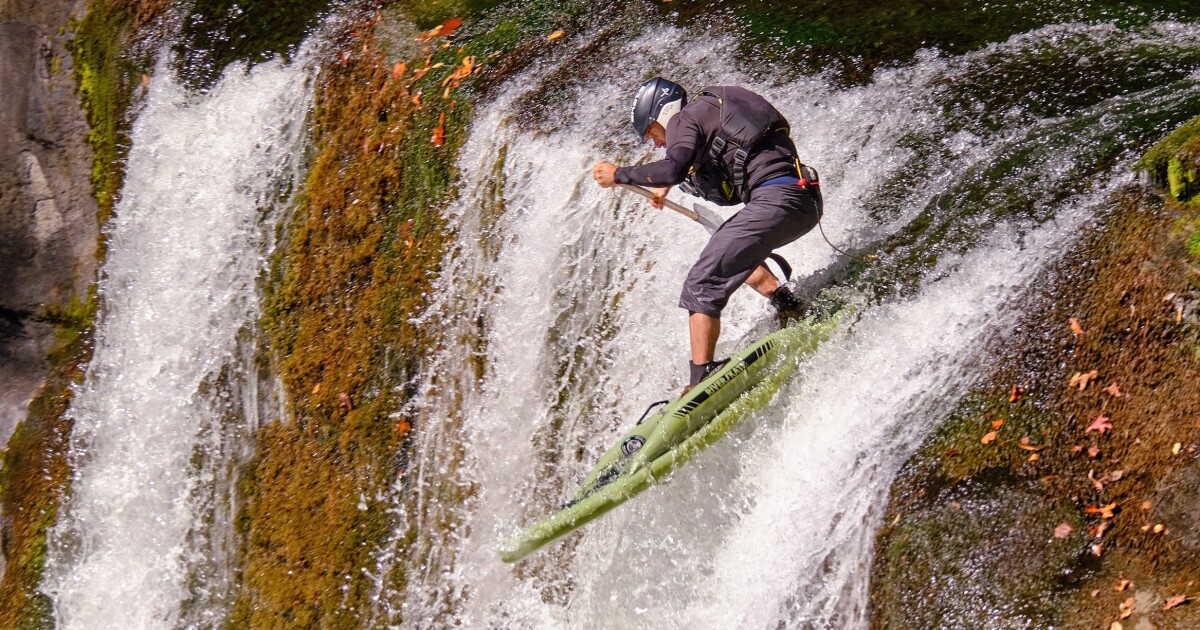
Although whitewater stand-up paddle boards do indeed exist, they’re (understandably) designed to float relatively high on the water’s surface. The Riverskate is different in that its bow and stern can be intentionally sunk, making all sorts of marvelous maneuvers possible.
Invented by North Carolina-based paddler David Miller, the inflatable-bodied Riverskate was inspired by a type of low-volume whitewater kayak known as a squirt boat.
Although squirt boats default to floating at the surface, they can be easily coaxed into dipping below. With a little help from the river’s current, it’s even possible to perform a maneuver called the “mystery move,” in which the boat and paddler repeatedly rotate like a compass needle while fully submerged.
Riverskate
While the Riverskate can’t go completely underwater, it can perform squirty maneuvers such as end-over-end cartwheels; bow stalls (where it hangs almost vertically in the water, nose-down); stern stalls (same idea, but nose-up); and tail dips, where it can turn on a dime by pivoting on its submerged rear end.
Of course, the Riverskate is reportedly also no slouch at more traditional whitewater tasks such as surfing and plain ol’ rapid-running.

Riverskate
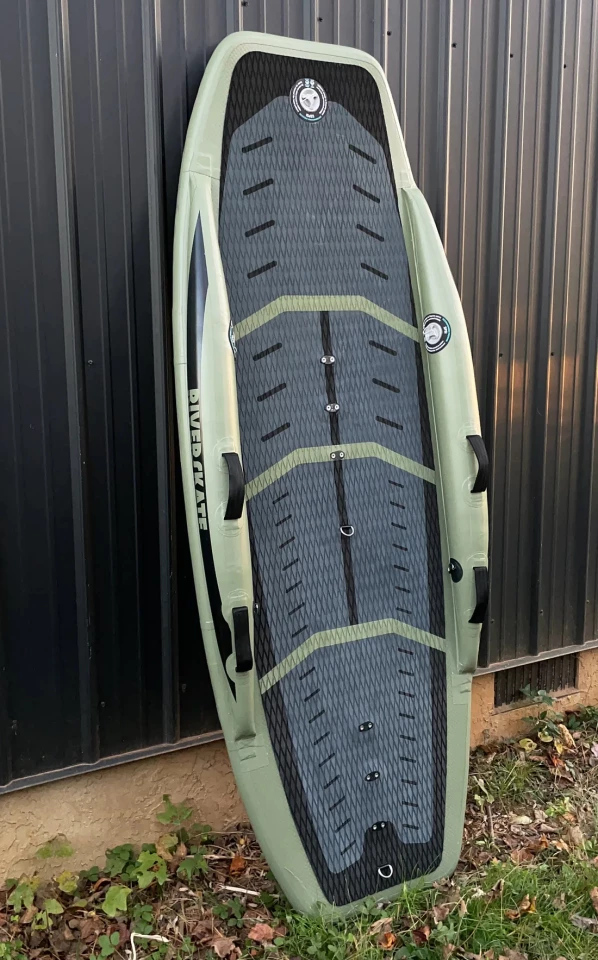
Its versatility all comes down to the two things you see running along its sides, which are known as Grab Wings. These are claimed to ensure proper body positioning as the paddler braces their feet and knees (depending on stance) against them, although their selling points don’t stop there.
“The Grab Wings are patent pending and were originally designed as a way to redistribute volume from the ‘body’ of the board – particularly the nose and tail – toward the center rails. By shifting volume laterally into the rail structure, we’re able to achieve much lower-volume boards while increasing stability,” Miller tells us.
“The wings widen the effective engagement point when the board is edged. As the rider leans, they engage progressively, creating a predictable secondary stability ‘catch’ rather than a sudden roll. That redistributed buoyancy also makes it easier to pressure and momentarily sink the stern when initiating vertical moves, surfing steeper waves, or pivoting in eddyline currents. The intention wasn’t just added stability – it was controlled, dynamic stability that still allows for vertical expression.”
Riverskate
The Riverskate is available in two models, both of which are made of double-layer dropstitch PVC with an EVA traction pad deck. There’s a 120-liter version for paddlers weighing up to 160 lb (73 kg) that sells for US$999, and a larger 150-liter model for paddlers up to 215 lb (98 kg) that goes for $1,149. They tip the scales at 22 lb (10 kg) and 24 lb (11 kg), respectively.
Miller tells us that he sold out of an initial run of Riverskates last November, and that a new batch will be available this spring.
Source: Riverskate

