


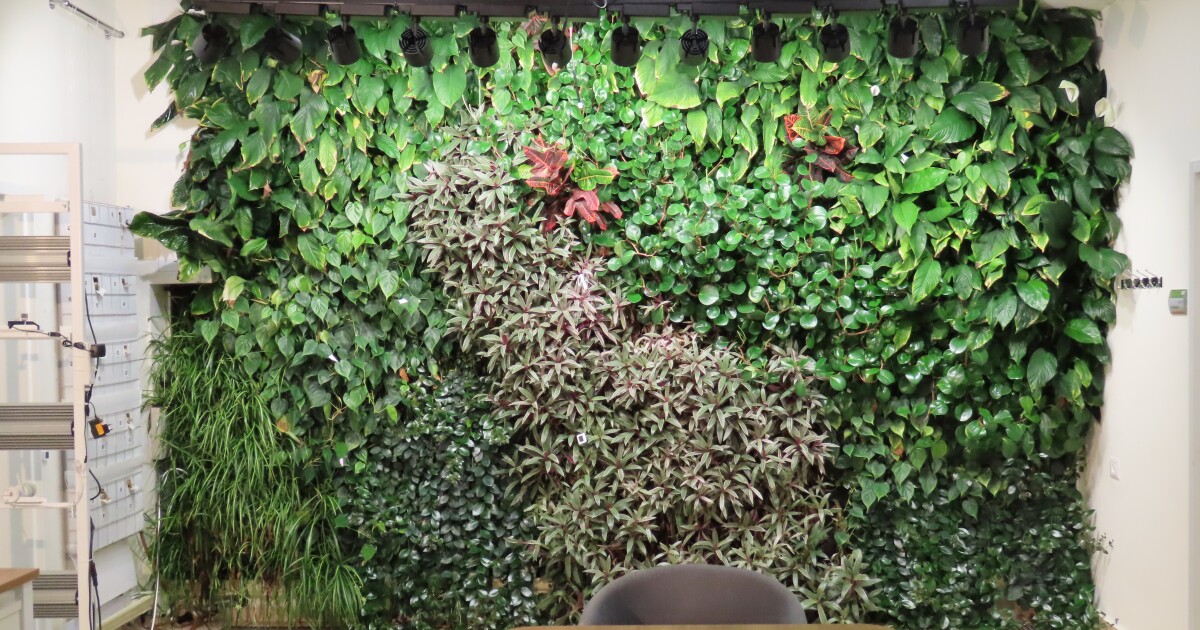
Vertical living green walls comprised of live plants are a natural energy-saving method for improving indoor air quality and enhancing interior design, but they’re hampered by inconsistent performance.
Some green walls will flourish under certain indoor conditions, improving indoor air quality and lowering energy costs, while others struggle and require a complicated feeding and water maintenance schedule which limits widespread adoption.
“Green walls have enormous potential,” say researchers from the Hebrew University of Jerusalem, “but until now, we lacked the tools to truly understand and manage how they function indoors.” That’s where the scientists’ VertINGreen system comes in.
Utilizing a combination of hyperspectral imaging and machine learning, the setup can plot out suitable planting activity across entire walls, identify the early stages of plant stress, and alert users to any possible problems that arise weeks before they are visible to the human eye. This results in proactive solutions and lower costs in greenery upkeep, leading to healthier and flourishing green wall installations.
David Helman Lab
The researchers started by gathering approximately 2,000 detailed measurements on how indoor plants “breathe,” absorb carbon dioxide, and release water under a variety of conditions. This allowed them to design a forecasting system that can predict how a green wall installation might reduce energy consumption or the need for mechanical ventilation, for example.
“For the first time, designers can ask, ‘What will this wall actually do for my building?’ and get a reliable answer,” say the researchers. “It gives architects, engineers, and building managers the tools they need to trust and fully utilize nature inside buildings.”
A paper on the research, which was led by Yehuda Yungstein and Dr. David Helman, was recently published in the journal Indoor Air.

