


Beyond the rather low efficiency of today’s solar panels in converting the power of the sun into electricity, the transformational potential of solar energy is presently held back by battery storage technology.
A new, molecular-scale breakthrough could unlock a new path to long-term solar energy storage for heating homes and providing hot water – without a conventional battery in the equation.
How in the world would that work? To answer that, we need to take a quick dive into the world of electrochemistry. So grab your coffee and settle in.
Batteries store power as chemical potential energy. The energy stored in a chemical battery exists as a sort of tension and imbalance in how atoms and electrons are arranged between two materials. When a battery charges, external energy forces electrons and ions into higher-energy configurations where they wouldn’t naturally want to stay, creating potential energy. It’s the chemical equivalent of lifting a weight onto a high shelf or compressing a spring.
That potential energy remains stored as tension until the circuit closes, and the electrons can flow through that circuit from the anode back to the cathode toward a lower-energy state. In energetic terms, they’re simply moving downhill, releasing that stored potential energy, which we harness as electrical current flowing through the circuit.
It’s a system that works remarkably well, which is why batteries have become the backbone of modern electronics. But, like everything else in life, they also have limits. Over time, batteries begin to degrade and release a chalky white residue, or else begin to swell up and release heat – familiar warnings of failure. They also rely on complex materials, and aren’t always ideal for storing energy over long periods.
For solar power in particular, batteries introduce extra steps. First, sunlight must be converted through photovoltaic panels into electricity, which is then stored in a battery. When that energy is needed, it has to be pulled back out, routed through a circuit, and converted again into something usable, whether that’s light, heat, or motion.
But researchers at UC Santa Barbara say they’ve managed to vastly simplify the overall system. In a groundbreaking study recently published in Science, the team claims to have developed an organic molecule capable of absorbing sunlight and storing it directly within its own chemical bonds. And this molecule beats the energy density by weight of all but the most experimental (and dangerous) lithium batteries.
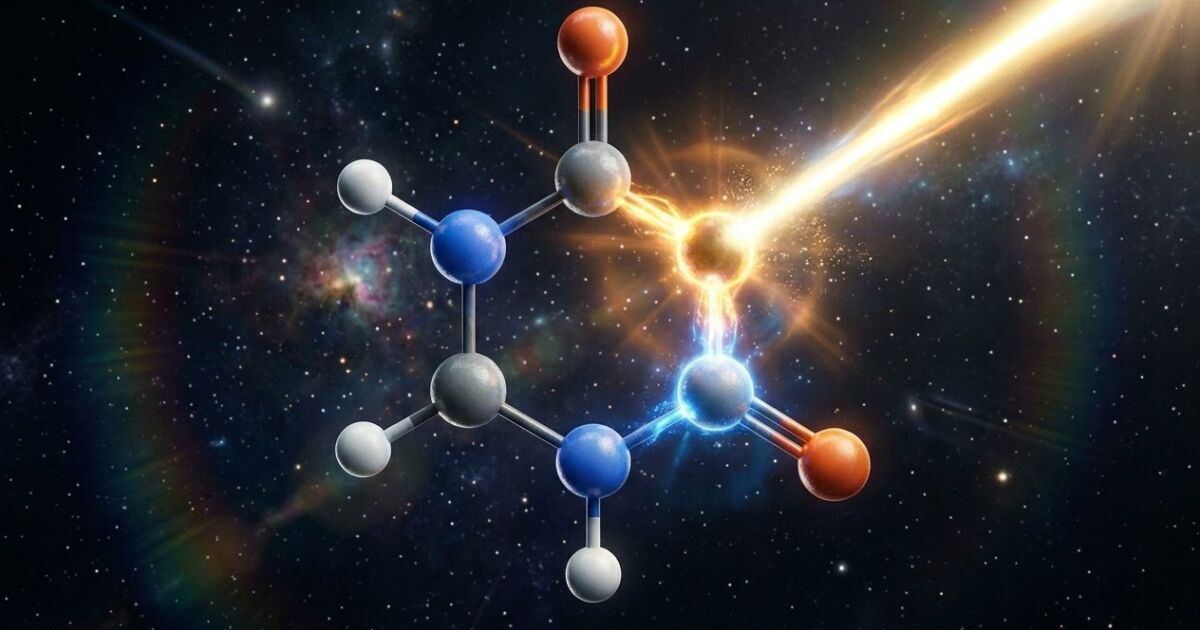
The molecule, called Pyrimidone, is derived from structures related to the building blocks of DNA. Here, the team has modified it into a compact system designed specifically to capture solar energy. Scientists refer to technologies like this as Molecular Solar Thermal Storage, or MOST.
“In MOST systems, energy is stored in chemical bonds rather than as heat or electrical charge,” said Han Nguyen in an email to New Altas. “Chemical bonds are generally stable, which allows energy to be stored for long periods without significant loss. In our pyrimidone-based system, the energy is stored in a strained form called the Dewar isomer. Once the molecule is in this form, it remains there until we deliberately trigger its release of energy.”
What she’s describing happens within a single molecule. Instead of moving electrons between materials, this system works internally. When sunlight hits the structure, it shifts into a strained configuration that locks potential energy into its chemical bonds.
In some ways, the molecule behaves like a tiny molecular mousetrap. Sunlight sets the trap, pushing the structure into a tense, high-energy position. Chemists refer to this kind of structural switch as photoisomerization, a process in which light changes a molecule’s geometry without breaking it apart.
In this system, that reversible shape change acts as the storage cycle itself. To release the energy, an acid catalyst is applied. What makes it especially interesting to the modern energy storage mix is that the energy is released as heat, not electricity – “enough heat to boil water,” according to the study.
Most renewable energy systems today are designed to store electricity, when in fact what you often want to come out the other end is actually heat. Hot water, many industrial processes, and building heating all rely on thermal energy, so energy stored in traditional batteries needs to go through another conversion step. The MOST system is designed to cut out the middle man and meet that need directly.
“We see it as a complementary technology, not a replacement for what already exists,” said Han Nguyen. “The energy landscape increasingly relies on photovoltaic panels paired with lithium-ion batteries, and those systems are excellent for electricity. But roughly half of global energy demand is for heat — warming homes, cooking, providing hot water — and for that application, a system that stores and delivers heat directly is a more natural fit.”
In terms of efficiency, this is a genuinely remarkable energy storage solution. It holds 1.6 megajoules of energy per kilogram of material. That equates to around 444 Wh/kg – nearly twice what you’d typically see in the lithium-ion packs running today’s EVs, and not far off what CATL has achieved with its frankly scary 500 Wh/kg “condensed battery.”
But the technology is still in its early stages, and researchers are currently working to improve efficiency, durability, and scalability before the system can move beyond the lab.
“The most immediate challenge is improving how efficiently the molecules charge under sunlight,” said Nguyen. “At present, our pyrimidone absorbs primarily in the ultraviolet range, which represents only a small fraction of the solar spectrum. We need to shift absorption toward visible wavelengths to make better use of the energy available outdoors.”
Researchers are also exploring structural tweaks to the molecule that could expand its absorption range into the visible light spectrum while maintaining its energy density and stability.
Beyond improving how the molecules absorb sunlight, the team is also focused on making the system practical to use.
“On the device side, we are working to replace the homogeneous acid catalyst used in our proof-of-concept experiments with heterogeneous catalysts, i.e., solid catalysts that can be embedded in a flow channel and reused indefinitely,” said Nguyen.
That means swapping out a one-time-use liquid component for a solid material that can be built into a reusable system. It’s a shift that would allow the technology to cycle repeatedly, capturing and releasing heat without needing to be reset each time.
With those pieces beginning to fall into place, even at this early stage, the team’s work is already reshaping how we think about energy storage. For more than a century, storing energy has largely meant relying on batteries. Here, that shift takes a different form, with sunlight captured and held not in metals and moving electrons, but in the shape of molecules themselves.
This study was published in the journal Science.

