


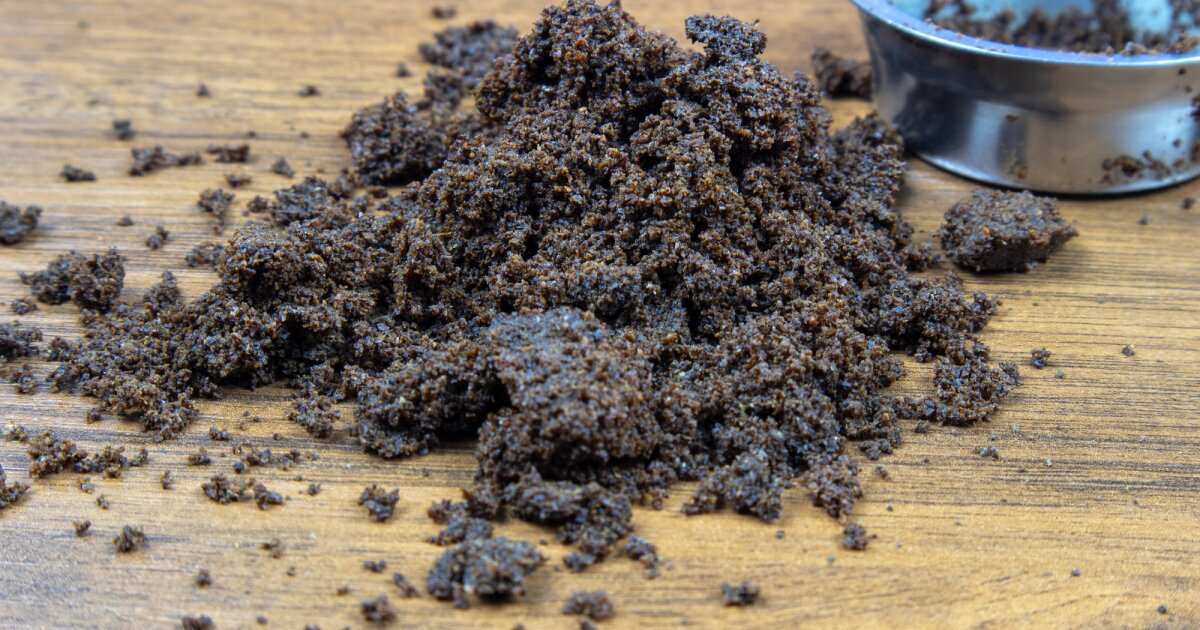
Around the world, over two billion daily cups of coffee are consumed. That means there are a staggering amount of coffee grounds getting tossed away every day. Researchers now have a plan to turn all that waste into eco-friendly insulation.
While some people hold on to their coffee grounds for use in their gardens or compost pile, the large majority of grounds wind up in landfills. It’s hard to pinpoint exactly how many coffee grounds are discarded annually, but estimates range from 8 million to 60 million tons. Coffee grounds in landfills are particularly problematic because they can lead to the release of methane and carbon dioxide and also contribute to spontaneous combustion events.
With all of that free material being constantly produced as a result of the world’s coffee habit, researchers have naturally sought ways to turn the grounds into something useful. While converting them to biofuel is the most common approach, we’ve also seen the grounds recycled as a sustainable road material; used to make concrete 30% stronger; and turned into a 3D printing material. There’s even been research to suggest that coffee waste could be repurposed into carbon quantum dots that could protect our brains from the microbes that cause neurodegenerative diseases.
Now, researchers at China’s Shenyang Agricultural University (SAU) have found a way to turn spent coffee grounds into an insulating material that could replace common petroleum-based products like styrofoam or spray foam with a more eco-friendly solution.
Previous efforts to turn coffee grounds into insulation exist, but they all ran into the same issue: coffee grounds have a porosity of only around 40%. This means they’re not particularly good at trapping air, which is what makes a substance a good insulator.
To sidestep this issue, the SAU researchers first converted coffee grounds into biochar, a charcoal-like substance made from organic materials. To do this, they oven-dried the grounds at 80 °C (176 ºF) for a week, then heated them to 700 °C (1,292 ºF) for an hour. This converted the grounds to biochar and simultaneously increased porosity from 40% to 71%.
Next, to keep the porosity intact while forming the biochar particles into a usable composite material, the team came up with what it calls a “pore restoration” strategy. The biochar was pre-mixed with propylene glycol to fill the pores, and an ethyl cellulose powder was added to the mix to create a matrix to give the biochar structure. The mixture was compressed in a heated mold at 150 °C (302 ºF) for 10 minutes. Then it was placed in a vacuum oven at 80 °C (176 ºF) for an hour to remove the propylene glycol but leave behind the holes it initially filled.
The resulting material demonstrated impressive insulating ability. Ethyl cellulose alone has a thermal conductivity of .24 per meter per Kelvin. When it was mixed with the biochar in this experiment, however, it dropped to .04, which means the biochar improved its insulation ability by six times, making it comparable to commercial expanded polystyrene. The researchers tested its effectiveness in solar panels where it effectively limited heat transfer from the panels to the surroundings.
“This approach not only improves material performance but also contributes to a circular economy,” said study co-author, Seong Yun Kim. “By turning waste into a functional product, we can reduce environmental burdens while creating new opportunities for sustainable materials.”
The study has been published in the journal, Biochar.
Source: Shenyang Agricultural University via EurekAlert

