



The expression of symbolic behavior, such as drawing, dates back to Paleolithic societies. Alongside modern humans (Homo sapiens), we now know that Neanderthals (Homo neanderthalensis) also engaged in abstract behavior.
Ochre was one of the most widely exploited materials, and a new study has revealed Neanderthals from a Paleolithic site in Crimea appear to have turned ochre fragments into pencil-like crayons, using them for drawing or marking in a way that goes beyond everyday practical needs.
“Our evidence for shaped ochre crayons in Crimea is a part of a growing corpus showing that Neanderthal cultures across Europe engaged in symbolic practices,” the first author of the study, Francesco d’Errico, told New Atlas via email.
Francesco d’Errico and his colleagues used X-ray fluorescence and electron microscopy to analyze 16 lumps of ochre. The analysis shows traces of deliberate modifications like shaping, grinding, scoring, and tip resharpening. Three pieces in particular (ZSKV-05, ZSKV-06, and ZSKV-07) exhibit traits such as repeated resharpening and polished surfaces, suggesting intentional production as curated marking tools for repeated use.
d’Errico et al., Science Advances (2025)
“This repeated maintenance shows planning, knowledge of how different techniques affect ochre, and an intention to keep the tool usable over time,” Francesco told New Atlas. “That level of foresight strongly suggests skilled, culturally transmitted know-how rather than incidental by-products of powder production.”
Among these three pieces, ZSKV-06 is the clearest “complete crayon” candidate. ZSKV-06 is an elongated yellow-ochre tool deliberately shaped with a pointed, pencil-like tip. It shows a sequence of scraping to rough out its form, followed by finer grinding to regularize the surfaces, and repeated sharpening of the tip through burin-like flake removals and regrinding.
“Its tip displays distinct wear consistent with drawing or marking, not with powder extraction,” Francesco told New Atlas.
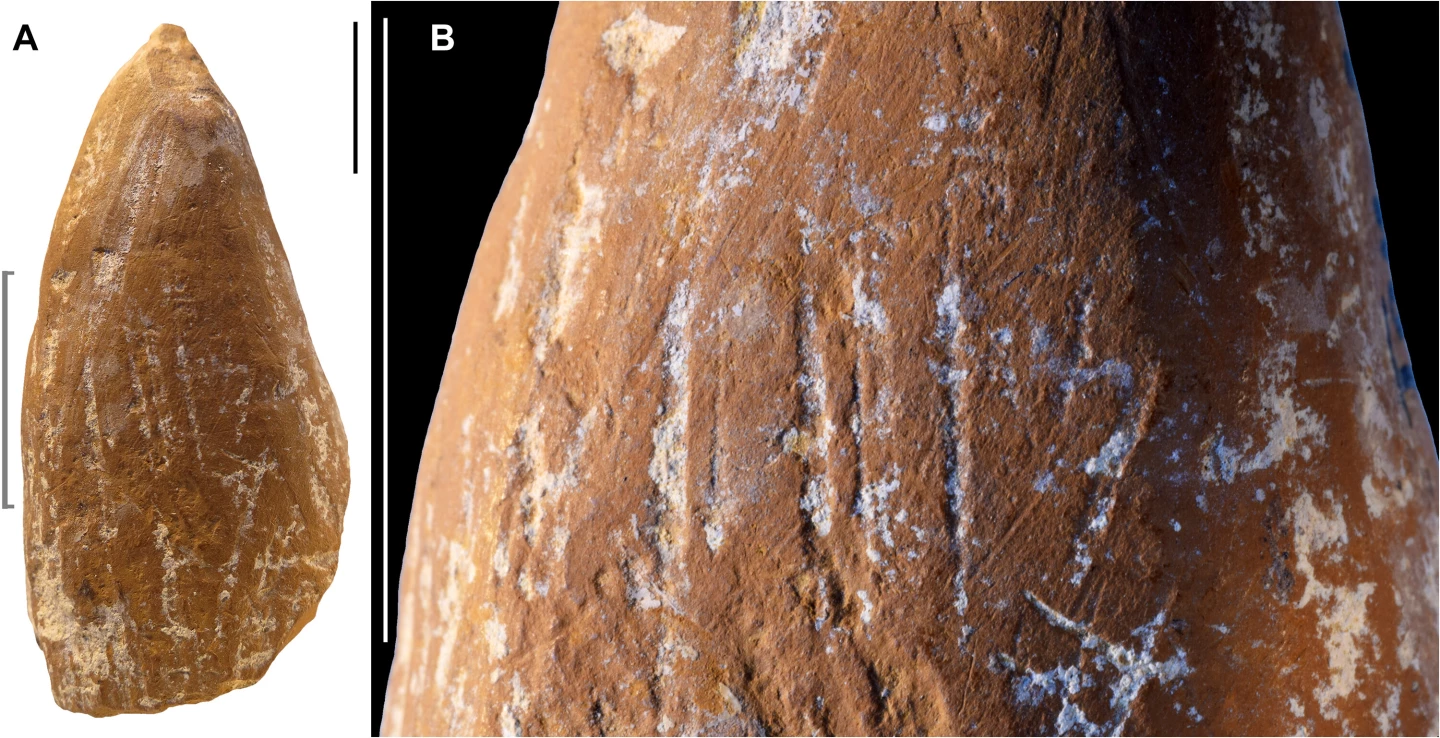
d’Errico et al., Science Advances (2025)
The researchers claim that many archaeological pieces, especially the red and yellow ochres, came from the local outcrop, Red Gully. However, the authors are careful not to cast every ochre fragment as having a symbolic focus.
“We did not claim that all ochre was involved in symbolic practices; some pieces clearly could have been used for extracting powder that may have been used in practical tasks,” adds Francesco. “In all known societies, the use of pigmental material for utilitarian functions also has symbolic or signaling functions.”
These findings suggest that symbolic marking, object curation, and deliberate use of color were not isolated innovations but meaningful components of Neanderthal cultural traditions. Recently, archaeologists discovered a pebble with a Neanderthal fingerprint, dating back 43,000 years. Francesco says that recent discoveries alongside this new evidence strengthen the conclusion that some Neanderthal groups developed their own durable symbolic practices that were distinct, regionally structured, and maintained over tens of thousands of years.
The study was published in Science Advances.

