


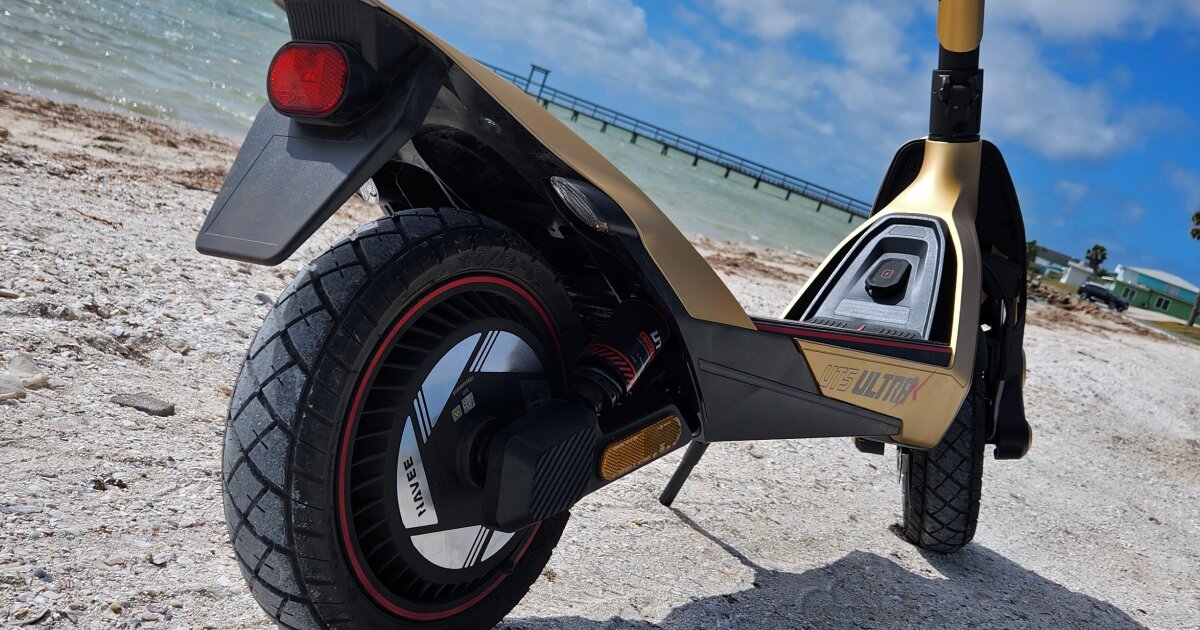
While the ebike market has been under fire lately with regulatory stuffs, the stand-up scooter market remains pretty much untouched. I’m not sure why, exactly, as these things just keep getting more and more powerful.
This UT5 Ultra X literally has all the basic features of a motorcycle and then some: two wheels, claimed 6.44 horsepower (4,800 peak watt), claimed 369 lb-ft torque (500 Nm), traction control, hi and low beam headlights, brake lights, proper turn signals, a horn … the thing even has cruise control and a USB-C port for charging your whatever. And it’ll do 44 mph (70.8 km/h) without breaking a sweat, even with my substantial, ‘Murica-fed dad bod atop it, ham-fisting the throttle.
I have a motorcycle endorsement on my driver’s license, so I kinda feel like I can “legally” get away with such speed on public roads on what most people probably think of as a kid’s toy … but I assure you, the UT5 is no kid’s toy.
It’s a land yacht – and I say that in the best way possible.
JS @ New Atlas
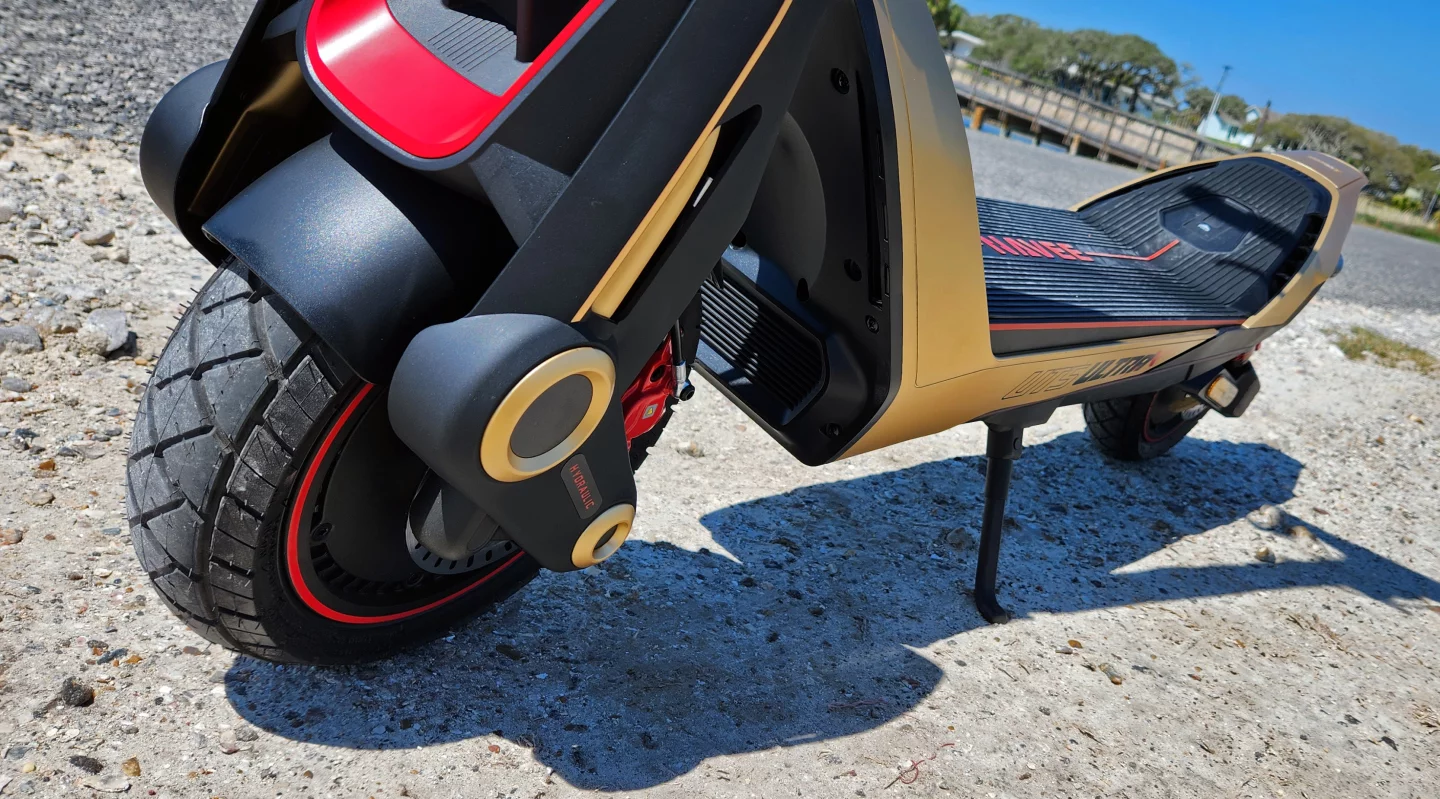
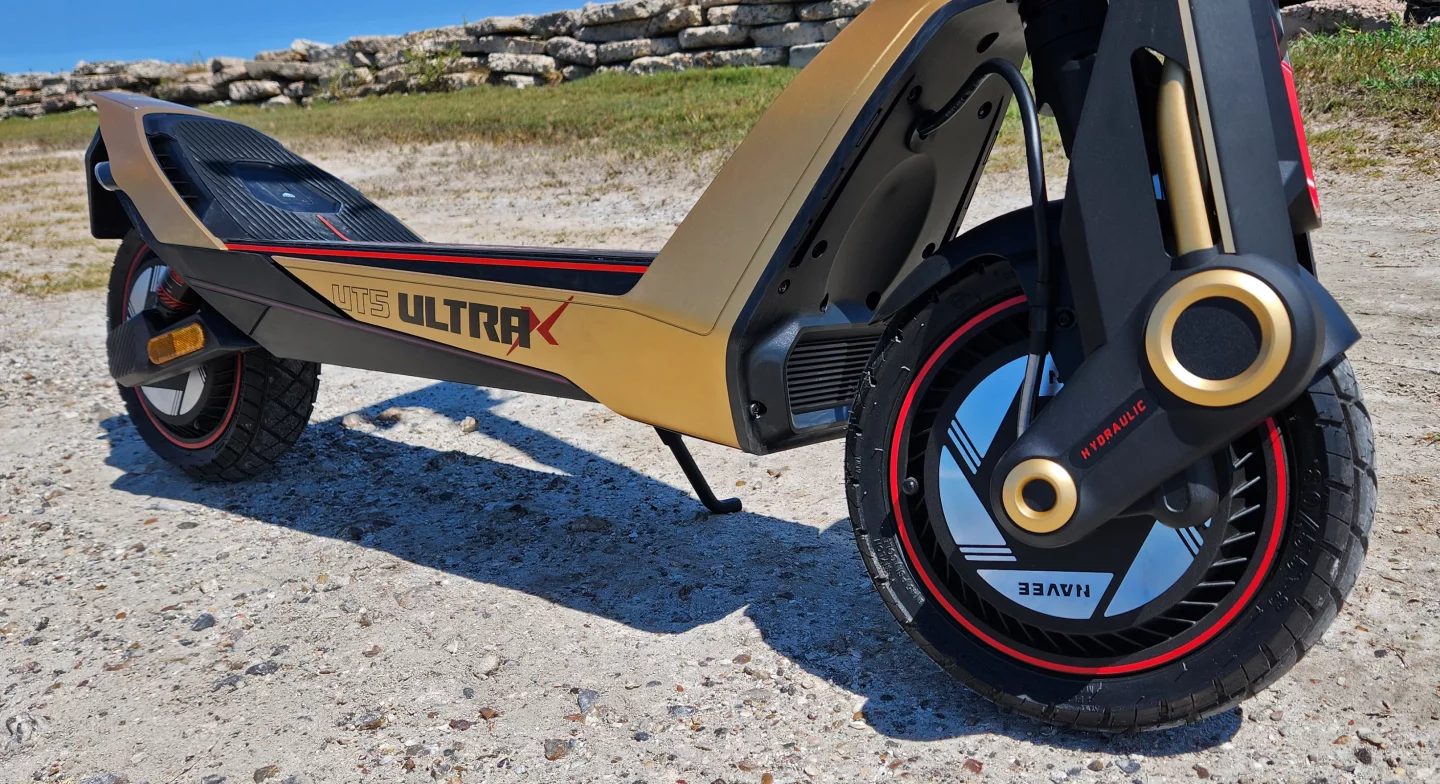
It feels like luxury. It genuinely feels like the ~US$2500 hole in your wallet was well spent. Its form, while kind of absurd, honestly, is polished, clean, and well put together, with every part having function. There’s no wasted space. Even its flashy gold, black and red paint scheme lends to its seemingly affluent nature.
If the ST3 Pro I previously reviewed is a Rolls-Royce, then the UT5 Ultra X is an Oceano. But with only a few caveats … like it doesn’t float.
The suspension: it’s good. It’s far better than nearly everything else I’ve ridden in the past. However, I’ve been spoiled by Navee’s ST3 Pro scooter with its ridiculous-looking yet best-ever-performing “damping arm” front and rear boingers. The ST3 not only soaks up teeth-chattering bumps, but also the big stuff, the stuff you’d swoop rather than clang over. Once you get a taste of that kind of suspension, everything else simply becomes not-as-good.
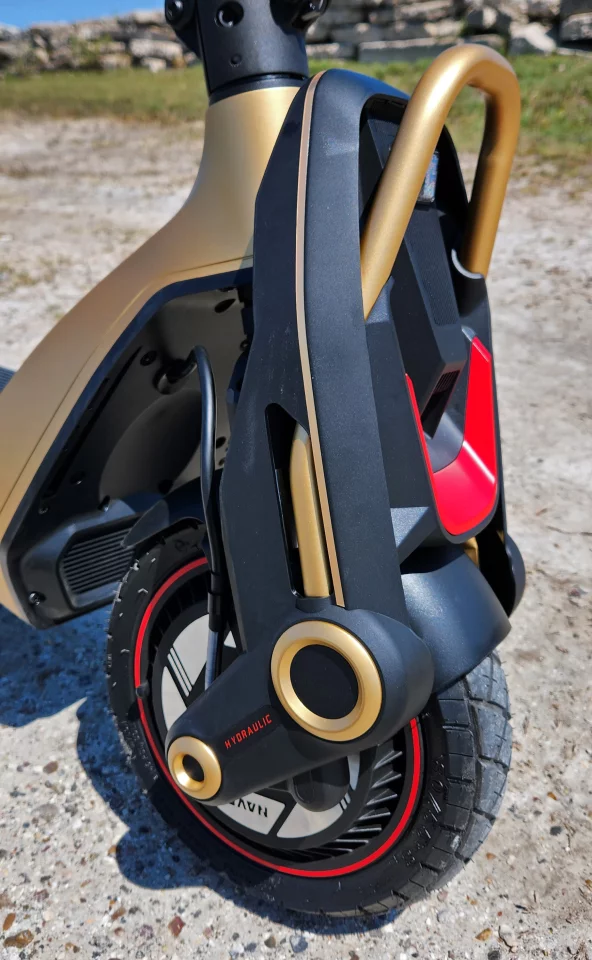
That being said, the UT5 suspension is good for a scooter with hydraulic suspension. If anything, it could stand to be softened slightly for regular road use. If I could, I’d take out 7 clicks of compression, 3 turns of preload, and just slow down the rebound a little bit to compensate.
JS @ New Atlas
Navee’s website says the UT5 has “NavXride Adjustable Damping for racing,” but I can’t find it. Even the bottom of the fork tube doesn’t seem to be it, which is common on upside-down forks, though the UT5 is standard forks. It does, however, have a spring collar on the rear shocks, which means I could take out some preload. My usual chip-seal patch, where I test out scoot-damping-capabilities, well, let’s just say that it’s fast enough to float over that section. If I make the playing field level and ride it at 25 mph like the rest of my scooter tests have been, my eyes will vibrate to the point where it’s a little hard to see.
Because of its stiffness – which would be great on a smooth racetrack – it’s much less comfortable to jump stuff, like curbs and kickers, not that this machine was designed for such antics. Regardless, I still give the UT5 a solid 7/10. It would be an 8 if I didn’t already have to deal with a weeping oil seal in one fork leg. I think a snugger, higher quality dust seal would help. Eventually, it’ll stop weeping, when it runs out of oil … 😉
Stats at a glance:
- 43 mph max speed
- Dual 2400 peak watt motors
- Switchable from 2WD to 1WD
- 0–12 mph in 1.78 seconds (unless I’m on it)
- 46% max climbing slope (haven’t tested, but I believe it)
- Up to 75 miles of range at 9.3 mph (and you weigh < 165 lb)
- Dual hydraulic suspension
- 12-inch tubeless “self-healing” tires
- Apple Find My + Bluetooth tracking with auto unlock
- Traction control (TCS)
- 6W and 12W headlights
- 60V 22.3Ah battery
- ~6-hour charge time from dead @ 3.5 amps
JS @ New Atlas
This thing has juice. And let me tell ya, when I found where the boost button was, whoa baby.
Its dual 2400-peak-watt motors, even with TSC on, will still chirp when you punch it. Even a rolling ~10 mph (16 km/h) start will chirp front and rear. Navee says 369 torques, and maths say that 4,800 watts equals out to about 6.4 hp … but after riding it and prior to learning what the torque figures are and doing the math conversion, my butt-dyno told me “it feels like 6-7 ponies” and that “yes, I think it could tow a Honda Civic across a Lowe’s parking lot in a pinch.” Hauling my derriere over the only “hill” I have nearby (a bridge, really), the scoot doesn’t bat an eyelash.
Six or seven butt-verified ponies doesn’t sound like a lot when you compare it to a Lightning LS218‘s dyno-actual 244 hp (182 kW), but I assure you, that instant delivery from both wheels punching out a combined 4800 watts worth of very excited electrons is indeed fast, especially on a machine that weighs less than half of what I do (90.4 lb / 41 kg … not me, the scooter). Put it this way: I have yet to proper wheelie it because I’m afraid.
JS @ New Atlas
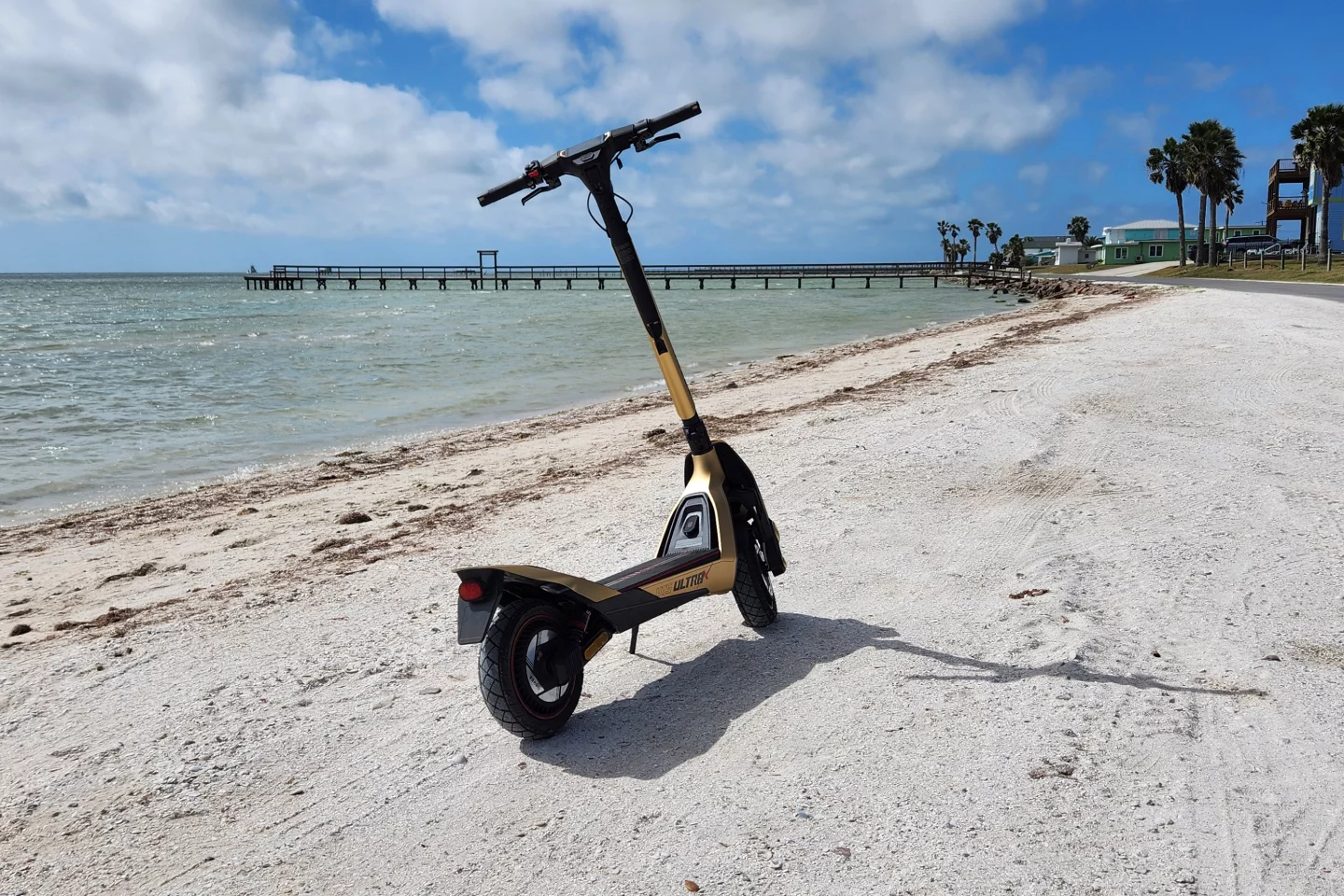
On the other hand, where the UT5 also mirrors this yacht-ness I speak of is its stability.
If you’re familiar with two-wheeler geometry, there are these two really important aspects that will ultimately dictate its stability and whether it’s quick to turn on a dime or it feels like you’re trying to turn a bus: rake and trail. Skip the next paragraph if you know what I’m referring to.
//Lesson on.
Rake is the angle of the fork to the ground while the bike is upright. Trail is the distance between the contact patch of the tire and where the invisible line would touch the ground if you followed the angle of the fork all the way to the ground. The basic rule of thumb is more trail = more stable in a straight line and more difficult to initiate direction changes. Less trail = faster turn-in, less stable going straight, and an overall more twitchy feel in the steering.
//Lesson off.
JS @ New Atlas
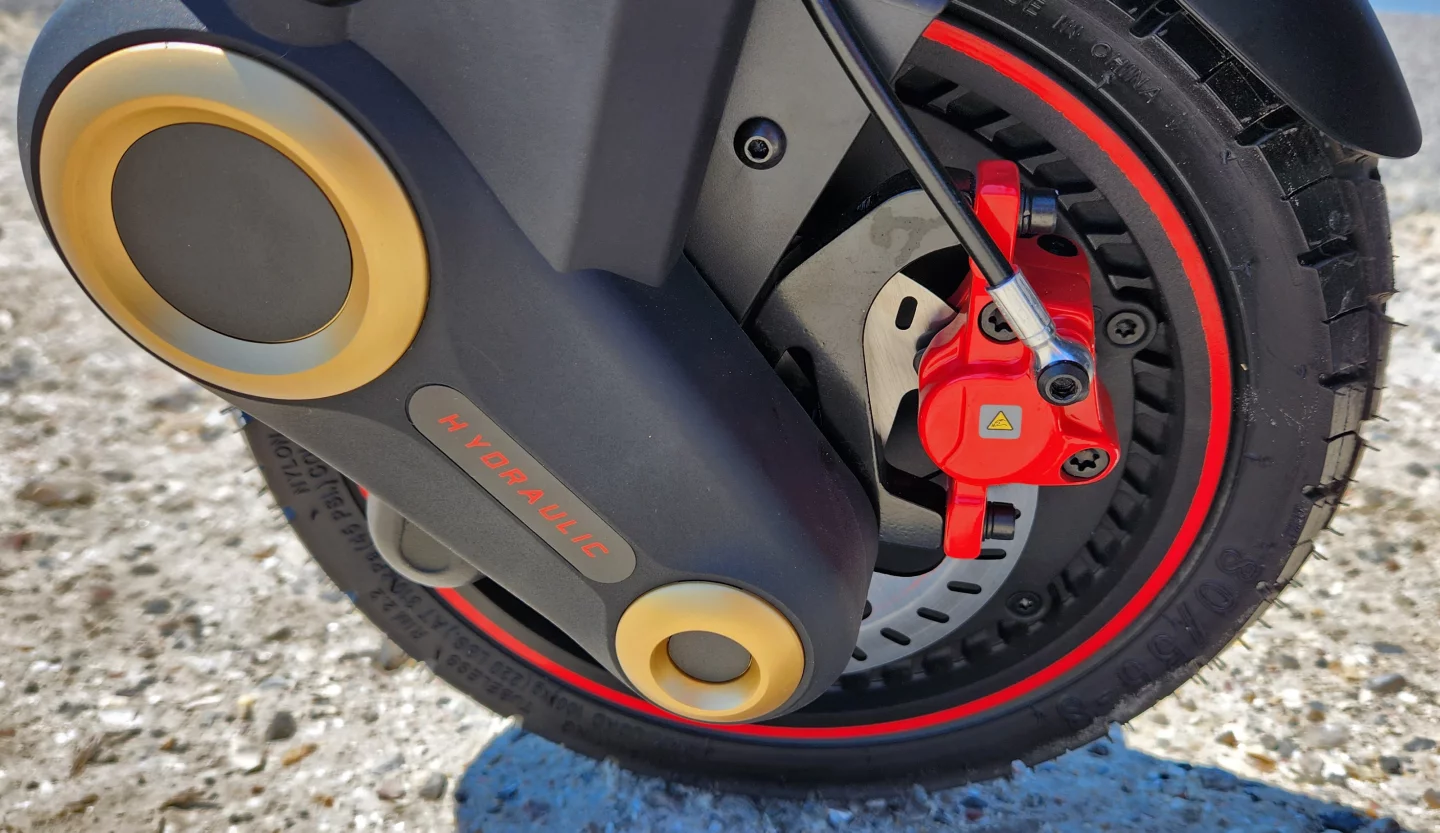
The front wheel axle is offset by 2.5 inches (63.5 mm) rearward relative to the fork – adding to a caster-like stability effect – and making the trail numbers on this thing absolutely insane at 5 inches (127 mm) – on my tape measure at least – for a stand-up scooter. It may exist elsewhere, but I’ve never seen it on any scooters I’ve tested so far. Having said that, there’s a whole lot I’ve not ridden yet.
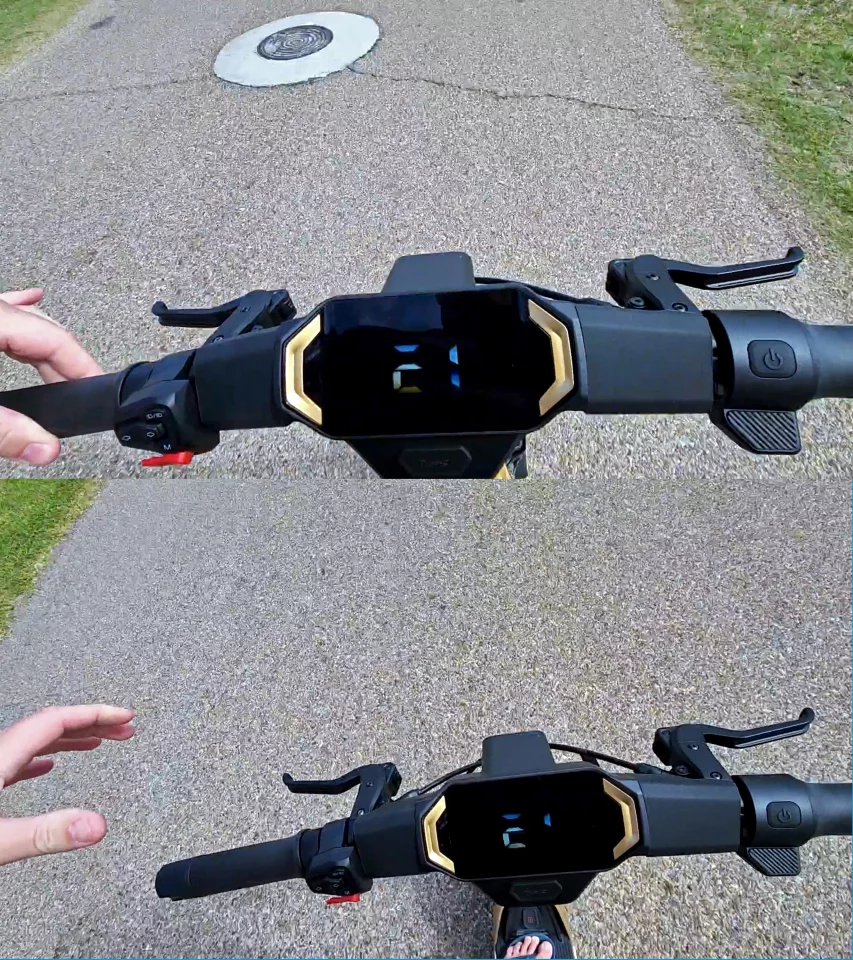
But, I kid you not, this thing is so planted that on my very first ride, I put it in cruise control at 27 mph (43.5 km/h) on a smooth, empty street and turned my body sideways like I was riding a snowboard and simply let go of the bars, “Look ma, no hands!” style. Since my first ride, I’ve made a habit of taking my hands off the bars for no other reason than I can … quietly hoping the Sausage Creature isn’t around where it can see me.
JS @ New Atlas
I assume it’s by design, but there’s another feature that likely lends to its high-speed stability that I’ve not encountered on any two-wheeled machine (that had a proper functioning set of head bearings, at least): there’s a notch in the steering, pointed perfectly straight. It’s subtle, but I can feel it. If the bars are nearly dead straight, the notch will slightly tug at the bars/wheel to pull the front wheel perfectly straight. Anything over 10-ish miles per hour, and it’s almost imperceivable. Slower than that, and it can be felt. It makes slow, lock-to-lock riding not this lengthy machine’s particular forte, especially combined with the huge trail numbers I mentioned earlier.
If you’re finding yourself on sidewalks, weaving through crowds of people, you’re not in the scooter’s happy place, therefore you will not be in your happy place. You’d be better off in the street, cruising at 35 mph (~56 km/h), lane splitting cars (disclaimer: where permitted, of course!).
I’ve put 162 miles (261 km) on the Navee in the last three weeks. I had one gremlin pop up at around 30 miles (48 km) that caught me by surprise and made me a bit leery for the next couple dozen miles: While cruising at about 25 mph, I suddenly lost throttle (not power), and the scooter started to coast.

JS @ New Atlas
Normally, after five seconds of inactivity at a standstill, the scooter goes into P(ark) mode, where the throttle won’t respond unless you tap either brake lever. It’s a zero-start safety feature that prevents you from accidentally yeeting your scooter into your neighbor’s lawn while you’re chit-chatting simply because you leaned on it the wrong way.
That’s what the scooter did to me while coasting from 25 mph. It beeped, showed P on the dash, and just kept coasting, while I was locked out of throttle. I tapped the brake to disengage Park mode, twisted the throttle, and it just started going again as if nothing had happened. I took note that the app disconnected when it happened, and it reset that particular ride info at that exact moment.
Over 130 miles later, the scooter has yet to hiccup on me again. Was it an app crash that caused the glitch? I’m not sure. Am I still concerned? No, not anymore. Should you be? I doubt it, but in my experience, nothing ever works 100% of the time 100% of the time.
JS @ New Atlas
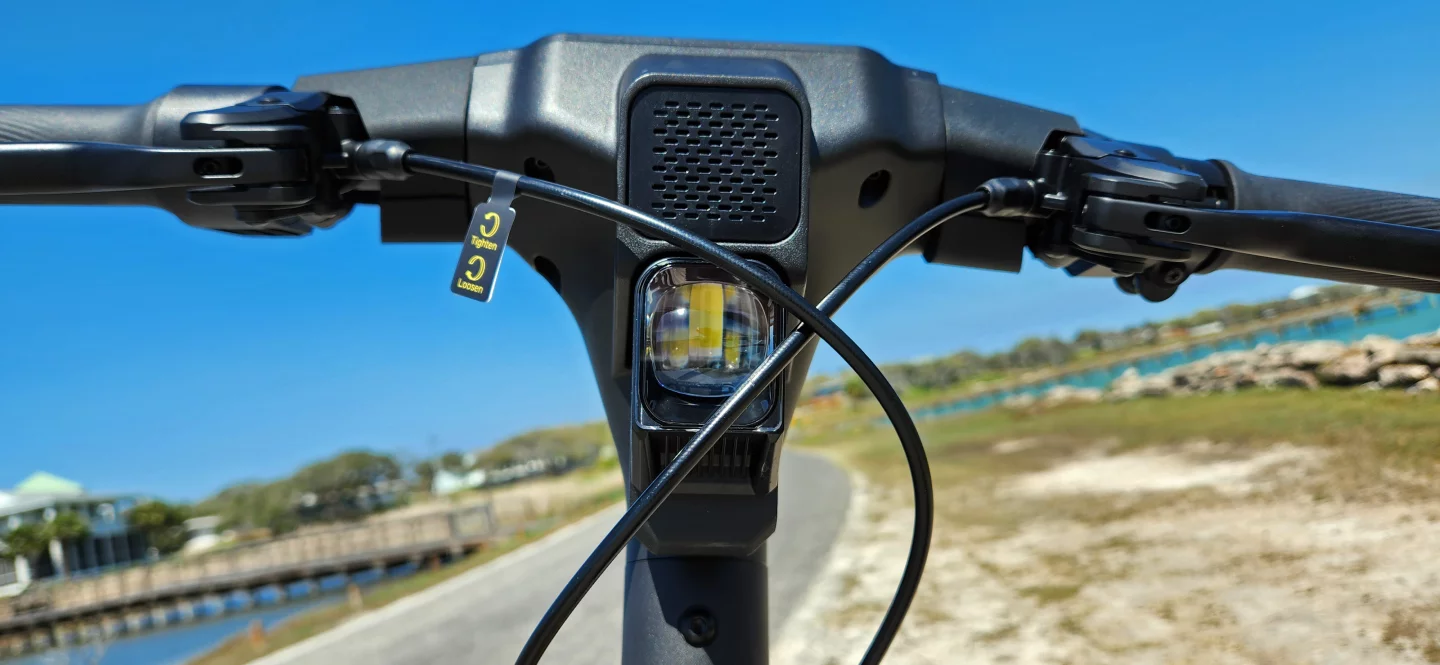
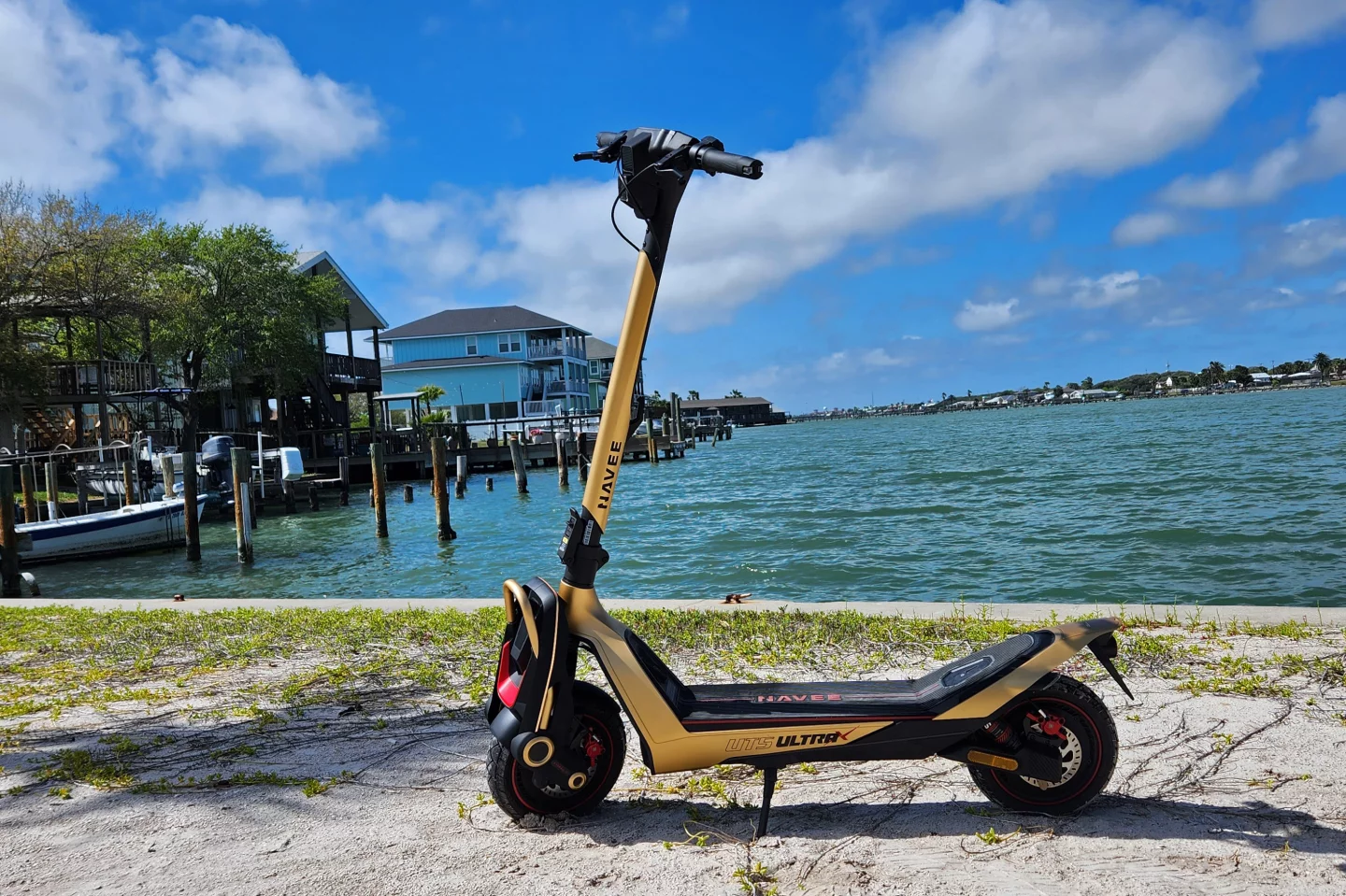
The UT5 Ultra X has the entire suite of lighting, from two sets of opulent under-and-side glow that you can customize patterns, colors, and even conditions, like if you’re in boost mode or not, as you peacock around town. It also has bar-end turn signals and turn signals on the back – which means us thicker folk aren’t trying to awkwardly lean to the side as to expose the bar end indicators to the traffic behind. The brake light stays lit and gets brighter when you brake, and the crème de la crème, in my opinion, are the 6-watt LED low beam and the 12-watt high beam headlights. They’re legitimately good. The headlights are nearly as bright as a motorcycle with decent LED headlights. I can comfortably ride 35 mph at night and feel like I’m not at all overriding my ability to see. Kudos for good lighting, Navee!
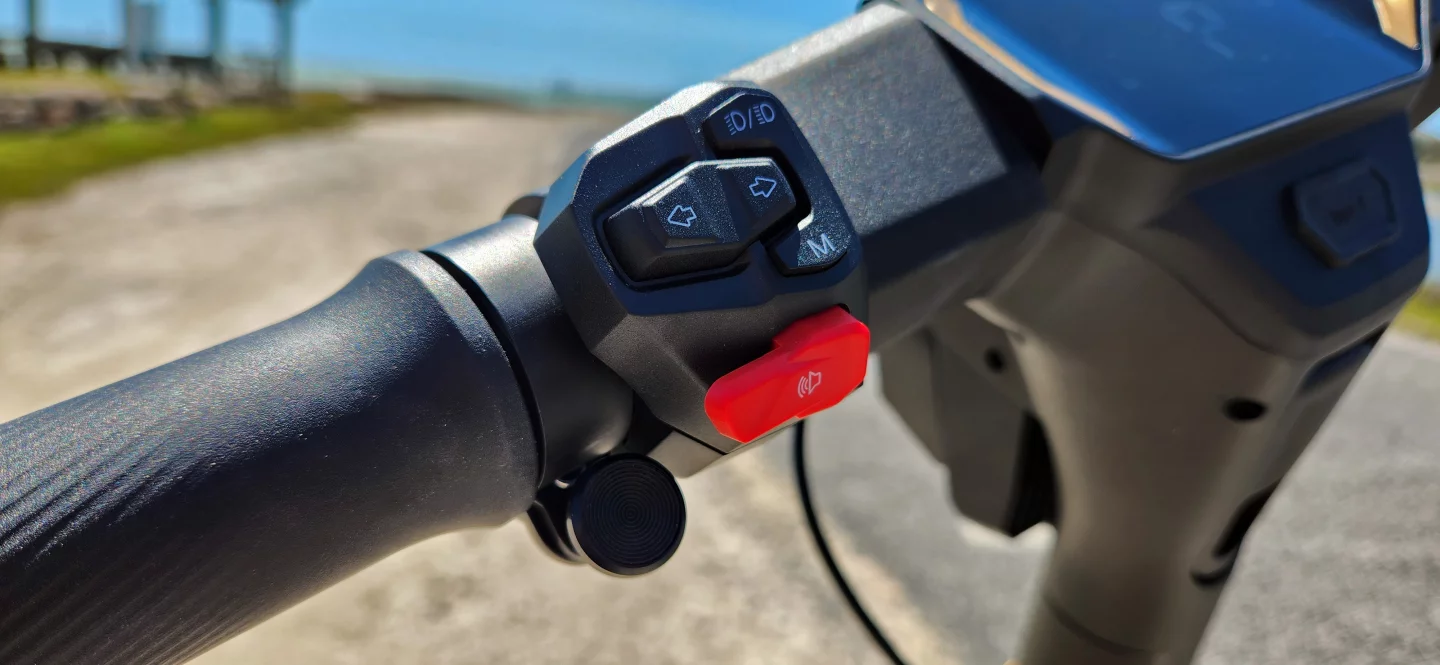
I do have one big annoyance, for sure, and I suspect anyone else who’s ridden the UT5 will agree: the button layout on the left controls. They look good, the layout looks clean, but they’re impossible to easily – and more importantly – correctly hit the button you were aiming for.
Normally, that wouldn’t be such a big deal, but if you’re trying to use your indicators, it’s inevitable that you’re going to hit the boost button instead, or both. Switching on your low beams? Yep, you’re going to hit that boost button. Beeping the customizable horn to make duck-quacking sounds on the bike path as you catch up to every other person/bike? Yeah, boost button, I tell ya. Changing modes from Sport to Walking mode? Uh-huh, that’s right, boost button.
You probably thought I was going to throw in something that didn’t result in going into boost mode, didn’t you? Unfortunately, it doesn’t exist. All roads lead to boost.
JS @ New Atlas
And for clarity’s sake, hitting the boost button alone isn’t like dumping NOS directly into your intake. It’s more like opening the NOS bottle, so the second you flip that switch, you’re getting all the juice … and in the case of the UT5, the throttle IS the switch. So if you’re not ready for it … well, you just need to be ready for it.
When the UT5 is in boost mode, throttle sensitivity increases pretty significantly, and both motors are happy to receive any and all power you give them in order to turn 12-inch rubber into fine rubber particulates. I’ve definitely snapped my head back a couple of times, not realizing I was in boost mode after indicating. Don’t get me wrong, boost sure is fun! But less so when you’re navigating a Walmart parking lot at 10 mph.
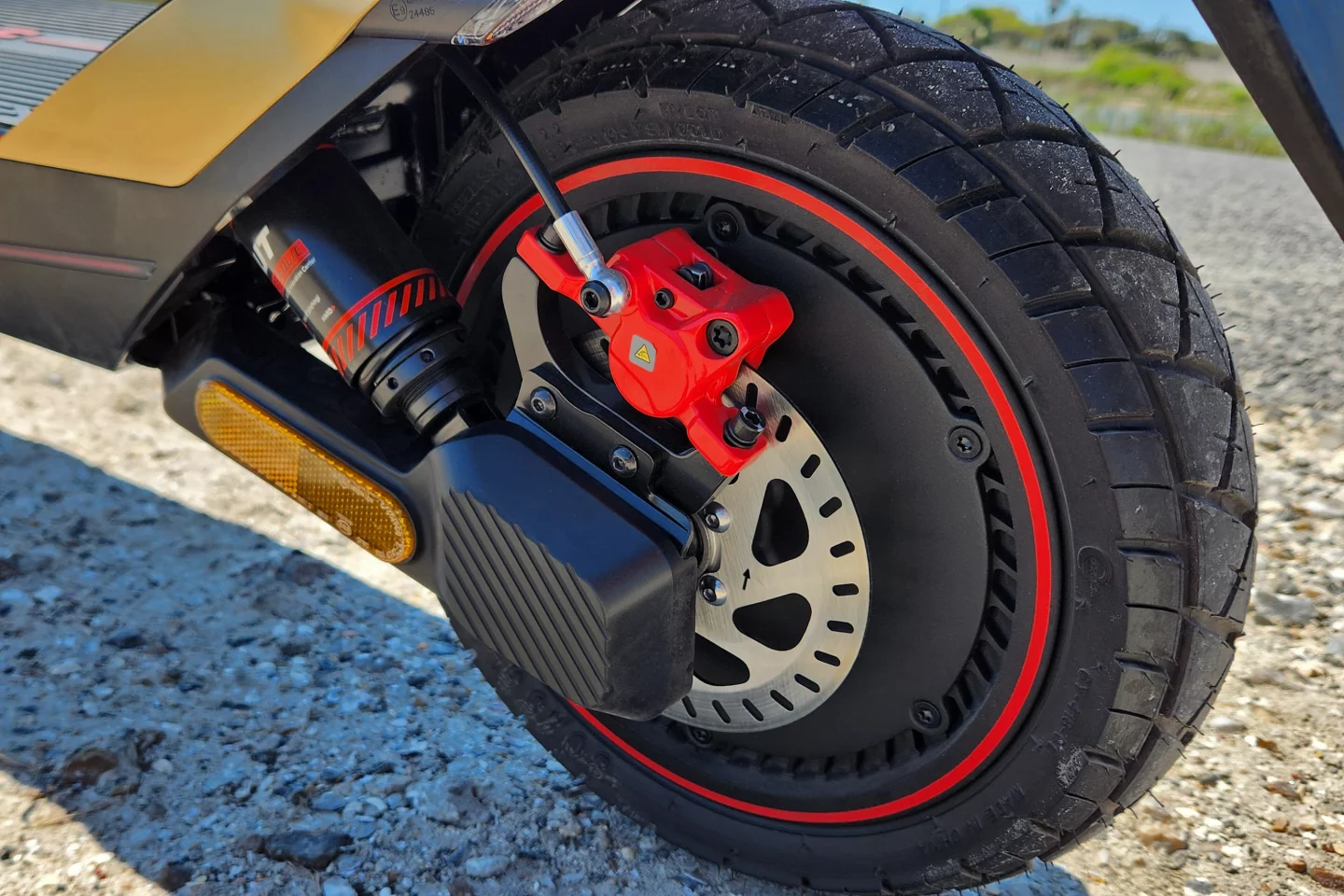
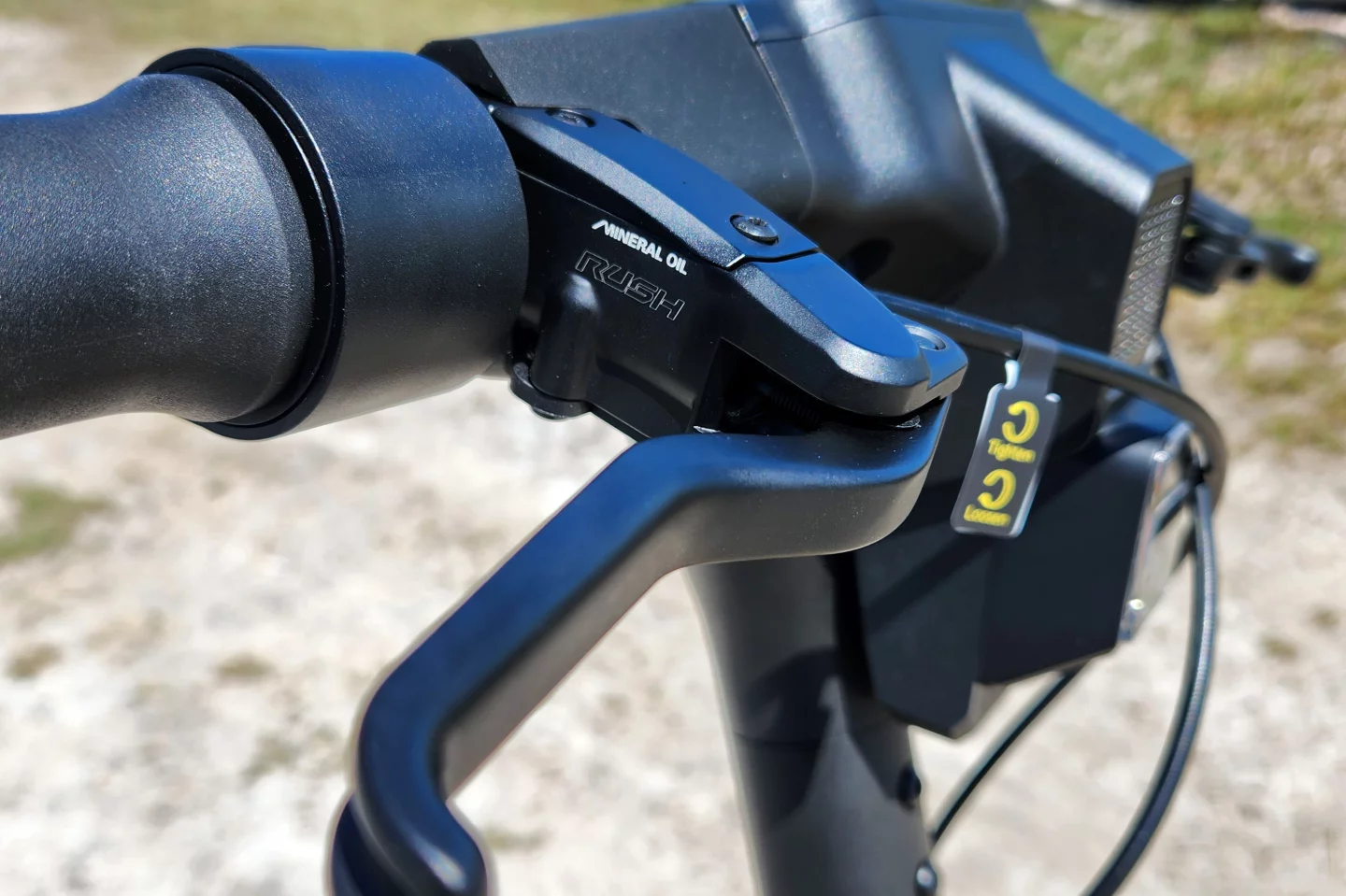
More important than the throttle, in my opinion, are the brakes. How quickly can I get slowed down safely before I go flying overboard and into the ocean? Navee’s flagship scooter has “hydraulic brakes.” That’s how it’s listed on Navee’s website. The master cylinders say “Rush” and “mineral oil” on them.
That’s where I think Navee might be doing themselves a disservice, by not mentioning that they’re RADIAL master cylinders rather than the conventional old axial style. And maybe that doesn’t resonate with people as much as it should, but radial-mounted master cylinders are the bee’s knees! Radial M/Cs give you so much better feel on the lever and feedback to what the tire is doing on the road surface, while also being more linear. The brakes on the UT5 are superb, paired up with 130-mm rotors front and rear, also with radial-mount calipers. And the kicker? The front brake is on the right … just like a motorcycle. I love it.
JS @ New Atlas
ECO mode! That was my complaint with the ST3 Pro. Navee’s ST3 uniquely has three modes that differ from other scooters: W(alk), D(rive), and S(port) … which, on every other scooter, would be E(co), D(rive), S(port), and you’d have to use the app to enable W(alk).
Well, Navee took heed and properly named the UT5 modes to what they really are: Walk, Eco, Sport, and now BOOST! It’ll do about 3 mph in Walk, 14 mph in Eco, and a blistering 44 mph in Sport (4.8, 22.5, and 70.8 km/h, respectively) … Boost will just get you there faster. The neat thing about Boost mode on the UT5 is that it’s a on/off toggle, and not just limited to a few seconds like some other scooters have. You can happily bobble-head in Boost until the batteries die, if you wish (or at least down to 28%, as that’s the lowest I’ve gone on the scooter with Boost on so far).
I recently went to CES in Las Vegas and used my ST3 to get around, spending the better part of three days in Walk mode. It’s the first scoot I’ve ever used where Walk mode genuinely worked and without fail. Well, I’ve put Walk to the test on the UT5, and I have to say, it’s even more impressive – especially with zero-start enabled. Even when it lugs down to 1 mph (1.6 km/h) in deep sand, it just applies more power and keeps you going.
The deck height is massive on the UT5. I measured the deck, and it sits at TENNNNN inches tall, 8 inches wide, and 28 inches long of usable foot space, including the kick plate (25.4 x 20.3 x 71.1 cm). That makes me over seven feet tall (213.4 cm) when I’m riding it. It’s a proper step to get up. And that kick plate sure is handy (footy?). My back foot pretty much stays permanently on it to handle (footle?) all the torque the motors throw at me.

JS @ New Atlas
The wife’s friend saw me cruising the other day and didn’t realize it was me at first. Later, she says to me, “Do you realize how big of a man you are on that thing?” Why yes, I do, actually, because I have to duck a lot for tree branches and other obstacles that I never had to duck for before. Quack-quack! That being said, the drapes match the carpet in that the bar height is pretty tall too. Perfect for my six-foot-three (190.5 cm) frame. The UT5 makes my – what I thought was a big-boy – ST3 scooter feel like a little Razor freestyle scooter by comparison.
Is the Navee UT5 Ultra X worth it? And who is it for? Well, if you’re into this kinda thing (“nerdy” scooter riding, but secretly you’re actually a really cool guy/gal that loves having fun) and you have $2,500 burning a hole in your pocket, you’re darn-tootin! It is gold, after all!
JS @ New Atlas
And as far as who I think would benefit the most from this kind of scoot: pleasure seekers.
I’ve been averaging about 30-33 miles on a charge of normal riding. And by “normal,” I mean in sport mode, having fun, but not being super aggressive, mixed in with slow cruising along the beach, hanging out. I haven’t done a flat-out, full-throttle range test on it, nor have I tried to hyper-mile it either (who wants to ride ~70-miles-plus at 9.3 miles per hour? That’s insanity!).
It could also very well be used as an urban commuter to-and-from work, sure, and it’ll do the job really, really well. But, in my experience living in cities, this isn’t the scooter I’d want to park in public, that’s for sure. It looks too good, or maybe just too interesting, to keep bad actors at bay, and little kids from wanting to clamber all over it, knocking it over. If you’ve ever owned a nice motorcycle before, I’m sure you’ve returned to it only to find a random mom having put her random three-year-old atop it before. It’s hard to be mad when you see the kid’s face light up, but scratches in your tank are forever. Or worse, it gets tipped over.
JS @ New Atlas
Oh, and I forgot to mention, the UT5 is UL Certified. I’ve recently gathered that that’s an important marketing keyword to throw in. 😉 And as I was about to submit this incredibly long scooter review, I also remembered another neat feature: You can set a charging limit on the battery to extend the life of it. For example, there’s never really a day that I burn through the entire battery, so I have it set to charge to a maximum of 80%.
Is there anything better on the market right now? I’ve heard heaps about the new Segway GT3 Pro, which has similar specs to the UT5 Ultra X (and double the pricetag), and the slightly lower spec’d (and much cheaper) GT3, but I’ve not actually ridden either of those, so I can’t personally attest. I read up on a bunch of Reddit posts in the scooter forums, and it’s pretty split – about 100 ways from Sunday – on which scooter ranks “best overall.” I have caught wind of a new Inmotion RS-like scooter on the horizon that I may be checking out sooner rather than later that falls squarely in the realm of the UT5, spec-wise. I’m looking forward to the heads up comparison on that one.
This is the second Navee product I’ve tested, and I’m a fan. The company genuinely makes a solid product. That being said, if I could combine aspects of the ST3 Pro and the UT5 Ultra X, I would in a heartbeat. I feel like the suspension went a bit backwards on the UT5, and the buttons drive me crazy, but the stability and the power … oh the POWAAHHH … fair trade, I suppose.
JS @ New Atlas
//Not really review related, but to wrap up:
Which brings me to the beginning of this review again, and perhaps a small soapbox of thought … what’s the legality of these large, high-speed, long-range stand-up beasts?
I looked up the law where I live in Texas. There’s no specific speed at which a stand-up scooter is limited to, according to section 551.352 of the Texas State Transportation Code. However, stand-up scooters may not be used on roads where the speed limit exceeds 35 mph. So there’s that. Your mileage may vary where you live.
And for the most part, stand-up scooters fall within the “micro mobility” category across the US according to the US Consumer Product Safety Commission, meaning there’s very little legislation on them, period.
Good news for us – for now. But as these things keep getting bigger, faster, stronger, yachtier … the law is going to take notice, just like it has with ebikes in recent years.
There are already upwards of 100-mph capable (160-km/h) scooters on the market. And even EUCs that are in that territory as well. It’s probably only a matter of time before us goofy folk on stand-up scooters start to feel the pressure, too.

JS @ New Atlas
Nearly everyone who stops me while I’m riding around town will first compliment my ride, and quickly follow it up with a secondhand story about someone they know getting absolutely crushed in a crash on a Lime or Bird or whatever-public-rental-scooter is in your area. Not at all different from my decades of riding motorcycles, really. And should I happen to fall off my UT5 Ultra X at even 25 mph (40 km/h), it’s not going to be pretty in a tank top, shorts, and flippy-floppies – attire you’d never have found me riding motorcycles in. Again, not at all different from my decades of riding motorcycles.
But oh boy, these scoots sure are a hoot!
Product Page: Navee UT5 Ultra X Scooter or Amazon ($300 coupon at the time of writing)
New Atlas may receive commission when you purchase through our links, though that does not affect our reviews. Our opinions are our own.

