


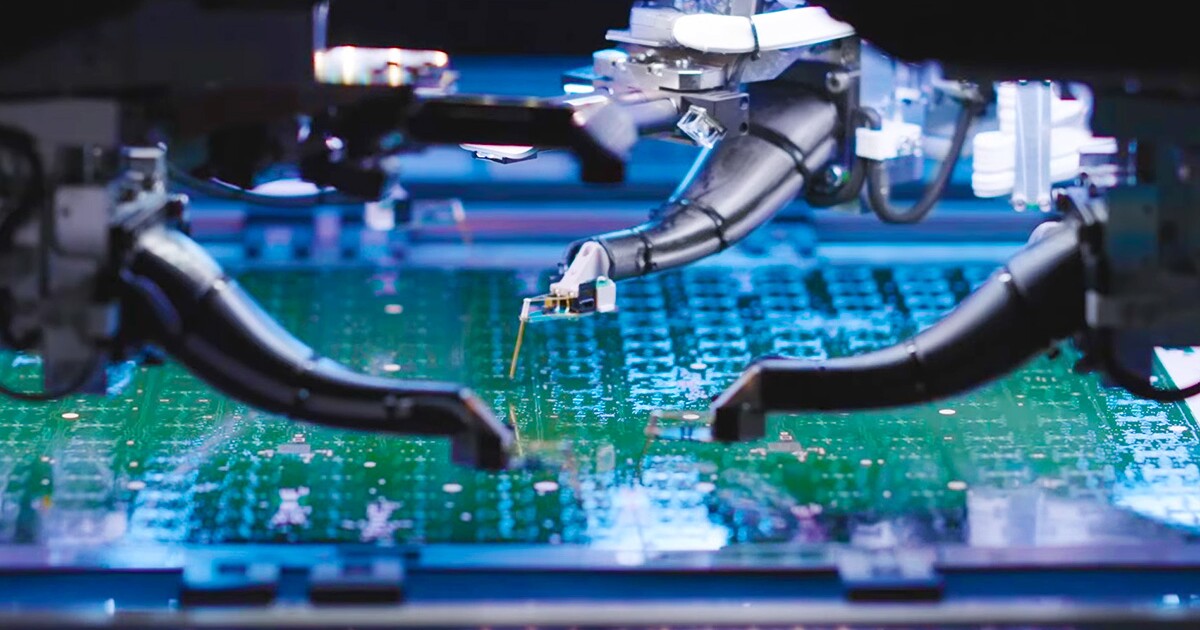
Elon Musk has previously promised the arrival of fully autonomous Teslas and ultrafast Hyperloop transport – both of which are yet to materialize. For his next trick, the galaxy’s richest earthling plans to build an enormous chip manufacturing plant that will positively dwarf every other such facility on the planet.
Musk believes that scaling computing power is the path to solving complex physics challenges, accelerating humanity’s future, and becoming a multi-planet species.
To that end, Terafab is a joint venture between his firms Tesla, SpaceX, and xAI, to create the largest end-to-end chip design and manufacturing facility. This will kick off at the Advanced Technology Fab in Austin, Texas, which is home to Tesla’s headquarters.
TERAFAB
The idea is to produce about 50 times the quantity of chips specifically for AI applications that all of the world’s major manufacturers (like TSMC and Samsung) make annually. Musk estimates that’s just about 20 GW of compute – so Terafab, as the name suggests will aim to hit 1 terawatt of compute with its chips.
The project is expected to cost upward of US$20 billion, and will produce two types of chips. Chip design, lithography, fabrication, memory production, packaging, and testing will all happen under one roof, which Musk notes hasn’t happened before. Tesla notes it’ll work on 2-nm process technology, which means it’s got its sights set on the most advanced techniques for building highly efficient chips possible.
The first will power Tesla’s self-driving vehicle tech in its cars and robotaxis, as well as the brains in its Optimus humanoid robots for helping out around the house and in industrial applications.
Tesla
The second will be built for use in space – a more difficult environment to run reliably over time – to expand AI computing resources in orbital data centers (which SpaceX announced it’s getting into last month, as it merges with xAI). Compute in space should also help further harness the power of the Sun with next-gen energy systems. Musk believes it’ll be possible – and cheaper – in just two or three years to launch AI chips into space and run them in satellites up there.
He estimates that we’ll soon need up to 10 billion robots a year, and then you’ve got all those satellite data centers. That means Terafab is targeting production numbers of several billion high-end AI chips annually, starting with small batches this year and ramping up volume in 2027.
This all sounds terrific, Elon. The trouble is, it’s all astronomically difficult, and quite likely impossible. Building out a state-of-the-art chip fabrication facility will cost billions of dollars and take years before you can even get started producing anything – and that applies to companies that have extensive experience doing this sort of thing.
That’s because constructing the facility, with its complex physical infrastructure like cleanrooms and high-end air filtration and chemical handling systems, takes a lot of time to build in the first place. You also need time to perfect the chip architecture and manufacturing processes, and you need to build an incredibly skilled team to nail it at scale. Musk is promising all this with a brand new moonshot.

Tesla
I can appreciate that ambitious plans demand you to dream big and aim for the stratosphere and all that. But a lot of what we’re hearing in the Terafab pitch is already known to be challenging; getting anywhere close to achieving a fraction of the stipulated production goals in Musk’s proposed time frame is wishful thinking. Color me skeptical as hell – and let me know what you make of it in the comments.
Source: SpaceX / X

