


Behind any great sports car stands a great motor. So it follows that behind an absolutely insane hypercar stands an equally insane hyper-motor. Or two. That’s how it breaks down with the all-new £1 million McMurtry Spéirling, the modern-day fan car that can sprint from standstill to 60 mph faster than virtually any four-wheeled vehicle not specced for Top Fuel drag racing. Beyond nearly 50,000 rpms worth of asphalt-sucking fan power, the Spéirling requires a pair of electric drive motors that measure among the most power-dense out there. And with electrons flying at full bore, the furious single-seater promises to keep igniting the record books into embers and ashes.
McMurtry’s Downforce-on-Demand fan system has tendency to hoard all the attention – and for good reason, as it allows the car to suck track so hard it can actually drive upside down – but it also takes a state-of-the-art motor (or pair of motors) to translate that ground suckage into the fastest 0-60 mph (96.5 km/h) sprint any production car has ever made. In this case, it takes a pair of radial flux motors capable of putting out a combined 1,000 bhp and 1,000 lb-ft of torque to get things done.
Helix
British motor supplier Helix might lag behind its country mates at YASA when it comes to setting power density records on the dyno, but it has an absolutely brilliant history of putting incredibly compact, powerful motors inside some of the world’s most exotic and extreme cars. That lists includes the Spéirling, of course, but also Formula E race cars, the 2,000-hp Lotus Evija, the Aston Martin Valkyrie and the Czinger 21C – an off-all-charts stable of envelope-pushing electrified cars.
And lest we give the impression that Helix is purely an automotive supplier, its e-drives also feature in the Astro Mechanica supersonic jet and some pretty radical 360-degree marine pods that could vastly streamline how ships maneuver.
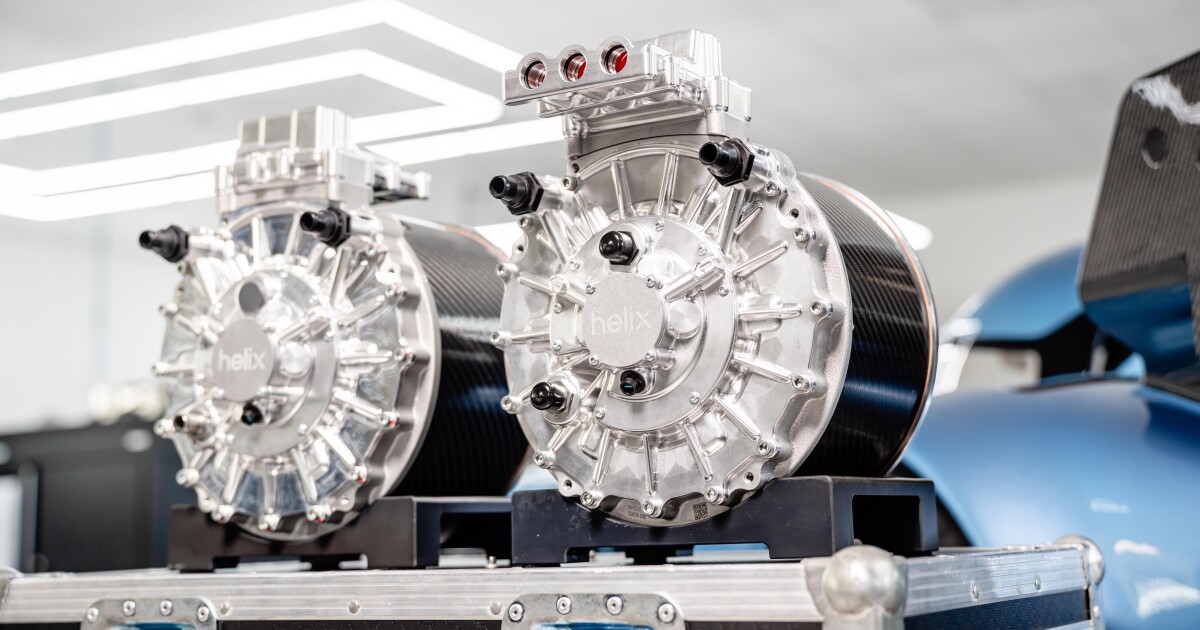
For the Spéirling, Helix supplies a bespoke drive system featuring two of its SPX242-94 motors fine-tuned to work with McMurtry’s bespoke gearbox. Each motor weighs in at 33 kg (72.7 lb) and puts out 368 kW (500 hp), equating out to a fierce power density just over 11 kW/kg.

Helix
The SPX242-94 motor’s high concentration of power is critical here because the 1,300-kg (2,866-lb) Spéirling is downright tiny at just 150.2 inches (382 cm) long, shorter than a Mini Cooper 2 Door or Mazda MX-5 Miata. It seats a single person below a centered, bubble-like canopy and leaves little room to spare under its magnificently blue body panels, especially at the rear where those twin 23,000-rpm fans develop the tornado of air force necessary to keep the wheels planted to the pavement like a slot car doing lazy Saturday loops around the plastic.
Results of McMurtry and Helix’s combination of high-tech electric motor and fan power were in long before the Spéirling hit production last month, and they were downright flabbergasting. Beyond setting a production car world record for a 1.55-second 0-60 mph sprint, McMurtry’s vessel clocked an 8-second quarter-mile and shattered records at world-renowned destinations like the Top Gear Test Track, Goodwood Hillclimb and Laguna Seca.
Pure nastiness.

Helix
We’re not sure we can even expand our minds out enough to envision what fan car technology would be doing in 2026 if it had been nurtured rather than shunned from racing during its initial invention back in the 60s and 70s. But we are glad we get to see what it’s doing below modern cars like Spéirling and Murray T.50s and look forward to watching the continued redirected trajectory of automotive performance from here.
As for Helix, while few will get to experience its motors grinding out a 1.55-second 0-60 or 190-mph (306-km/h) top speed run behind the wheel of a Spéirling, the scalable core technology means that its motor tech will continue to be adapted for all kinds of propulsion applications. The company is currently working to power a wide range of vessels that includes VTOLs, race boats and yachts, motorcycles and defense platforms, manufacturing motors at its 86,000-sq ft three-site facility in Milton Keynes, UK.

