


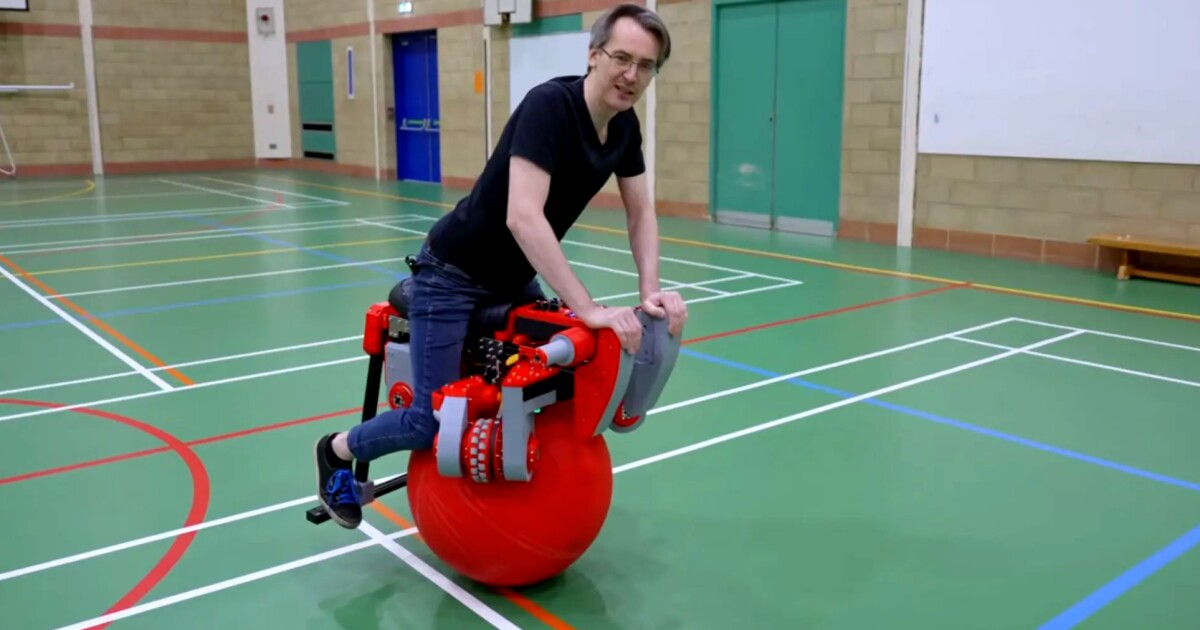
British inventor and YouTuber James Bruton has a habit of solving problems nobody asked him to solve – and then solving them again, harder. The man behind the screw-drive motorcycle (yes, it moves on spinning cylinders instead of wheels) and a rideable electric Lego skateboard has now tackled what might be his most deranged engineering flex yet: an electric moto that balances on a single giant ball.
If that sounds familiar, it’s because Bruton already built a two-ball version – a “ball bike” that stayed upright by spinning one sphere under each end of the frame. The logical next step, apparently, was to remove one ball entirely and see what happened. The answer, as you might expect, is: a lot.
I built an Omni-Directional ONE-BALL Bike
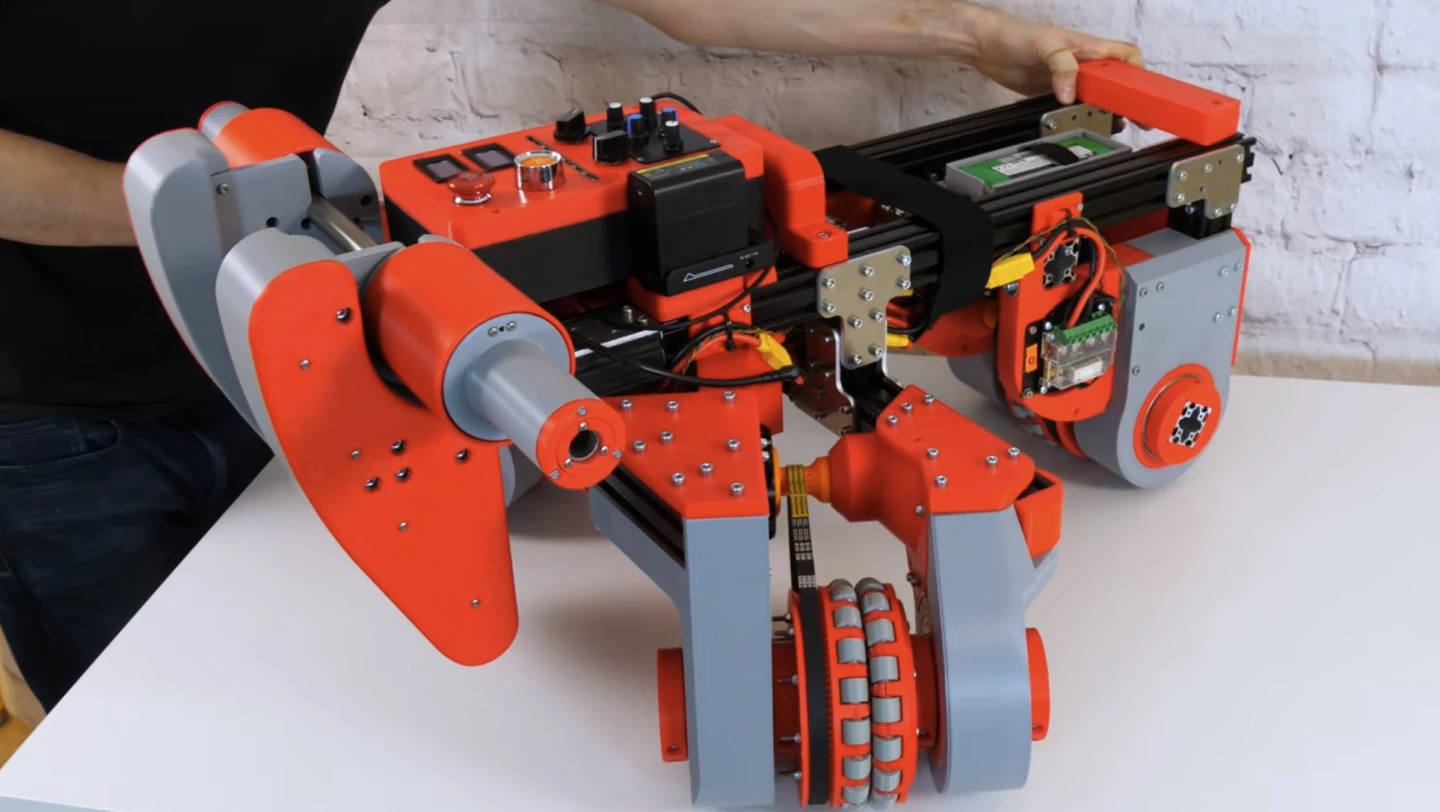
The new machine balances its entire frame – and a full-grown adult rider – on a single bright-red sphere. That ball is driven by three custom omni-wheels, each powered by a motor rated up to 2 kW, and arranged so that they sit at equal distances on the upper surface. By spinning these wheels at different speeds and directions, the control system can push the ball in any horizontal direction, which is how the bike moves and how it stays upright.
The omni-wheels themselves are an engineering project in their own right. Rather than lying flat (the typical configuration in balancing robots), Bruton mounted them vertically. This lets the passive rollers – the small barrel-shaped wheels that let an omni-wheel slide sideways – spin freely without jamming against each other at higher speeds. Each of the three large wheels carries two rows of 18 passive rollers, totaling 216 rollers across the whole drive system. Every roller runs on its own bearing, with custom aluminum hubs and TPU (thermoplastic polyurethane, a flexible 3D-printing material) tires.
James Bruton/YouTube
The speed relationship between the three motors follows basic trigonometry. When the bike travels in a straight line, the two wheels angled at 60° to the direction of travel spin at half the speed of the forward-facing wheel. Change direction, and those ratios shift accordingly.
Power comes from six LiPo (lithium polymer) battery packs wired in series pairs to deliver 50 volts, and the frame is built from 40 x 40-mm (1.6 x 1.6-in) aluminum extrusion profile, with most structural parts 3D-printed. A PID controller – a closed-loop algorithm that continuously corrects for error – reads tilt data from an IMU (inertial measurement unit, essentially a chip that knows which way is down) and adjusts all three motors simultaneously to keep the ‘bike’ upright in both the front-back and side-to-side planes at once.
Halving the ball count doesn’t halve the problems – it doubles them. The two-ball version steered by spinning each ball in opposite directions. With only one ball, that trick is gone. Bruton figured this out fast during early testing and was characteristically blunt about it: “No, it’s simply uncontrollable.”
James Bruton/YouTube
His interim fix is a large foam fin – hot-glued to the frame – that acts like a control surface to catch air and bias the direction of travel. Think of the angular front fins on a Star Wars speeder bike: same principle, minus the CGI budget. It also, somehow, works.
The other unsolved problem is static electricity. The plastic ball and rubber rollers build up charge that scrambles the electronics and causes unexpected shutdowns. Bruton’s hair visibly stood on end during testing – a fun visual, but less fun when the bike cuts out mid-run.
All code and CAD files are published open-source, giving other engineers a solid foundation to build on. Bruton’s next video will tackle the steering problem directly, and that’s the real test of whether this wonderfully absurd machine has a future beyond his workshop floor.
Source: James Bruton

