


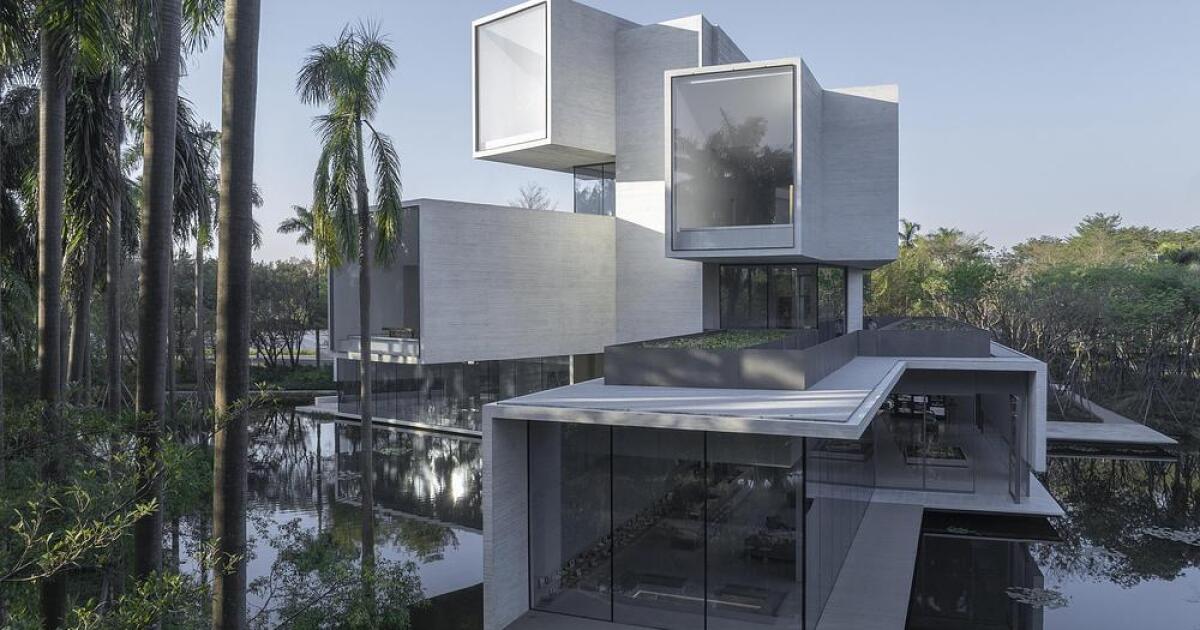
Inspired by a vision to support nature, architectural firm Studio Link-Arc has completed the Yunlu Wetland Museum in Yunlu Wetland Park in Shunde, within southern China’s Pearl River Delta. Positioned beside a protected habitat of wading birds, the museum combines a bird-watching tower with exhibition spaces, allowing visitors to observe the landscape while remaining secondary to the surrounding wildlife.
The museum is located adjacent to an ecological island inhabited by approximately 25,000 egrets. The presence of the birds is a relatively recent development, beginning after a local resident planted bamboo on the site, unintentionally creating the foundation for an urban refuge.
“The project originated from a bamboo forest planted by ‘Uncle Bird’ Xian Quanhui 26 years ago,” says Studio Link-Arc. “With the arrival of egrets, his long-term efforts gradually transformed the area into an ‘egret paradise.’ Today, the Shunde government has expanded the protected area thirteenfold, working with scientists, engineers, and designers to restore water systems, renew bamboo forests, and develop the site into Yunlu Wetland Park.”
Studio Link-Arc.
Set within this oasis, the Yunlu Wetland Museum is understated. From across the wetland, it blends into the greenery, integrating with the landscape rather than asserting itself as a landmark.
The architects avoided a singular monumental form, instead choosing to stack a series of offset volumes that rise vertically. Each floor is carefully aligned with specific environmental layers, from roots and trunks, to canopies and open sky. Visitors are invited to move through the building as if ascending the forest, with each level offering a calibrated view without the need to step outside.
Inside, the museum boasts a layout that departs from standard museum conventions. There is no central hall or dominant focal point. Instead, sightlines intersect across levels, and each window acts as a picture frame, capturing the continuously changing view of the surrounding environment.
A central void runs through the stacked volumes, allowing multiple perspectives to be observed simultaneously. This design reinforces the concept that no single viewpoint is ever complete, and allows visitors to move through the museum as active observers.

Studio Link-Arc.
Concrete is the primary building material, with surfaces textured using timber imprints. The interior finishes are restrained and tactile, emphasizing natural tones, while also blending in with the natural setting. Light enters from above, and is diffused to convey time and seasonal changes.
Constructing a concrete structure in a wetland raises challenges despite careful planning. Hundreds of trees were surveyed to limit removal, the footprint was kept compact, and a shallow-water landscape on the roof reduces visual impact from above. These measures mitigate but do not eliminate the tension between preservation and construction.
At the same time, it suggests that the role of architecture within nature should take a step back rather than a step forward. By lowering its voice, it asks visitors to listen more closely to the wildlife.
Source: Studio Link-Arc

