


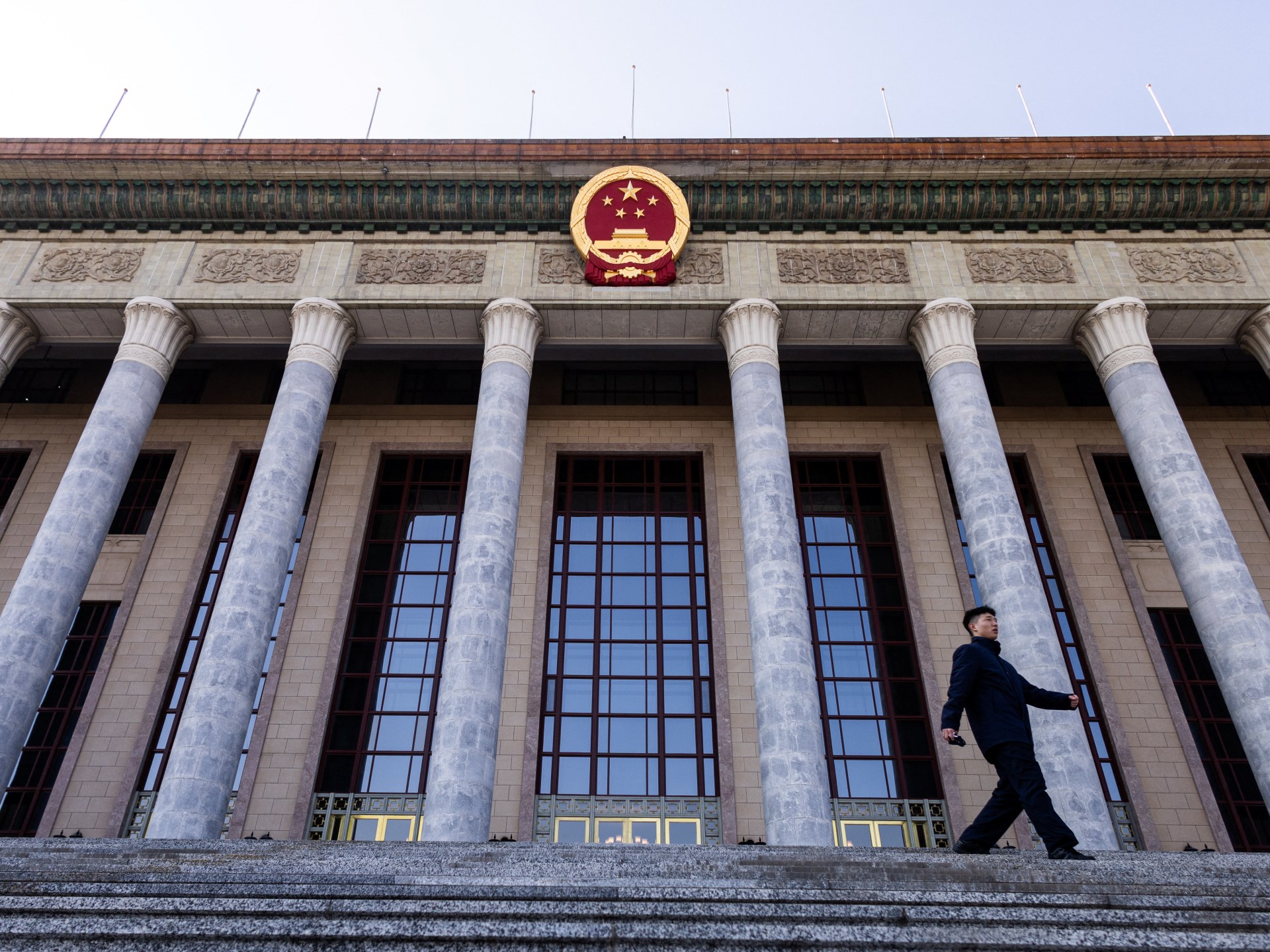
China is set to unveil a sweeping economic agenda for the next five years during a meeting of the National People’s Congress (NPC) over the next week at the Great Hall of the People in Beijing.
China’s 15th Five-Year Plan for 2026 to 2030 will be released during the NPC, one of China’s most important political meetings of the year, which starts on Thursday in Beijing and typically runs for a week, drawing 3,000 delegates from across China.
Recommended Stories
list of 4 itemsend of list
The last five-year plan was released in March 2021, as Beijing tackled the fallout from the COVID-19 pandemic.
This time around, analysts say, China’s leaders will need to explain their approach to new challenges, from the economic fallout of United States President Donald Trump’s trade war to the stalling of consumer confidence at home.
The NPC runs in parallel to the Chinese People’s Political Consultative Conference (CPPCC), which began on Wednesday, and together, they are known as the “Two Sessions”.
The CPPCC does not have the power to pass legislation, but it can make policy suggestions, and its committees play an important role in providing feedback to the Chinese leadership.
But the NPC is known as China’s “supreme organ of state power”, the highest government body and though functionally separate from the Chinese Communist Party (CCP), in practice, the congress is guided by the CCP’s policy recommendations.
According to Changhao Wei, founder of NPC Observer, an independent website monitoring the congress, this week’s gathering is due to codify its relationship with the CCP in the drafting of five-year plans under a forthcoming “Law on National Development Plan”.
Chinese Premier Li Qiang will also share the latest Government Work Report this week, outlining the state of China’s economy over the past 12 months and upcoming growth targets.
China is expected to announce a gross domestic product (GDP) growth target of 4.5 to 5 percent for 2026, according to the International Monetary Fund, plus desired adjustments of interest rates in light of inflation, unemployment and the fiscal deficit.
Absolute loyalty
This year’s delegate list for both events is notable for the absence of at least 19 delegates whose credentials were revoked last week, signalling they are under disciplinary action. The list of those disciplined, published last week by state media, included nine high-ranking members of the military.
They are among the more than 100 military officers who have been dismissed by Chinese President Xi Jinping in recent years on various charges, including corruption.
The dismissals have been interpreted as a strategic move by Xi, who removed presidential term limits in 2018, to consolidate his leadership and remove factions within China’s sprawling governance structures.
“Xi is trying to ensure the Chinese Communist Party’s governance system is run by absolute loyalty to him and that no one else has enough power base independent of him to potentially challenge his authority,” said William Yang, the International Crisis Group’s senior analyst for Northeast Asia.
While China no longer relies on Soviet-style state planning, its tradition of five-year plans sets out a midterm roadmap for economic reform, government spending, fiscal policy, industrial and energy targets and more.
Yang told Al Jazeera that he expects “industrial self-reliance” to be at the top of the agenda as China continues to compete with the US for technological dominance.
“The Chinese government is expected to outline a series of technology and science initiatives aiming at developing key sectors, including next-generation AI, advanced semiconductor production, industrial upgrades, and further expanding its renewable energy sector,” he said.
The five-year plan will address how officials can fight the problem of “involution” or excessive and self-defeating competition, said Fred Gao, who writes the Inside China newsletter from Beijing.
The practice has seen Chinese companies enter “relentless price wars, undercutting each other to grab market share while ignoring product quality and service improvement”, Gao said.
“The end result is a vicious cycle of low price, low quality, and low margin that ultimately hollows out the competitiveness of entire industries,” he told Al Jazeera.
Another new concept to look out for at this week’s NPC will be mention of China’s “low altitude economy”, which refers to a plan to utilise drones and other low-altitude vehicles to expand China’s delivery and logistics networks.
Consumer-led growth
More challenging this week will be for Chinese officials to outline how they intend to steer China’s economy towards consumption-led growth.
China’s economy has long been powered by sectors such as manufacturing, construction, and real estate, meaning the transition will be a long process, while consumer confidence and spending were shaken by the COVID-19 pandemic and economic slowdown.
Lynn Song, chief economist for Greater China at ING Group, told Al Jazeera he expected to see policies targeted at domestic demand and promoting growth in China’s service sector.
Gao said he will be watching how China expands consumption-focused policies and measures that will narrow the income gap between urban and rural residents, from minimum wage adjustments to higher pension payments.
Besides economic targets, the NPC also addresses social and environmental policies.
One new law that will be closely watched is the “Law on Promoting Ethnic Unity and Progress”, which will codify China’s approach to its 56 ethnic groups.
More than 90 percent of the Chinese population is ethnic Han who use Standard Chinese as their main language, but the vast nation is home to scores of ethnicities, languages and dialects.
NPC observer Wei said the law will require “the abandonment of ethnic privilege and distinction, and the proactive forging of a common culture, consciousness, and identity”, which could likely see further ethnic, social, and political assimilation.

