


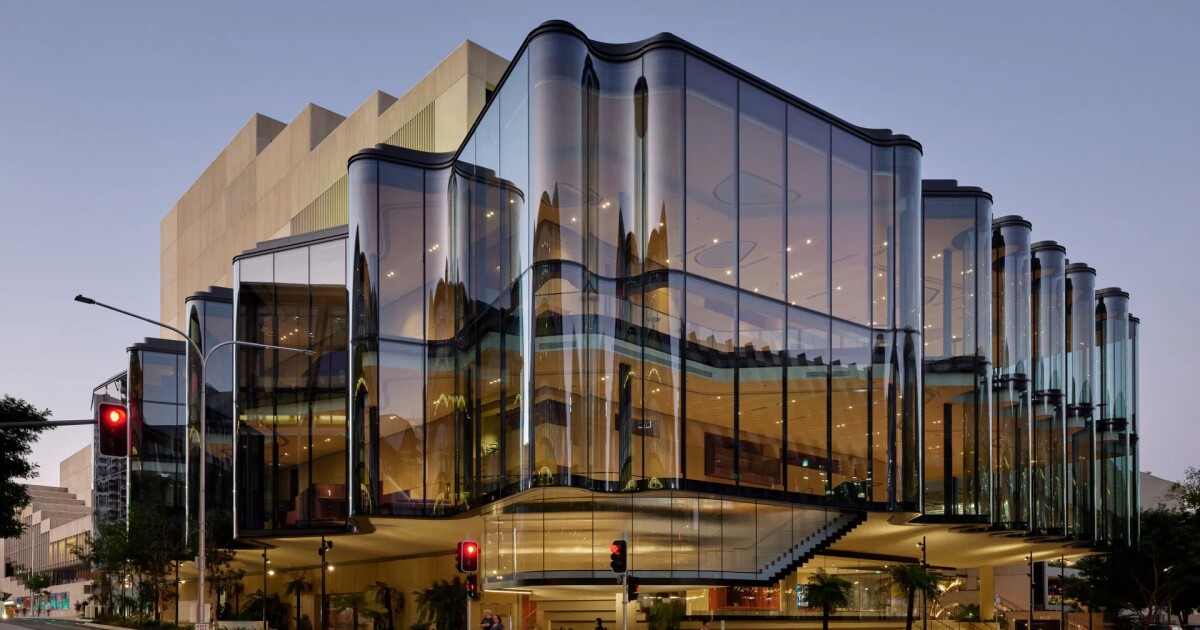
There’s a whole giant structure with remarkable details behind the glass, but we’re all really here for this building’s striking facade, first and foremost. This is the Glasshouse Theatre, the performance venue unveiled last week by the Queensland Performing Arts Center in the Australian state’s capital of Brisbane.
Built at a cost of AUD 184 million (about US$130 million), the 1,500-seater space is set to host ballet, dance, symphony, opera, theater, and musicals. Its size makes it the largest performing arts center under one roof in the entire country.
Christopher Frederick Jones / Snøhetta
Designed by Brisbane’s Blight Rayner Architecture and Norwegian firm Snøhetta, the venue most prominently features a liquid-like glass facade undulating across the cantilevered first floor.
The facade is made up of two tiers of 23-ft (7-m)-tall panels, making for a total of 217 glass panes spanning more than 25,800 sq ft. The largest panel weighs roughly 2.4 tons. Impressively, the glass doesn’t require the support of an external structural component; the curved form supports itself.

David Kelly / Snøhetta
The panels were manufactured by Austrian company Seele, which specializes in facades, and counts Apple’s 5th Avenue store in New York and the interior LED screen wall at the Sphere among its previous projects. The firm says each of these enormous panels was installed using a specialized suction cup device.
The insulated glass is fabricated in four layers with an intervening air gap for insulation. In addition, the facets that receive direct sunlight are embedded with a black ceramic inlay that blocks solar penetration to reduce glare. Together, these features help make the building more energy efficient.

David Kelly / Snøhetta
The glass waves reflect the shape of the iconic Brisbane River, and the idea behind it came from a a prose-poem written by Aboriginal Elder and artist Lilla Watson that referenced the city-spanning stream. This form gives the foyers behind the glass an airy feel, and allows in plenty of natural light.

Christopher Frederick Jones / Snøhetta
The auditorium is designed to feel intimate, with wrap-around balconies whose front edges stretch close to the stage. Dark gray ironbark walls, layered timber ribbons, and rainforest green carpeting and continental seats create an earthy character.

Christopher Frederick Jones / Snøhetta
There are lots more details to discover when you visit, including seven skylights embedded in the roof representing the seven watersheds of the state of Queensland, an energy-efficient air conditioning system in the hall that cools from below the seats rather than from the high ceiling to reduce energy use, and specially shaped walls in the theater that prevent frequencies bouncing around and muddying up the sound during acoustic performances.
Find out more about the Glasshouse Theatre!
Overall, it’s a stunning addition to the state’s cultural infrastructure, and Queensland hopes this will help attract an additional 300,000 visitors a year.

Christopher Frederick Jones / Snøhetta
The Glasshouse Theatre is set to open toward the end of March, with big-name shows like Queensland Ballet’s Messa da Requiem and The Last Ship featuring Sting set to kick things off.
Sources: Blight Rayner Architecture, Norwegian firm Snøhetta

