


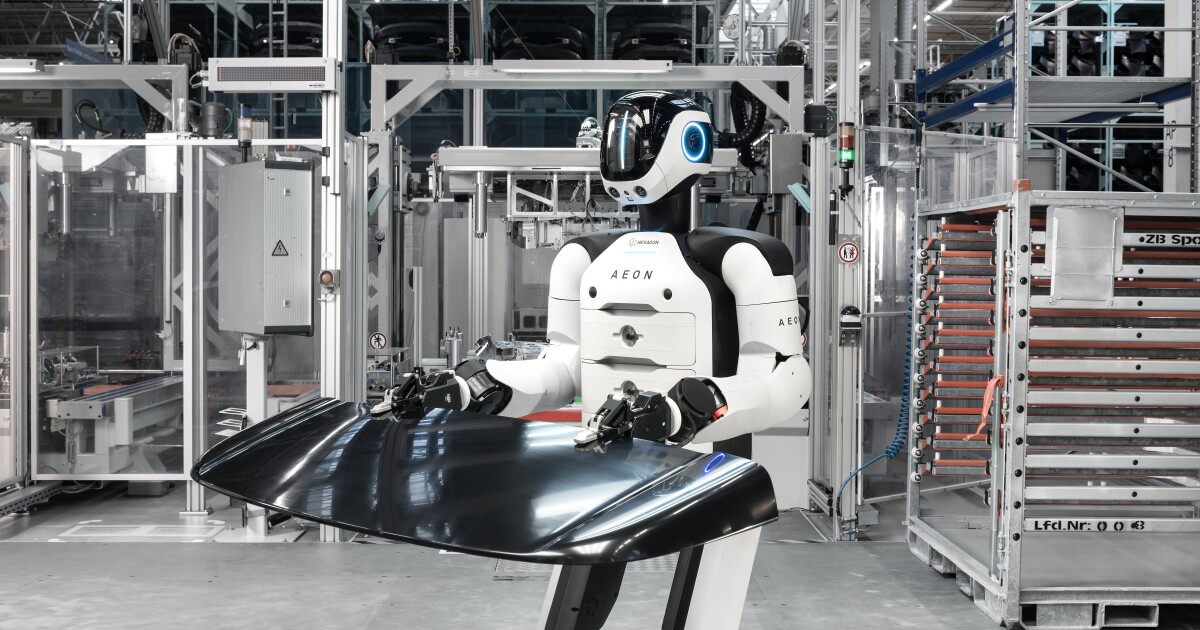
BMW is expanding its investigation of humanoid robotic workers at its factories. The automaker has just announced that it will trial a set of physical AI bots made by Hexagon for the first time at one of its European plants.
After about a year of training, BMW unleashed a fleet of robots made by Figure AI in its plant at Spartanburg, South Carolina, last year as part of a pilot program to see how the automatons would do in real-world manufacturing conditions. According to the company, that experiment went really well. The Figure 02 robots contributed to the production of over 30,000 BMW X3s by handling the precise positioning of sheet metal that needed to be welded. The bots executed this repetitive and physically demanding job for 10 hours a day, five days a week. At the end of the pilot program, which encompassed 1,250 operating hours, the humanoid work crew had moved a total of 90,000 components and taken 1.2 million steps.
Now, BMW is bringing humanoids from a different manufacturer to its Leipzig, Germany plant. The AEON bots are made by Zurich-based Hexagon, and were unveiled in June of last year. The machines are considered “physical AI” because they are equipped with AI-based motion control and sensors that can evaluate their environment and make independent decisions based on what’s around. They can also learn as they conduct various tasks and update their programming based on what they encounter. You can get a good look at them in the following slickly produced video released by the automaker.
Can a humanoid robot be integrated under real industrial conditions? Our BMW iFACTORY approach 🦾
AEON bots move via wheels at the bottom of their legs and can reach speeds of up to 2.4m/s (about 8 ft/s), weigh 60 kg(132 lb) each, have a human-like height of 165 cm (5.4 ft) , and can carry payloads of up to 15 kg (33 lb) over the short term, and 8 kg (17.6 lb) for extended periods of time. The humanoids are also equipped with auto-swap functionality so that when their batteries drain after about four hours of use, they autonomously get new ones to keep on rolling.
BMW says the bots will initially be put through their paces in a variety of tasks at the Leipzig plant during a testing phase and will eventually settle in during a pilot program to assemble high-voltage batteries as well as to assist with the manufacturing of other components.
“Our aim is to be a technology leader and to integrate new technologies into production at an early stage,” says BMW senior vice president, Michael Nikolaides. “Pilot projects help us to test and further develop the use of Physical AI – that is, AI‑enabled robots capable of learning – under real-world industrial conditions. The successful first deployment of humanoid robots at our BMW Group plant in Spartanburg in the USA proves that a humanoid robot can function not only under controlled laboratory conditions but also in an existing automotive manufacturing environment.”
Source: BMW

