


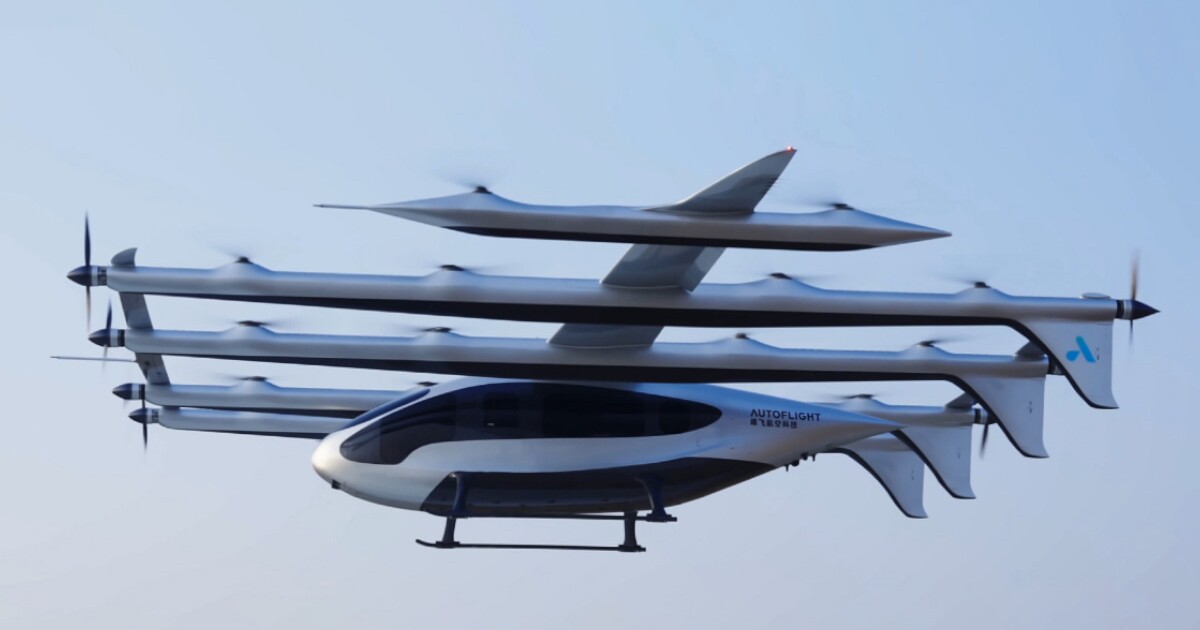
Multinational aviation company AutoFlight says its Matrix aircraft is the first 5-ton eVTOL on the planet – and it’s just completed a public full-transition flight demo at the Kunshan Civil UAV Flight Test & Operation Base in China.
That means it’s arguably among the largest electric VTOLs set to fly commercially in the near future. The Matrix is designed to seat 10 passengers – similar to the luxurious $29 million Gulfstream G300 – or hold up to 3,300 lb (1,500 kg) of cargo in its freight configuration.
You can see the imposing Matrix, with its six rails of rotors, fly alongside AutoFlight’s 2-ton CarryAll cargo eVTOL in the clip below. The Matrix has successfully pulled off its full mode transition flight sequence, transitioning from vertical take-off through cruise flight to vertical landing. That’s usually challenging for aircraft makers to nail with new vehicle designs; completing it marks a major milestone in the aircraft’s development process.
AutoFlight
It’s far larger than a lot of other eVTOLs we’ve covered recently. The Matrix features a 65-ft (20-m) wingspan, and measures 56 ft (17.1 m) in length, and nearly 11 ft (3.3 m) in height. Its maximum take-off weight is actually closer to 6 tons, at 12,566 lb (5,700 kg).

AutoFlight
For reference, the pilotless eHang VT35, which seats two, has a 26.7-ft (8.16-m) wingspan, measures 27 ft (8.26 m) in length, and can manage a 440 lb (200 kg) payload.
AutoFlight says the passenger variant will allow for either 10 business-class seats or six VIP seats; it’ll also feature bathrooms, climate control, ambient lighting, and oversized windows. The cargo variant, meanwhile, will get a hybrid power system, and have room for two AKE standard containers.

AutoFlight
As with some of the company’s previous aircraft, the Matrix gets a compound wing Lift and Cruise configuration. We’ve seen this enable 2023’s longest eVTOL flight of 155.74 miles (250 km) on the AutoFlight Gen-4 Prosperity. On this model, AutoFlight says it allows for aerodynamic stability across all flight phases. Twenty lift motors provide redundancy to keep the eVTOL in the air in case of single or even dual engine failures.
The all-electric Matrix will manage a maximum range of 155 miles (250 km), while the hybrid-electric variant can keep going for up to a whopping 932 miles (1,500 km). AutoFlight says these features and its large seating and cargo capacity will make the aircraft suitable for everything from recreational travel, logistics operations, and large-scale emergency response missions.

AutoFlight
The Matrix could potentially take advantage of AutoFlight’s other recent innovation: a solar-powered floating airport where VTOLs can land and take off from along rivers or coastlines. The company showed off a demo version of its vertiport concept last November in Shanghai.
We don’t yet know what the Matrix will cost, when it’ll be available, and where it will arrive first; we’ll update our post when we hear back from AutoFlight. At any rate, the company seems poised to compete strongly against the likes of more well-known names in the space like Joby and Archer Aviation that have been championing compact air taxis, particularly when it comes to bigger aircraft for cargo and large-scale logistics.
Source: AutoFlight

