


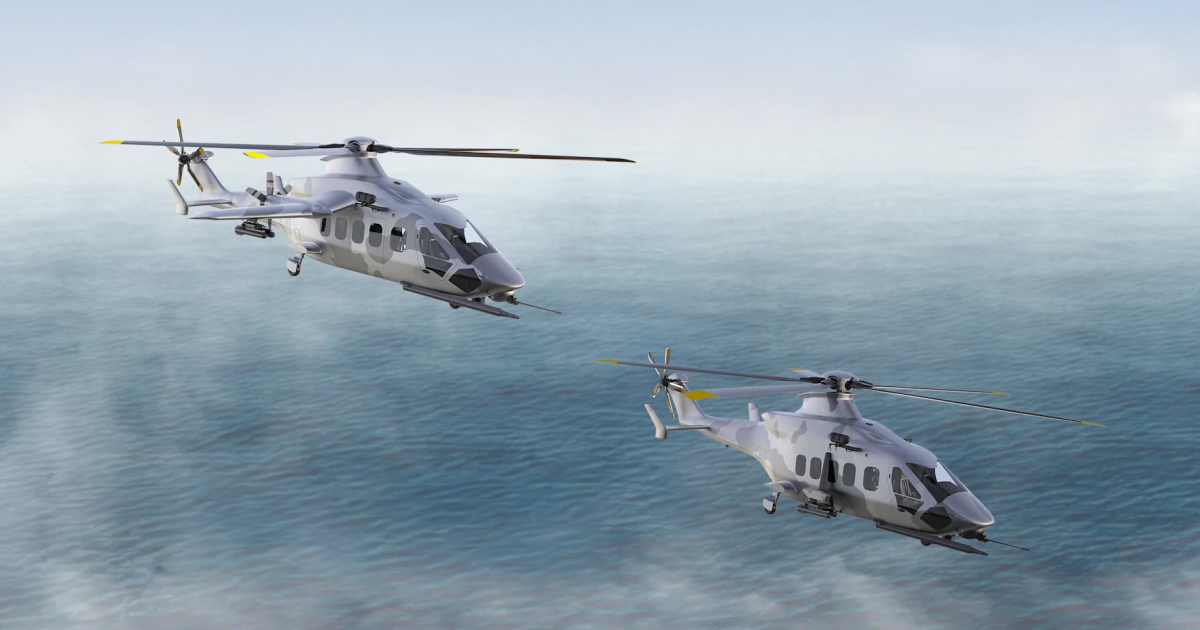
NATO is set to replace and modernize its current helicopter fleet, and Airbus Helicopters is giving us a look at its vision of the rotorcraft future with the release of two concepts being submitted for the alliance’s procurement competition.
With the rapidly changing geopolitical situation and the emergence of new technologies advancing by leaps and bounds, NATO has set itself the goal of rapidly rearming while adopting new policies to meet modern challenges. As part of this, the alliance plans to replace its fleet of 900 medium-lift rotorcraft between 2035 and 2040.
This falls under NATO’s Next Generation Rotorcraft Capability (NGRC) program, involving France, Germany, Greece, Italy, the Netherlands, Britain, and Canada, with the United States and Spain maintaining observer status. Of course, there’s more to it than simply getting a nod from over half a dozen nations to order a job lot of whirlybirds. It also means improving performance while reducing production timelines and operating costs.
Specifically, what the NGRC program wants is a new helicopter or similar rotorcraft with a range greater than 900 nm (1,035 miles, 1,667 km) without refueling, an optimal cruising speed of 220 knots (253 mph, 407 km/h), and the ability to carry 12 to 16 combat-equipped troops or a payload of four tonnes. All this must come at a flyaway cost target of €35 million (US$) or less per airframe, with operating costs between €5,000 and €10,000 (US$5,900 and US$11,800) per flight hour.
Oh, and it must be pilot optional with full autonomous or remotely piloted capabilities, because why not?
To meet these goals, Airbus is approaching the problem from two distinctly different yet complementary angles. While competitor Leonardo is putting forward a tiltrotor craft and Sikorsky is presenting a compound pusher design based on its X2 technology, Airbus has submitted two concepts of its own.
The first is a conventional evolutionary design that essentially refines traditional helicopters dating back to the 1940s. The goal is a new aircraft emphasizing reliability, a low acoustic signature, and reduced operating and maintenance costs. It is also intended to be quick to build in large numbers and easy to maintain in hostile environments where proper repair facilities may be scarce.
Though it has much in common with its NH90 predecessor to help keep costs down, the conventional concept uses an advanced five-blade rotor system with Blue Edge technology. Here, the blade tips are staggered so that a following rotor blade does not intersect the vortex generated by the one ahead of it, reducing noise and vibration.
In addition, the concept features a new anti-torque tail rotor designed to be safer around ground troops while improving aerodynamics. Another improvement is a twin-engine configuration with an Eco Mode that allows one engine to cycle into standby during cruise, reducing fuel consumption by up to 20%.
The second Airbus entry is the High-Speed Compound concept, derived from the company’s Rapid And Cost-Effective Rotorcraft (RACER) demonstrator. It is immediately distinguishable from the conventional concept by its box-wing design and, instead of a tail rotor, two lateral pusher propellers.
In this configuration, the box wing provides lift at high speeds while the pushers generate forward thrust. According to Airbus, the wing can provide 40% of the required lift in cruise. This reduces the load on the main rotor, preventing retreating blade stall and enabling higher speeds. The main rotor instead focuses primarily on vertical lift and control, slowing in horizontal flight to reduce drag.
Of course, there is a trade-off. The box-wing concept requires a more complex interconnected shaft system, allowing the engines to transfer power between the main rotor and the lateral propellers. This not only improves efficiency but also serves as a vital safety feature in the event of engine failure.
Both concepts share common features, including hardware-agnostic software for integrating new weapons and sensors, a triple-redundant fly-by-wire control system, and integrated electronic warfare suites featuring Directed Infrared Countermeasures (DIRCM) and automated chaff and flare dispensers coordinated by AI-driven threat detection. Both aircraft are also configured for Manned-Unmanned Teaming (MUM-T), allowing them to act as digital control centers for small and large drones.
Where the two concepts differ is largely in terms of performance. The conventional concept is designed for lower speed operations emphasizing reliability, hovering capability, and reduced complexity. The box-wing concept, meanwhile, is optimized for long-range, high-speed missions with greater technical complexity.
For example, the conventional concept has a top speed of about 160 knots (184 mph, 296 km/h), while the box-wing design can reach 220 to 235 knots (253 to 270 mph, 407 to 435 km/h). In other words, the conventional aircraft is aimed at utility and medevac roles, while the box-wing version is intended for combat and penetration missions.
“We want to ensure that Europe is in a position to propose a platform that will best fit our military partners’ needs in terms of affordability, operational efficiency and maximum availability for both the conventional helicopter and for the high speed rotorcraft,” said Bruno Even, CEO of Airbus Helicopters. “These two concepts are a basis to further exchange with our military partners on their vision and need for future military operations.”
Source: Airbus Helicopters

