


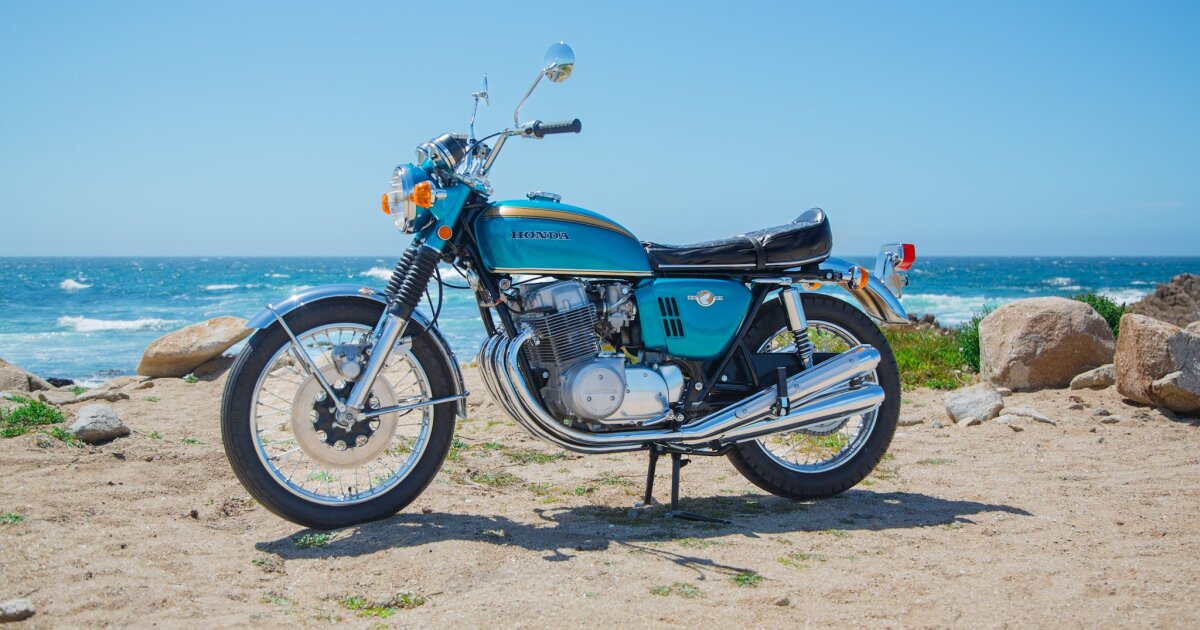
It took many decades for collectible Japanese motorcycles to get any respect on the auction block. It was 2009 before a Japanese motorcycle first topped the USD$100,000 mark at public auction, but collector generational change is inevitable, and Honda has now been the world’s largest motorcycle manufacturer since 1959 and today’s collectors are finally beginning to correctly frame the company in historical perspective.
Hence Mecum’s 2026 January Las Vegas Motorcycle Auction has created what looks to be a pivot point for the collectible motorcycle fraternity as there are TWO Honda motorcycles that might finally top the USD$1.0 million mark.
Mecum’s January Las Vegas Motorcycle Auction is now so important that it sets the agenda for global collectible motorcycle prices for the remainder of the year. The very best collectible motorcycles now routinely travel across oceans every year to present at Mecum’s annual Mecca-auction and last year saw someone pay $1.32 million for a Cyclone V-twin, the one and only time that a motorcycle has sold for more than USD $1.0 million at public auction.
And like the four-minute-mile that stood as a psychological barrier for eternity, once a mental barrier is breached, the flood gates often open – more than 2000 athletes have since beaten that mark.
The most obvious Japanese contender for the Cyclone’s $1.32 million auction record is this Honda CB750 prototype – Lot S155 to be auctioned Saturday, 31 January 2026.
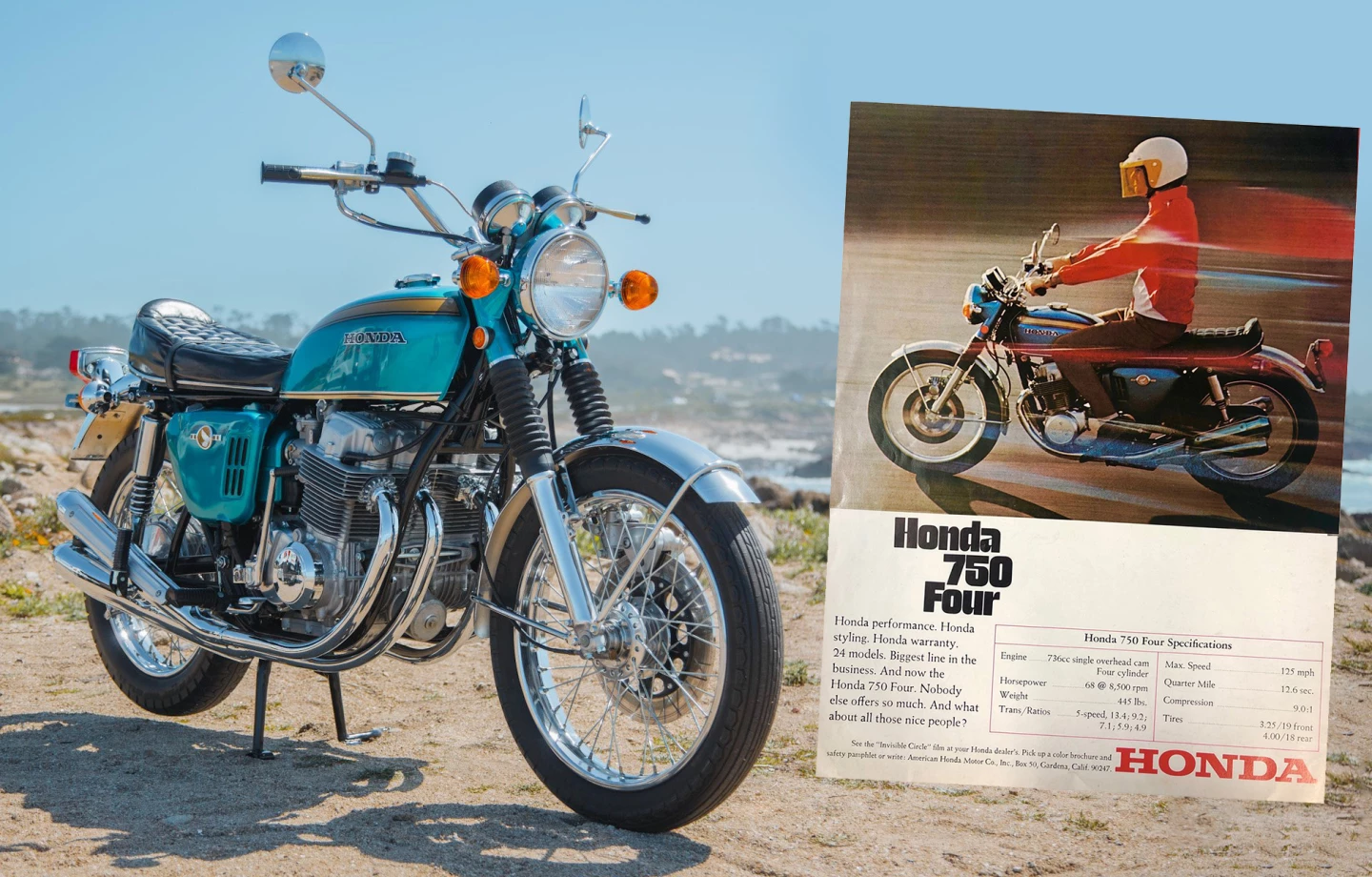
We’ve written about Honda CB750 prototypes previously, but we were wrong. We were of the understanding that the four bikes sent to America in January 1969 were prototypes whereas their status has now been identified as Pre-Production CB750s specifically built for display at Honda’s Las Vegas Dealer Show in late January (1969).
Those bikes were preceded by a solitary CB750 sent from Japan in October 1968 – this bike – and long-time Honda CB750 collector and authority Vic World is now selling what appears to be the sole remaining genuine Honda CB750 prototype in existence.

World Motorcycles specializes solely in the restoration of sandcast Honda CB750s, and all Vic’s knowledge and decades of research have gone into the creation of a web site that explains the significance of this bike: cb750prototype.com.
Given Honda’s consistent annual status as the world’s dominant motorcycle manufacturer for the last two-thirds of a century, and the Honda CB750’s now broadly acknowledged status as the most significant motorcycle in history, there’s every justification for this prototype being the most valuable motorcycle on Planet Earth at some point, and hence we think the serious collectors of the next generation will contend the prize.
Honda too, might be keen to reclaim this keystone of its heritage, and if it enters the fray, and there’s another deep-pocket contestant to bid against, who knows what might happen???
By almost any reckoning, the world motorcycle industry falls into two periods – before and after the release of the Honda CB750. The motorcycle world changed at that point. Not knowing there was an alternative, we motorcyclists had put up with finicky, unreliable motorcycles until that point. The CB750 was the first “superbike”, and it heralded a glorious phase of motorcycling history.
If you ever get the chance to ride an early Honda CB750, you will be amazed at how docile it feels compared to the new beasties that come off the showroom floor of today. That such a quantum leap in performance was offered by such a thoroughly civilised motorcycle speaks volumes for what came before it.
There’s also some irony in the pricing of collectible Honda CB750s to this point in time.
In retrospect, you’d think that Honda would have known it had a winning formula with the new four-cylinder CB750 well before it hit showroom floors, but the fact remains that the first 7,414 Honda CB750s sold were produced by a different engine-casting method because Honda wasn’t prepared to pay for the expensive moulds to produce them in bulk … and much cheaper. They weren’t “sand cast” but that’s what they became known as, and those bikes fetch a considerable premium today.
The four Pre-Production CB750s flown into Las Vegas in January 1969 have an auction history. Each was painted in one of the showroom-to-be colors, being “candy” versions of Blue-Green, Gold, Red and Green. After the dealer convention, the bikes were considered superseded and were dispersed. The Blue-Green eventually resurfaced in 2010 and was sold at auction in 2014 for $148,000. The Gold bike found its way to England and sold at auction in 2018 for $217,000.
The red bike was sent to Honda’s Wisconsin Training Center where its frame, motor, and some parts were crushed. The Green bike was last heard of in 1969 in France, and its whereabouts are unknown. It’s astonishing that a bike that would now be worth in excess of a quarter million dollars could be lost to time because it was perceived as worthless and outdated just 50 years ago.
Honda might have been late to the motorcycle party in historical terms, and its profound impact on every aspect of motorcycling has never been truly recognised on the auction block, but we expect that to change some time on 31 January and as Mecum’s auctions are streamed live, might we suggest that if you tune in to Mecum’s Youtube channel, you’ll witness an important moment in motorcycle history …
… perhaps more …
… because also on the same auction docket is another motorcycle which presents as one of history’s greatest two-wheeled treasures.
It is an atom-perfect replica of Honda’s fabled six-cylinder RC174 racer.

The word “replica” in an auction description normally induces caution and an immediate suspicion of lack-of-authenticity, and it invariably describes a poor long term investment if it didn’t emanate from “the source.”
This bike might best be described as an “authorised continuation model” because ten replicas of Honda’s most famous racing motorcycle were produced by prominent motorcycle personality and all-purpose rainmaker George Beale, with Honda’s permission and assistance, and they were sold for what was rumoured to be between GBP £250,000 and £400,000 after they were first available in 2006.
Now currency exchange rates during 2006 varied from USD $1.84 for each GBP £1.0 in May through to $1.94 in late November, and Honda itself purchased one for £400,000, which validates the authenticity and craftsmanship beyond reasonable doubt. The ten RC174 replicas built were so quickly purchased, that with the benefit of hindsight, many more could have been sold at that price.
Hence the numbers suggest that at least some of the RC174 replica recipients paid the equivalent of USD$750,000 in 2006 and with two full decades of historical perspective having settled in, and just 12 RC174 motorcycles on the planet, there’s plenty of substance to support a valuation of $750,000+ for the RC174 replica that will sell as lot 232 a few hours after the CB750 prototype.
Mecum is quoting $500,000 to $750,000 for the RC174 based on interest expressed so far, but when the auctioneer’s gavel falls on 31 January, this bike just might become the second million dollar motorcycle sold that day, and we suspect these two bikes will be the most valuable Hondas ever sold come 1 February 2026.

Now before you dismiss the RC174 as just a replica, George Beale has subsequently turned the whole journey into a coffee table book and the result is one of the greatest engineering journeys in motorcycle grand prix history – the book offers insights into Honda’s ingenuity and methodology, and the monumental hurdles this created in replicating a unicorn many decades later. Even if you don’t have a spare million to play this game, you will enrol in that journey if you read the book. Not many motorcycles have their very own coffee table book, but this one has, and that makes it even more special.
So there’s 236 four-colour pages detailing the exacting nature of every aspect of the creation of this bike (and its nine siblings) plus the provenance of Hailwood’s unbeaten Grand Prix adventures on the original, not to mention its pivotal place in Honda folklore.
The story is complex. Honda famously forged its world-leading motorcycle brand on the Grand Prix circuits of the 1960s, building ever-more-complex motorcycles each year as it fought to keep its four-stroke motorcycles ahead of the fast-evolving two-stroke racing motorcycles of Suzuki, Yamaha, MZ, Jawa, Bultaco et al.

By 1967, Honda had developed a twin-cylinder 50cc racer (RC115 and RC116), a five-cylinder 125cc racer (RC148 and RC149), a six-cylinder 250cc racer (the RC166), and in 1967, it fielded a 297cc RC174 six-cylinder motorcycle which dominated the 350cc class with seven wins from eight starts – the sole loss was when lead rider Mike Hailwood had already won the title and elected not to ride the 350cc class so he could concentrate on the 500 class where he was staging a monumental battle with Giacomo Agostini on the factory MV Agusta.
Mike the Bike was unbeaten on the RC174 at Grand Prix level and a perusal of the records and Hailwood’s dominance on the Honda RC174 begs disbelief. In the 1967 German 350cc Grand Prix at Sachsenring, he lapped the entire field. In the 1967 Junior TT at the fabled Isle of Man circuit, Hailwood lapped the 297cc RC174 at an average speed of 107.73 mph, setting a new outright lap record from a standing start.
When Honda pulled out of Grand Prix racing at the end of 1967, Agostini, who had won just one 350cc GP on the MV Agusta in 1967, was unbeaten in the 350cc class for several years.
Hailwood rated the RC174 as the best bike he ever rode.
He famously declared he “could have won on it with one arm tied behind my back,” emphasising its overwhelming superiority over the competition. Those racer-writers who have sampled a Beale replica have been similarly overwhelming in their praise for its precise handling, technological brilliance, dominant performance and unforgettable sound. Guy Martin was beyond complimentary. Another to have sampled George Beale’s RC174 on the racetrack is racing legend Mick Grant who spoke of it in terms of reverence.
Honda’s six cylinder racers in detail
So if you fancy an opportunity to own and actually experience what Mike Hailwood considers to be the best bike he ever rode, and hear that six-cylinder engine’s battle cry at 17,000 rpm from the saddle, here is your opportunity.
Will historical perspective eventually prevail?
In closing, I’ve always wondered what would happen to the memorabilia market as generational collector change occurred, and a new generation brings a different set of memories, knowledge and perspective.
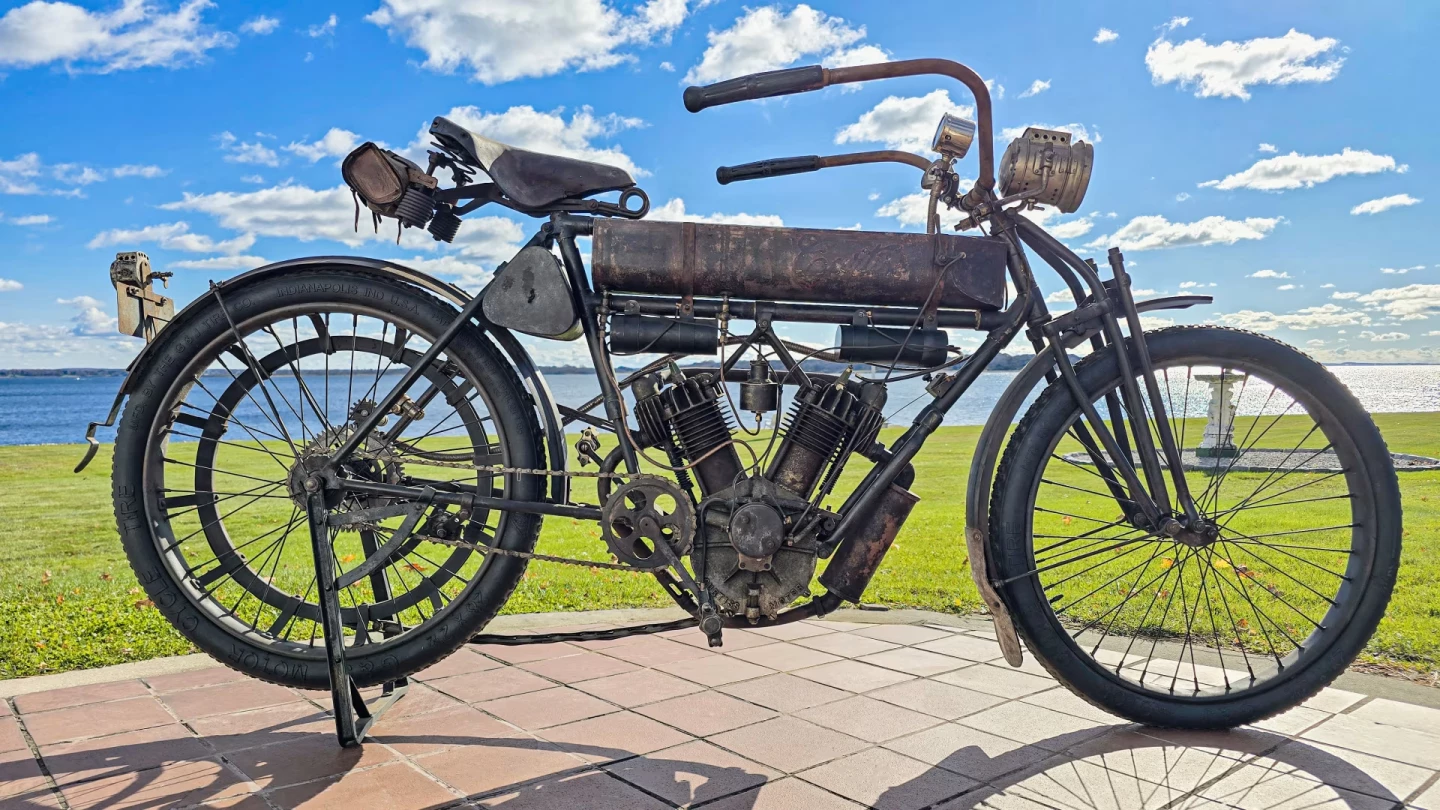
I’ve long opined that the most valuable motorcycle in America should be a Curtiss 1000cc v-twin. In 1903 Glenn Curtiss was timed at Yonkers (New York) riding his “Hercules” 1000cc v-twin at 64 mph (103 km/h), earning him a place in history as the first motorcycle speed record holder.
Curtiss manufactured motorcycles from 1902 to 1912, and his V-twin was introduced in 1903, three years ahead of Indian and six years ahead of Harley-Davidson. Curtiss designed, built and rode the FIRST American V-twin motorcycle.
Curtiss then responded to a personal request from Dr Alexander Graham Bell to build a lightweight engine capable of powering an aircraft so that the Aerial Experiment Association would have a suitable power unit to work with.
Curtiss then built America’s first V8 engine, a 4000cc 90 degree V8, installed it in a motorcycle and ran 136.27 mph (219.31 km/h) on 24 January 1907 during Daytona Speed Week.
An eccentric firing order is as American as apple pie, rock ‘n’ roll and blue jeans. Throughout the last century, America embraced both the v-twin for its motorcycles and the V8 for its automobiles and Curtiss built the first examples of both.
Curtiss’ final attempt at the motorcycle land speed record put him more than two decades ahead of the rest of the motorcycle industry, and made the Curtiss the only motorcycle to have ever held the outright world land speed record.

NewAtlas.com
In the annals of technological progress, the Curtiss name is indelible. His engines went on to power the American aviation industry, he is regarded as the father of naval aviation and he was a motorcycle designer and record breaker long before he built the world’s largest aviation company.
There are only five original Curtiss V-twins (one of which was sold as a Hercules) known to exist today, yet for some unfathomable reason, they just don’t fetch high prices at auction.
In 2006, Gooding & Company sold one for $132,000, then another was sold in 2009 for $200,000, and when a museum example went to auction in 2023, we expected a significantly higher price than the $214,500 that eventuated. Collectors’ lack of appreciation for Curtiss’ engineering landmarks is difficult to comprehend.
Fittingly, one of the surviving Curtiss v-twin motorcycles is going to auction on the same Mecum docket the day before these two bikes, representing an opportunity to purchase one of the world’s most important motorcycles for much less than common sense suggests it will eventually be worth based on it’s unquestionable historic gravitas. Perhaps not? If anyone can explain why the Curtiss v-twin is not as revered as it might be, please share your thoughts in the comments.
From the Dick Shappy Collection: The Historic 1909 Curtiss V Twin Roadster
For whatever reason the Curtiss has been ignored by motorcycle collectors, Honda is still the world’s largest motorcycle manufacturer, so it won’t be quite as easily overlooked or forgotten. The emergence of the original CB750 prototype and it’s appointment with the auctioneer on 31 January have changed my opinion.
I feel quite certain that this bike will become the most valuable two-wheeler on earth, if not on 31 January, then some time in the future when its massive historical significance become clearly visible with the 20-20 vision of hindsight.
Auctions are ideal for establishing a fair market price for extremely rare objects because they create a competitive bidding environment that reveals the maximum amount buyers are willing to pay.
On 31 January, we’ll find out what the collectors of the world think, and I don’t think I’ve ever looked forward to an auction quite this much. I suspect the live Mecum auction stream will draw a vast audience for similar reasons.
Put it in your diary.
Unlike the RC174 (ten replicas and two originals – $750,000 when new), the Cyclone 1000cc v-twin (approximately 14 extant – $1.32 million auction record), any Crocker v-twin (40+ known and an auction record of $880,000), Vincent-HRD Series-A Rapide (60-65 extant, $420,000 record), Vincent Black Lightning (40 extant and a $929,000 record) and Harley Davidson “strap tank” (around a dozen extant and a $935,000 record), there is only one known prototype of the most significant motorcycle in history.
The stage is set for an intriguing auction indeed!

