


The fruits of car designers’ efforts are often revealed at vehicle launches with all the ceremony of a fine-art unveiling. Trumpets sound. Spotlights glare. Curtains sweep back. The assembled motoring press discovers that a front grille has been bravely reworked or a headlight subtly reshaped. Very little that is genuinely new makes it to these grand reveals.
So there has been a quiet uproar behind the scenes in the automotive world after Peugeot designers dared to meddle with one of the cornerstones of car design. Their latest concept vehicle has been boldly described as “the future of driving,” and it features what the company calls a revolutionary advance: a square steering wheel.
Peugeot
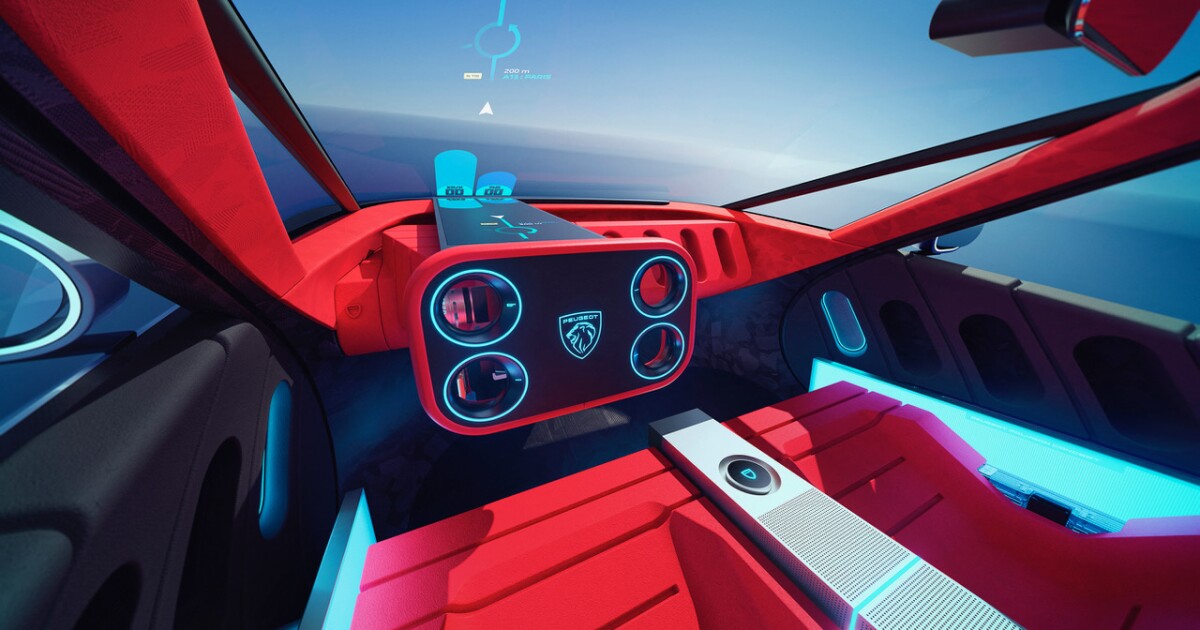
Among familiar futuristic staples such as gull-wing doors, customizable panels, and very fancy wheels, this single feature of the Peugeot Polygon has already divided experts.
The oblong, gaming-style controller has the slightly cringe-worthy, teenage-like name: “Hypersquare,” but its design is genuinely unusual. It is a thick rectangle rather than a wheel, with four thumb holes that allow multiple grip styles.
Its technical credentials are impressive. The Hypersquare uses a speed-sensitive electronic connection to the wheels and houses controls for most of the car’s onboard functions. The design credentials are less clear-cut. It seems a bit like steering with a thick coffee-table book or an oversized smartphone.
Top Gear Magazine road tester Paul Horrell tried the system and was told that those who adapt most easily to the Hypersquare tend to be younger drivers who are more familiar with gaming controls. “If you’ve steered by keypad or joystick, this’ll seem wholly normal,” Horrell says.
Peugeot CEO Alain Favey believes the system could make the brand relevant to tomorrow’s buyers. “We are playing a role in the future of cars,” he says. “In 20 years, everyone will be offering this.” But Favey also admits that the Hypersquare “only works if it really is popular.” If it’s not, the cost would be too high to justify inclusion in mainstream vehicles.

Peugeot
Drive-by-wire steering is not new. A handful of niche vehicles have experimented with it and the industry has long viewed it as a possible future direction.
Fully electronic steering systems replace the traditional mechanical link between steering wheel and wheels with sensors and actuators. The benefits include adjustable steering feel, easier parking, improved maneuverability, and compatibility with fully autonomous driving.
Peugeot’s system takes advantage of variable steering ratios that adjust with speed. The steering rack is driven by two digitally controlled 12-volt motors. Behind the Hypersquare, a smaller motor sends feedback from sensors near the rack that measure forces acting on the wheels. This information is fed back to the driver to simulate steering feel, signaling grip loss or changes in road surface while filtering out unwanted vibration and torque steer.
Between the steering rack and the cabin, the only physical connection is wiring. This simplifies dashboard and bulkhead design and makes noise reduction much easier. Switching production between left- and right-hand drive becomes straightforward. The system is not especially power-hungry, and most of the components and software already exist. Peugeot claims it is cheaper and more effective than four-wheel steering.

Peugeot
At low speeds, the extremely low gearing allows quick, easy parking maneuvers. Full lock requires less than a single turn of the controller, compared with roughly three full turns of a traditional steering wheel.
At higher speeds, only small inputs are needed to adjust the car’s trajectory. Peugeot promises a “unique feeling of hyper-agility,” although Horrell found the behavior could become unpredictable during transitions, such as braking from high to low speed while cornering.
Automotive historians will point out that squared steering wheels are not entirely new. Manufacturers have long flirted with breaking the circular tradition. A squared-off wheel can improve forward visibility and avoid banging against the driver’s knees.
Tesla’s Cybertruck uses one, and it also relies on drive-by-wire steering. Formula 1 cars feature squared wheels too, though these resemble gaming controllers even more closely, with hand grips, paddles, and built-in buttons. In the past, square or rectangular wheels have appeared in vehicles as varied as the 1960s Imperial Crown and the 1970s Austin Allegro.
In fact, if you go back far enough into automotive history, it was the steering wheel itself that was once new and controversial. Early cars were steered using a tiller. The wheel idea was introduced by bold engineer Alfred Vacheron in 1894, when he fitted one to his Panhard car for the Paris–Rouen race. He did not win, but the concept quickly caught on and became the standard. Ironically, the tiller-steered car that beat Vacheron and won the race was a Peugeot.
Source: Peugeot

