


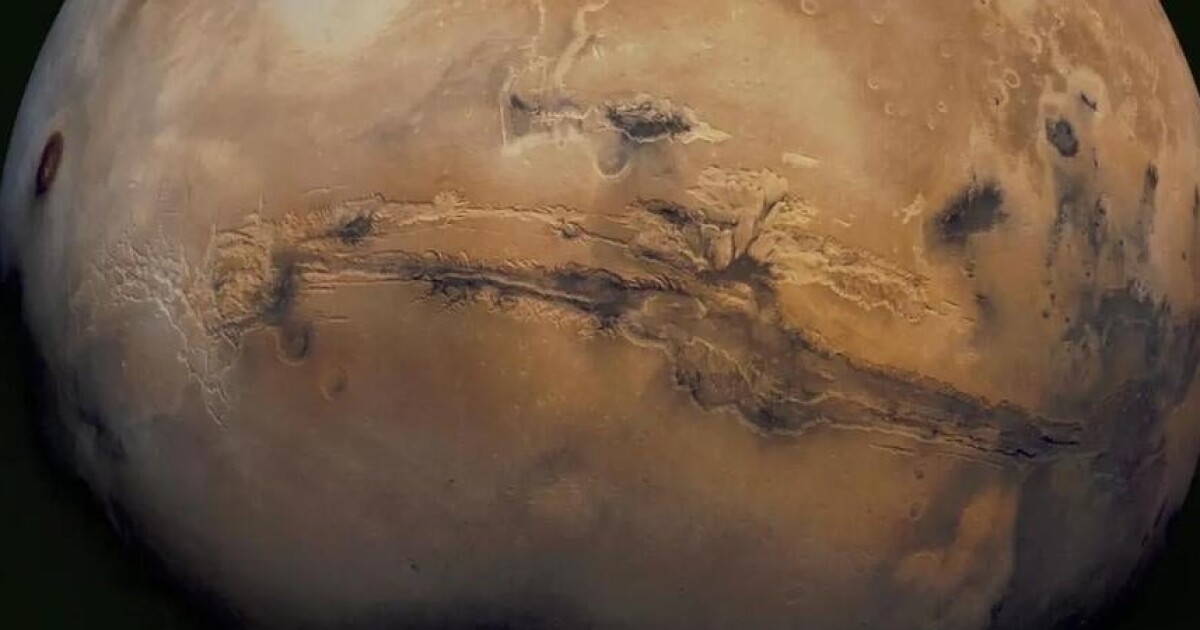
Why did the ice ages occur? If you need a scapegoat, a new study by Stephen Kane of UC Riverside suggests pointing the finger at Mars. According to computer models, the pull of the Red Planet may have altered the Earth’s orbit until things got nippy.
These days, the word “climate” is tossed around so much that many use it as if it’s synonymous with “weather.” In fact, there are many differences between them, not the least of which is a matter of sheer scale.
The weather is very short term. It’s on a scale of hours, days, weeks, and months. Climate operates on the scale of decades, centuries, millennia, and epochs. It also involves mindbogglingly complex, interacting cycles that can stretch over millions of years.
If you follow weather news closely (and who am I to judge?) you’re probably familiar with short-term weather cycles like El Niño and La Niña that are fluctuations of surface sea temperatures and air pressure over the tropical Pacific Ocean that run over two to seven years. There are also longer ones like the decadal and multi-decadal cycles that take 10 to 80 years.
But these are rookie numbers compared to the really long climate cycles that take millions of years to complete.
Two of these are the Metronome and Modifier cycles that take 405,000 years and are the result of the pull of Jupiter and Venus on the Earth’s orbit. These are called Milankovitch cycles that pull our planet’s orbit out of a circle and make it slightly elliptical. This causes the distance between the Earth and the Sun to alter significantly throughout the year, resulting in the solar radiation reaching us changing by as much as 23%.
NASA
These cycles are fairly well understood, but what Kane’s simulation has uncovered is that Mars has a significant effect on the Earth’s climate as well. Of course, what with Isaac Newton and all, he expected some effect, but not what he saw in the figures.
“I knew Mars had some effect on Earth, but I assumed it was tiny,” said Kane. “I’d thought its gravitational influence would be too small to easily observe within Earth’s geologic history. I kind of set out to check my own assumptions.”
One aggravating habit of the Earth is its geographically recent tendency to plunge into ice ages with major glaciations every 100,000 years. According to current thinking, Venus and Jupiter provide a long-term metronome to the Earth’s orbit. They don’t cause ice ages, but they do control the volume of things like glaciation and the factors that can trigger ice ages.
Kane’s simulations show that without Mars the frequent and intense transitions between deep ice ages and warm interglacial periods as we’ve seen over the past 2.6 million years wouldn’t happen. Instead, it controls a 2.4 million year Grand Cycle that can be seen in deep-sea sediments that show hiatuses where deep-sea currents become so vigorous that they erode the sea bed, preventing sediments from accumulating. This cycle set off mechanisms that make ice ages more icy and warm periods warmer and the switch between them more dramatic.
The implications of this go beyond Mars helping to keep the Earth’s climate from looking like a dreary day in the Orkneys. Some anthropologists contend that rapid climate shifts caused by these orbit cycles caused a shift in Africa from forests to grasslands. This, in turn, produced environmental pressures that pushed humans to start walking on their hind legs and develop a bigger brain.
It’s always something.
Source: UC Riverside

