


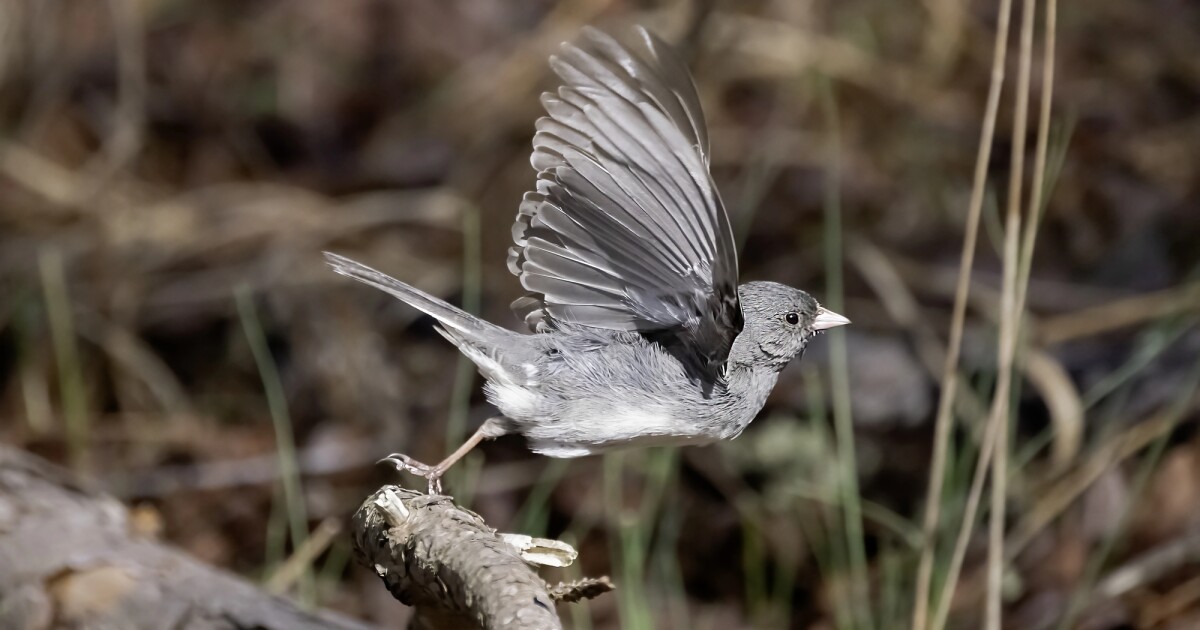
When COVID-19 lockdowns emptied city streets, urban environments changed almost overnight. New research suggests that Los Angeles city birds responded just as quickly, with measurable shifts in beak shape during this period. The changes coincided with altered food availability and reduced human activity, offering a rare opportunity to examine how human behavior can rapidly shape biological traits in urban wildlife.
Researchers at the University of California Los Angeles (UCLA) followed dark-eyed juncos (Junco hyemalis) living on a university campus from 2018 to 2025. They found that birds hatched during the lockdown period developed beaks that more closely resembled those of nearby wildland populations, rather than the shorter, thicker beaks typically seen in urban juncos. As human activity and food waste returned, those differences appeared to fade in later generations.
Urban juncos typically have shorter, thicker bills compared to their wildland counterparts, a shape thought to help them exploit human-associated food sources such as waste and handouts. During the lockdown period, however, juncos – which are small, gray sparrows – born in the city developed longer, more slender beaks that closely resembled birds living in nearby non-urban habitats.
Crucially, these shifts appeared in birds hatched during and shortly after the period of reduced human activity, then reversed in later generations once city life resumed.
“The most novel aspect of this study is the speed with which these changes are observed and, equally surprising, their reversibility when human activity is restored,” said Inmaculada Álvarez-Manzaneda Salcedo, a professor of ecology at the University of Granada, who reviewed the findings but was not involved in the study.
What makes these changes especially revealing is not just their speed, but the circumstances that produced them. COVID-19 restrictions created a rare, large-scale natural experiment, briefly stripping urban environments of the human pressures that usually define them.
In cities, where environmental pressures usually overlap and blur together, that kind of on-off switch is almost never available. In this case, it allowed researchers to isolate human presence, along with the food waste and disturbance that come with it, as a distinct ecological pressure acting on an urban population.
The researchers suggest that food availability likely played a central role. Lockdowns closed dining facilities and sharply reduced organic waste, potentially cutting off a dependable resource that urban juncos had long exploited. As a result, birds may have shifted toward more natural food sources and into green spaces that had previously been heavily trafficked by people.
“This change was likely driven by a significant decrease in their main food source, the organic waste available in the city,” said Graciela Gómez Nicola, a professor at the Complutense University of Madrid who reviewed the findings but was not involved in the study. “This forced birds to change their diet.
“The beak is an essential tool for eating, so a change in diet may have favoured a beak shape more suited to this new type of food,” the scientist added.
The researchers involved in the study are careful not to overstate what the findings mean. Changes in physical traits like these can arise through multiple pathways, including genetic evolution, developmental plasticity, or selection acting on existing variation within a population.
In this case, the rapid response is consistent with the possibility that selection favored certain bill shapes already present in the population, rather than depending on new mutations to arise.
The team also acknowledges the possibility that birds from surrounding wildland populations may have moved into the now-quieter city and bred with urban juncos. While the researchers consider this explanation unlikely given the consistency and timing of the observed changes, they emphasize that further genetic and behavioral tracking over multiple generations will be needed to fully rule it out.
Together, the findings underscore how tightly urban wildlife is coupled to human behavior. When people briefly vanished from city spaces, the ecological landscape shifted, and birds responded on timescales that are rarely so clearly documented.
Rather than offering definitive proof of evolution in action, the study highlights how quickly biological traits can track environmental change, and how urban ecosystems may set the stage for evolutionary processes to unfold over longer periods.
This study was published in the journal Proceedings of the National Academy of Sciences.

