


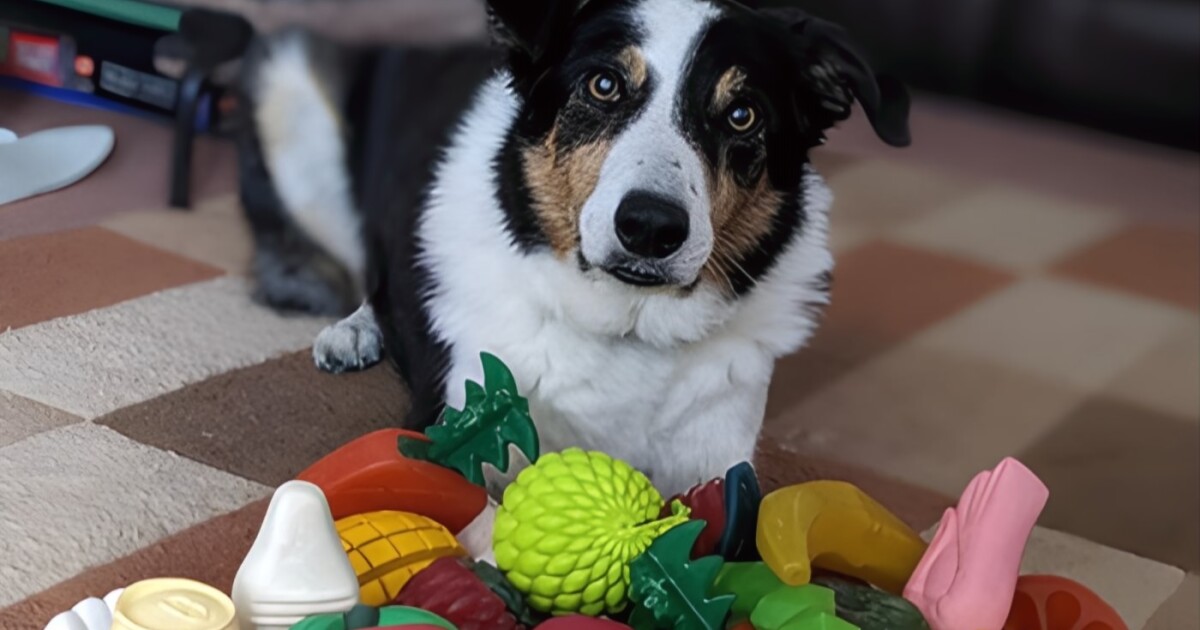
Spelling F-O-O-D or O-U-T might only get you so far around your dog if he or she is considered a Gifted Word Learner (GWL). Researchers have just figured out that even when you’re not talking to them directly, they’re still acquiring new terms.
The researchers at Eötvös Loránd University in Budapest seem to have one of the best jobs in the world. They get to more or less play with dogs every day to learn about their use of language. For example, late last year, a team of scientists there figured out that a certain category of dogs, known as GWLs, were able to not only identify toys by their names, but they were also able to group toys by their function – either pull or fetch. GWL dogs are considered those having the uncanny ability to memorize the names of dozens and dozens of different objects.
Now, in a new study, the pup-loving Hungarians have discovered another impressive power of GWL dogs: They can learn new words simply by listening in on human conversations, a skill exhibited by human babies around the age of one-and-a-half.
“Our findings show that the socio-cognitive processes enabling word learning from overheard speech are not uniquely human,” says study lead Shany Dror. “Under the right conditions, some dogs present behaviors strikingly similar to those of young children.”
To isolate this canine capability, the team devised a few different experiments using 10 GWL dogs. The first had two phases. Initially, owners introduced two new toys to their pups and continuously repeated the names of the items during a play session; they basically taught them what each toy was called. In the second phase, two different toys were used but this time, the owners simply talked to another person about them without addressing the dog directly at all.
In both cases, the researchers placed the toys in a separate room after the initial exposure and then asked the dogs to retrieve them by name, which you can see in the following video summing up the research.
Some dogs eavesdrop on their owners!
They found that in both cases, seven out of 10 dogs learned the names of the toys, a result that closely mimics the abilities of human babies. Follow-up tests showed that dogs were able to retain the knowledge of the toy names for at least two weeks even without seeing them again, which indicated true learning.
In a second study, eight of the dogs were given the toys to play with, but no names were assigned to them. Then, the toys were put into a bucket at which point they were named. So the dog couldn’t actually see the toy when its name was assigned. The researchers were trying to test a concept known as temporal discontinuity, in which a brief amount of time passes between the introduction of an item and the assignment of its name. Toddlers possess this ability, and it turns out that the majority of the gifted dogs do as well, with five out of eight of them successfully completing the task.
When repeating the tests with dogs that weren’t considered GWLs however, the team did not find any significant correlation between overhearing and learning, a finding of significance according to Dror.
“These dogs provide an exceptional model for exploring some of the cognitive abilities that enabled humans to develop language,” she concludes. “But we do not suggest that all dogs learn in this way – far from it.”
The research was conducted as part of the Genius Dog Challenge research project, which focuses on GWL dogs and their capacity to learn and process human language. If you think you have such a pooch, the researchers say you can contact them via their Facebook or Instagram profiles. You may also want to start lowering your voice around them if you’re talking about something you don’t want them to know.
Source: Eötvös Loránd University

