


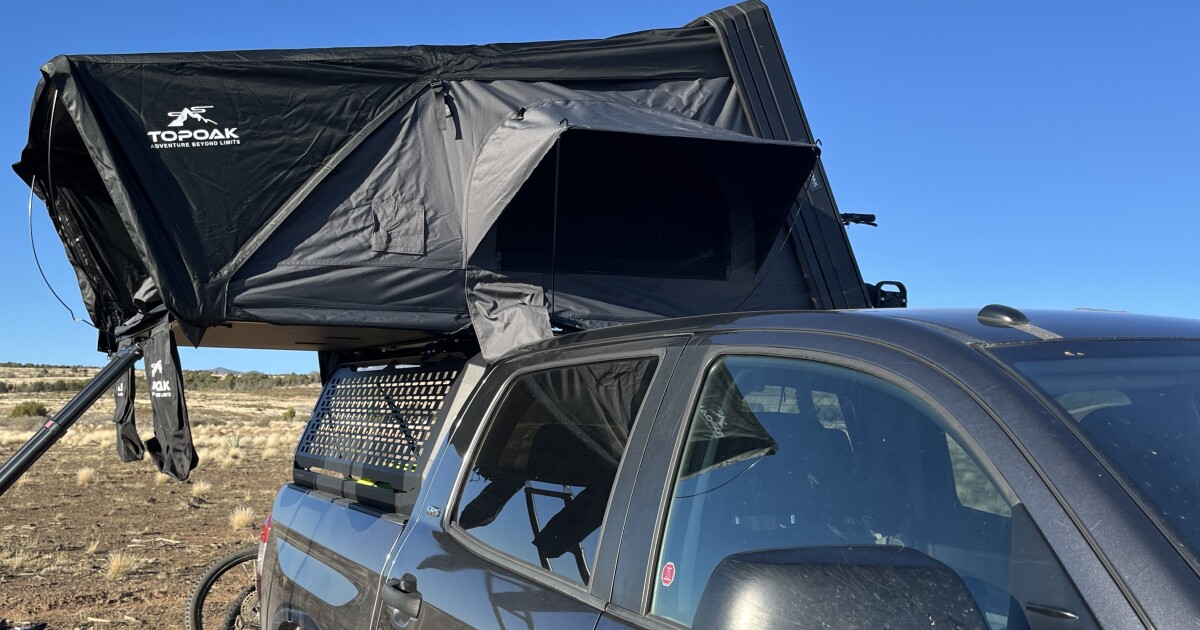
After years of admiring iKamper as the modern innovator behind the expandable three/four-person rooftop tent (RTT), we think we’ve found a new favorite family-size RTT. The Vision XL from Topoak offers a thoughtful design for less than half the MSRP of iKamper’s Skycamp 3.0 and other major competitors. While it might not be perfect, the tent packs an impressive blend of materials and features for that bargain price. And its biggest drawback is easily fixable.
At this point, expandable hardshell RTTs have become popular enough to need no introduction. But as a quick recap, this style tent combines the benefits of a hardshell case – quicker packing, tougher on/off-road protection and faster setup – with the expandable size that was once solely the domain of soft-shell RTT models. They achieve the extra space with a fold-out floor that packs inside the hard case or doubles as the hard case top.
Topoak contacted us around springtime to see if we’d be interested in testing one of its tents. Hesitant at first because we were unfamiliar with the brand, we took a closer look at its products and specs, checked out a few reviews, including a glowing YouTube video titled “Best Rooftop Tent for 2025,” and decided the brand was worth a closer look, particularly given its low price points.
Since I do most of my camping with my family, I requested the Vision XL, the company’s largest model.
The delivery
Topoak’s HQ and manufacturing and are based in China, but the company has California and New Jersey warehouses to cover distribution around the United States. It operates an email-based customer service and warranty claim system to resolve any issues and advertises a 24-hour response time on emails. It also has a website live chat feature and operates a Facebook Topoak owners group as further communications tools.
It’s a sort of hybrid business model that falls between Alibaba-style direct-from-factory RTT manufacturers that don’t offer support or even so much as handle import duties and US brands or brand offices that sell and distribute tents made in China or elsewhere via a storefront and/or in-country retail network. You’d expect to find the lowest prices from the former, the highest from the latter, with a hybrid model like Topoak falling in between.
Being in Utah, my tent shipped from California and arrived on a freight truck. What was immediately striking about the drop-off was that the tent was packed inside a wooden crate. This adds considerably to the shipping weight, which Topoak lists at a cool 335 lb (151 kg), or 137 lb (62 kg) more than the tent itself. With the tent and hardware packed tightly inside, protected by sheets of packing foam, it also offers seriously robust protection during shipping.
CC Weiss/New Atlas
Admittedly, my prior experience in rooftop tent delivery was limited, and the last time I had previously had one shipped to my doorstep was back in 2018. That tent, from one of the biggest brand names at the time, had arrived naked atop a shipping pallet – just the soft-sided tent with a form-fitting waterproof tent cover that had been ripped and beaten up pretty thoroughly.
That 2018 tent was a media demo unit that shipped from one tester to the next without intermediate inspection by the company’s PR team. And while they did quickly replace the cover with a brand-new one that could properly protect the tent from weather, it didn’t make for a good first impression at all.
Since then, I’ve read some nightmare reviews of torn-up cardboard boxes and dented and damaged RTTs shipped from other manufacturers to customers, so the Topoak delivery experience was much better than I had ever anticipated. And there are other accounts and photos out there of the same wood crate packaging, so it does not appear specially staged for the purpose of a media review.
The numbers
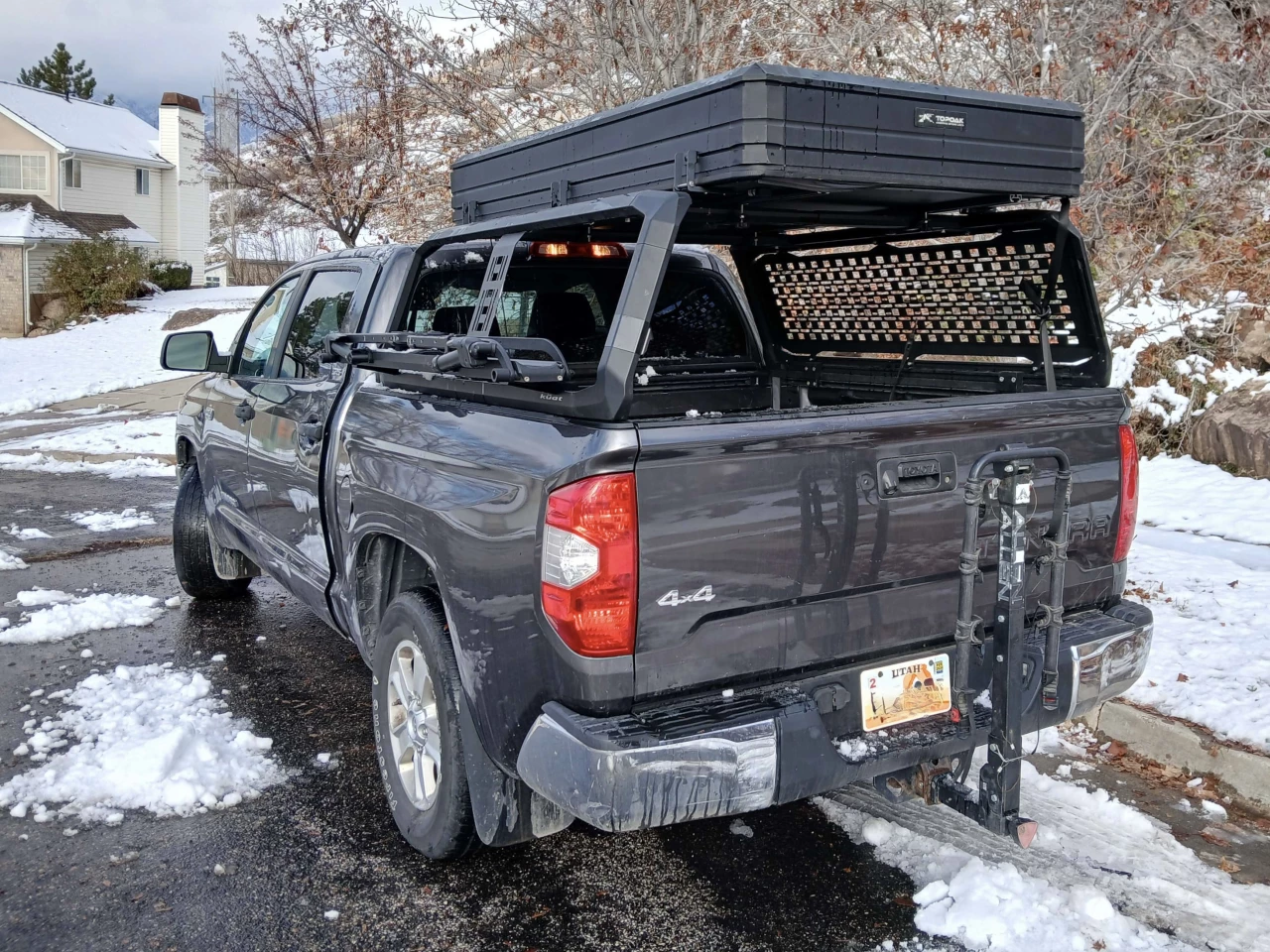
Topoak only makes hardshell RTTs, and the Vision XL is the largest of the bunch, rated for up to three adults and one child. It ultimately sizes in as a sort of hybrid between a full-on four-person tent and a three-person model – maybe call it a “three+.” It measures 75 x 83 x 47 in (191 x 211 x 119 cm) when open and packs into a case that we confirmed to be 75 in long x 46 in wide (191 x 117 cm). The tent packs up and rides lengthwise on the vehicle but sleeps widthwise thanks to the fold-out floor.
CC Weiss/New Atlas
As is typical with this style of tent, the fold-out floor panel is narrower than the fixed floor panel secured to the vehicle crossbars because of the way it’s hinged. The mattress tapers along with it, which manufacturers tend not to note in their dimensions. We verified the max mattress dimensions of 70 x 78 in (178 x 198 cm, W x L), sizing between a residential queen and king, but also noted the foot area tapers in to a width of 62.5 in (159 cm).
The 70-in mattress width is pretty tight for four people, breaking down to only 17.5 in (44.5 cm) per person, under the 20+ in (50.8+ cm) of tent sleeping width that’s the lowest we’ve seen recommended for even a child. So fitting four people is really best for a family of four with younger children. You can also optimize space by alternating lying head to feet. Otherwise, you might want to limit it to three people.
I was comfortable lying with my two pre-teen children in the bed while my wife slept on a mattress in the truck with our Swissy (she doesn’t like heights anymore than the dog likes ladders).

Topoak
Other four-person RTTs include a little more sleeping area. IKamper specs the Skycamp 3.0 with a sleeping area that includes a max width of 77 in and a length of 82.8 in (196 x 210 cm), and Overland Vehicle Systems’ (OVS) Bundu tent spreads even wider at 82 inches (208 cm) by 81 inches (206 cm) long.
One four-person-rated tent that is even narrower than the Vision XL is Roofnest’s Condor 2 XL Air, but that packs extra length for more overall sleeping area. Its sleeping area sizes only 68 in (173 cm) wide but has 89 in (226 in) of length. Perhaps it was that narrow, oblong space that led the brand to introduce the Condor 2 XXL Air series earlier this year, which it bills as the world’s largest hardshell RTT. It rates it a “4-person+” size and carves out a huge total sleeping area of 80 x 95 in (203 x 241 cm), gaining interior width competitive with other four-person RTTs to complement its extra length.
Three-person expandable hardshell tents, typically offered by brands that don’t sell a four-person, tend to come with a max sleeping width of 60-something inches. For example, the Ironman 4×4 Ursa 1300 is advertised for two adults and a child, offering a sleeping space of 60 x 78 in (152 x 198 cm). The 23Zero Armadillo Horizon 3 has a 68 x 83-in (173 x 211-cm) sleeping area.
Long story short, it’s best to treat manufacturer person capacities as light guidelines and compare actual mattress or sleeping area sizes. In that case, the Vision XL is pretty comfortably a 3+ instead of an all-out 4.
CC Weiss/New Atlas
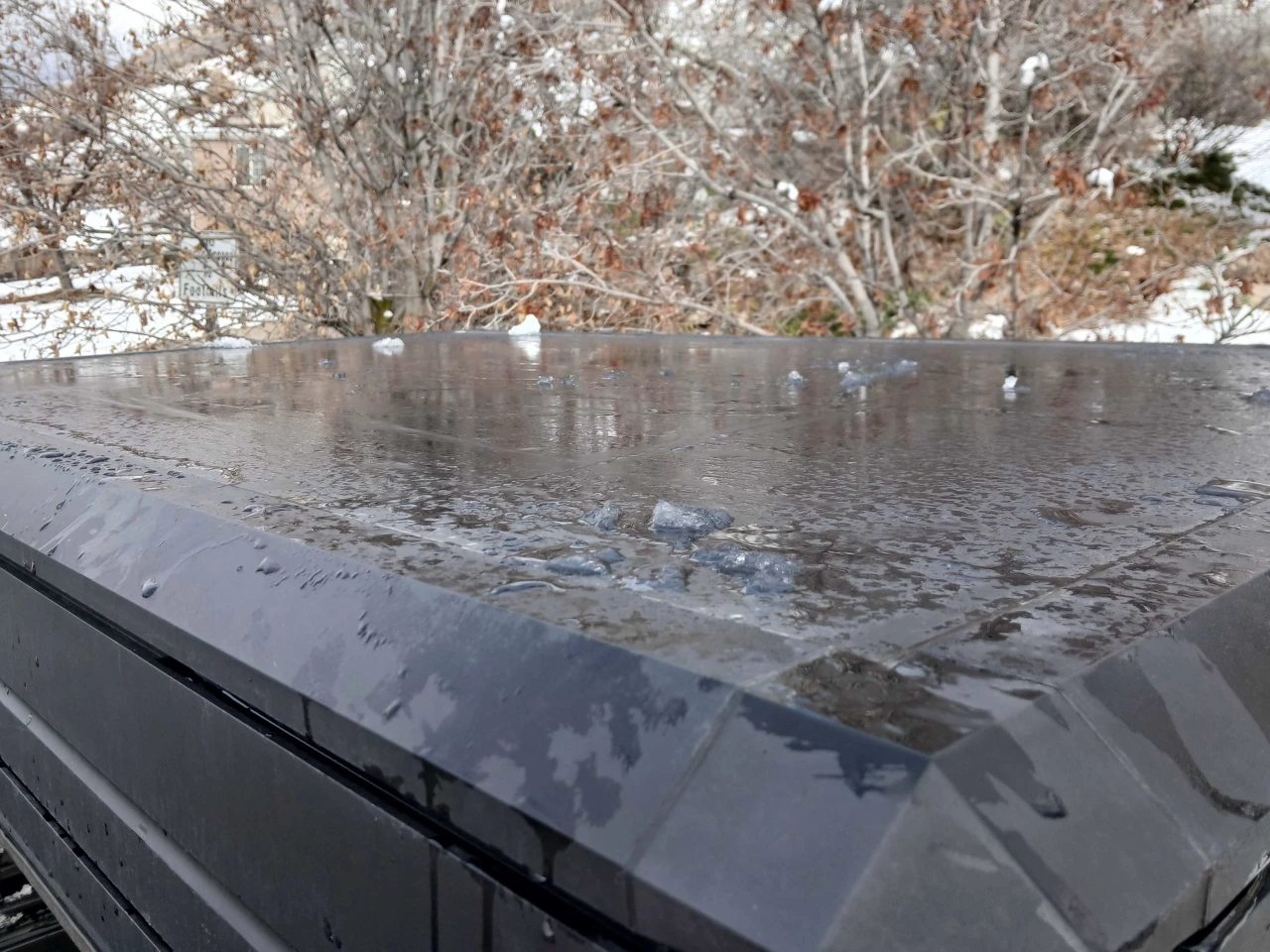
Once packed up, the Vision XL’s 10-in (25-cm) height, which we verified, is the lowest we’ve seen for this size/style of tent, with a few competitors tying it and others, such as the 13.5-in (34.3-cm) Skycamp 3.0, exceeding it by a few inches. Note, however, the Vision XL is also essentially one big 10-in-tall block with a completely flat roof, whereas some hardshell RTTs, including the Skycamp, have roof designs with a high point that arches down toward the front and/or back.
The Vision XL’s listed 198-lb (90-kg) weight puts it toward the top of the RTT market as a whole but falls around the middle of the pack for this style and size hardshell tent, a category in which listed weights commonly range from 165 to 240 lb (75 to 109 kg).
The build
We wouldn’t say Topoak has done anything particularly original with the Vision XL design – it’s basically the same style of fold-out hardshell we’ve seen from one RTT company after another since iKamper debuted the original Skycamp in 2017. What’s remarkable about Topoak’s tent, though, is the number of features it squeezes in as standard for a price that’s way lower than average.
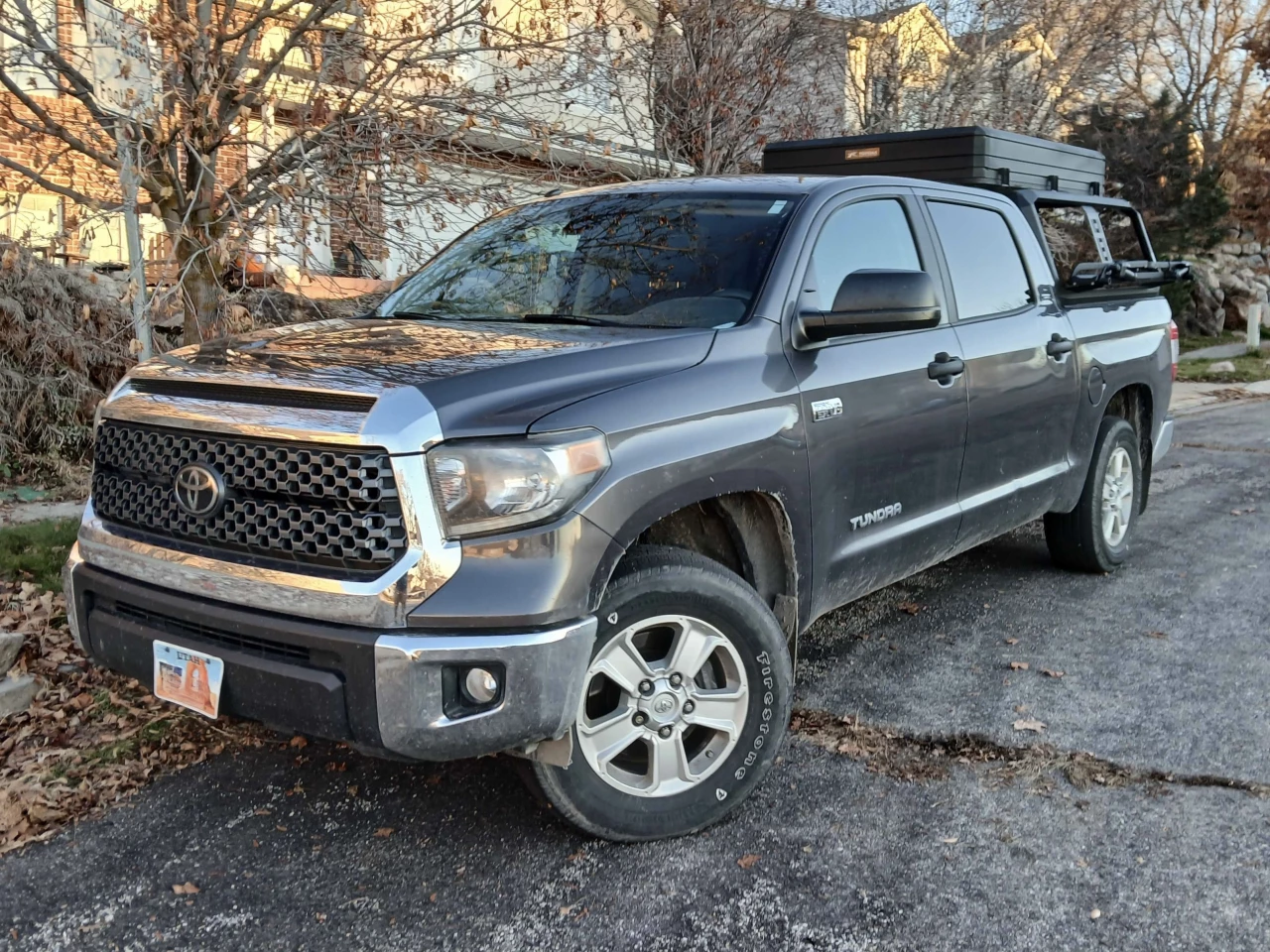
The Vision XL standard features package starts with an all-aluminum shell construction. If you plan to keep your rooftop tent installed all or most of the year, it’s bound to see some weather extremes. That’s definitely true in my backyard in Northern Utah, where conditions range each year from triple-digit heat to single-digit cold or lower, not to mention the feet of snow that fall some winters. Trees are few and far between, and shade can be a rarity. I park my truck outside year-round, where it’s directly in the sun and weather for the better part of daylight hours.
I’ve personally seen the potent sun here turn hard cooler and soft storage crate plastic into a brittle shell that easily breaks apart by hand. And while plastic composite RTT bodies are fortified for resisting UV damage, they’re still known to shrink, crack and wear from sun exposure. Aluminum is superior for holding up to the UV radiation and overall weather to which any rooftop tent gets exposed. It’s also more likely to dent or bend on impact rather than crack.
CC Weiss/New Atlas
All-aluminum shells are often reserved for more expensive hardshell RTTs, but the sub-$2K Vision XL is among the lower-priced options that feature one. It feels to be a robust construction, too, with thick, solid, T-track-burrowed edges all around. I’m sure the thinner top panel might dent or warp from a direct hit by something like a big falling tree branch, but it feels plenty sturdy for normal on/off-road wear and tear.
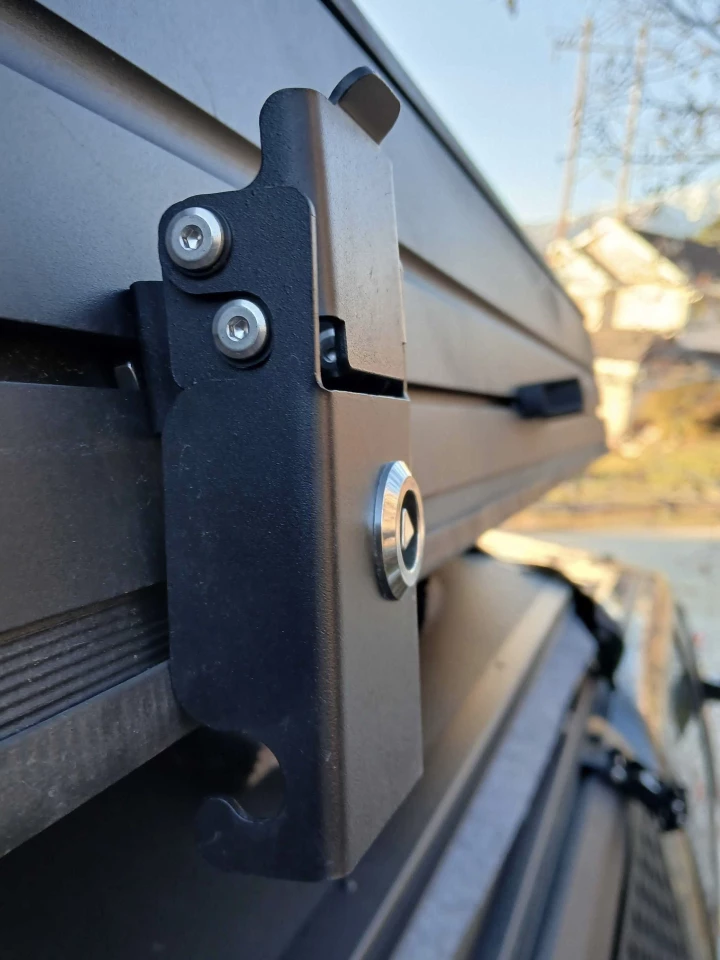
Keeping that hardshell closed is a pair of wide, beefy aluminum latches with a lower swing arm that clasps to a closure bar via a pair of hooks. The upper pull handle drops down to pop the lower latched arm open and pushes up to secure it in place.
CC Weiss/New Atlas
Topoak complements the burly shell construction with aluminum honeycomb floor panels and a tent body made from 300gsm poly-cotton blackout canvas designed to reflect UV rays and keep the interior cooler in hot weather. The rainfly is a thinner 180-gsm poly ripstop waterproof-rated to 8,000 mm and coated in a black-out finish of its own. The tent fabrics definitely feels robust, not like thin ground tent ripstop, and the floor panels seem solid and sturdy.
From there, Topoak includes features that are usually only available on the options sheet. Of particular note, two crossbars are included with the base price. They secure to brackets that bolt to the T-track running the entire edge of the tent and provide up to 99 lb (45 kg) of carry capacity atop the tent.

CC Weiss/New Atlas
Other features we didn’t expect to see packaged standard on a $2K RTT are the Anderson SB50 electrical port for hooking up to the vehicle battery or a separate leisure battery to power the internal LED light strip and USB/12V outlets, an HVAC port for running air-blown heat or AC, a transparent stargazing panel with black-out shade, and a pair of shoe bags that slide into the T-track next to the ladder and keep your shoes off the ground but out of the tent.
The mount
I won’t get into exactly how my wife and I mounted this 200-lb aluminum/fabric brick onto the Kuat Ibex rack aboard my 2018 Toyota Tundra on a hot, shadeless July afternoon with help from only a Rovr Rollr cooler. I will just say that this method is entirely unrecommended.
What I do recommend is getting at least two other hardy adults, maybe three, to help you lift the tent directly up onto the truck or roof rack. Use whatever payment or bribery is necessary. It will probably take mere minutes rather than the hour+ we spent wrestling the big block of hot, black metal up the back of the truck and rack in a variety of ways, none of them great. We eventually got it, but there were no guarantees.
CC Weiss/New Atlas
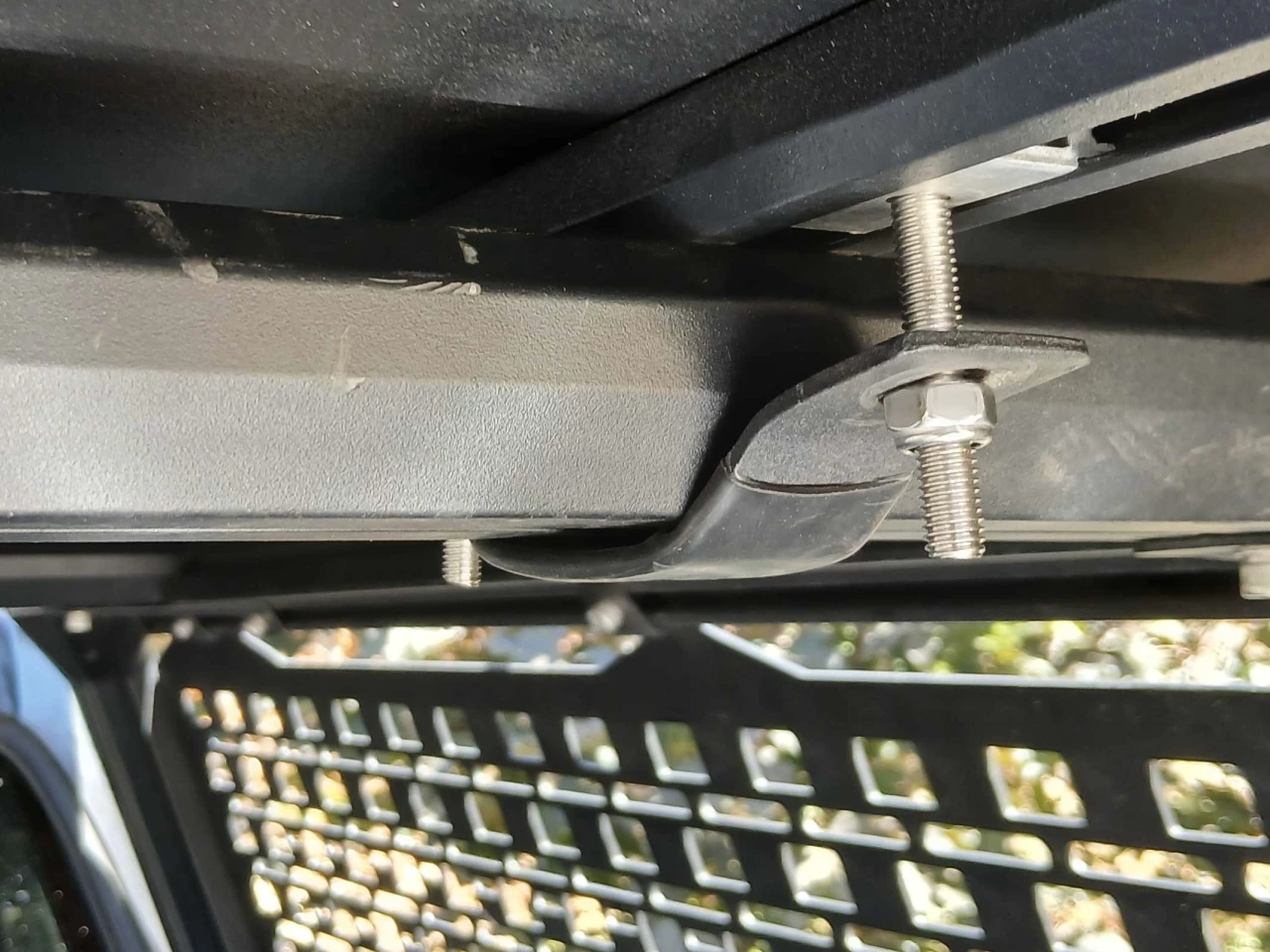
Once the tent is up there, by hook or by crook, you can breathe easy because the rest of the job is simple and suited to just one person. The Vision XL mounts just like any other rooftop tent, using a series of four brackets. Two T-bolt assemblies per bracket slide into the tracks on the base of the tent to secure each bracket around a crossbar.
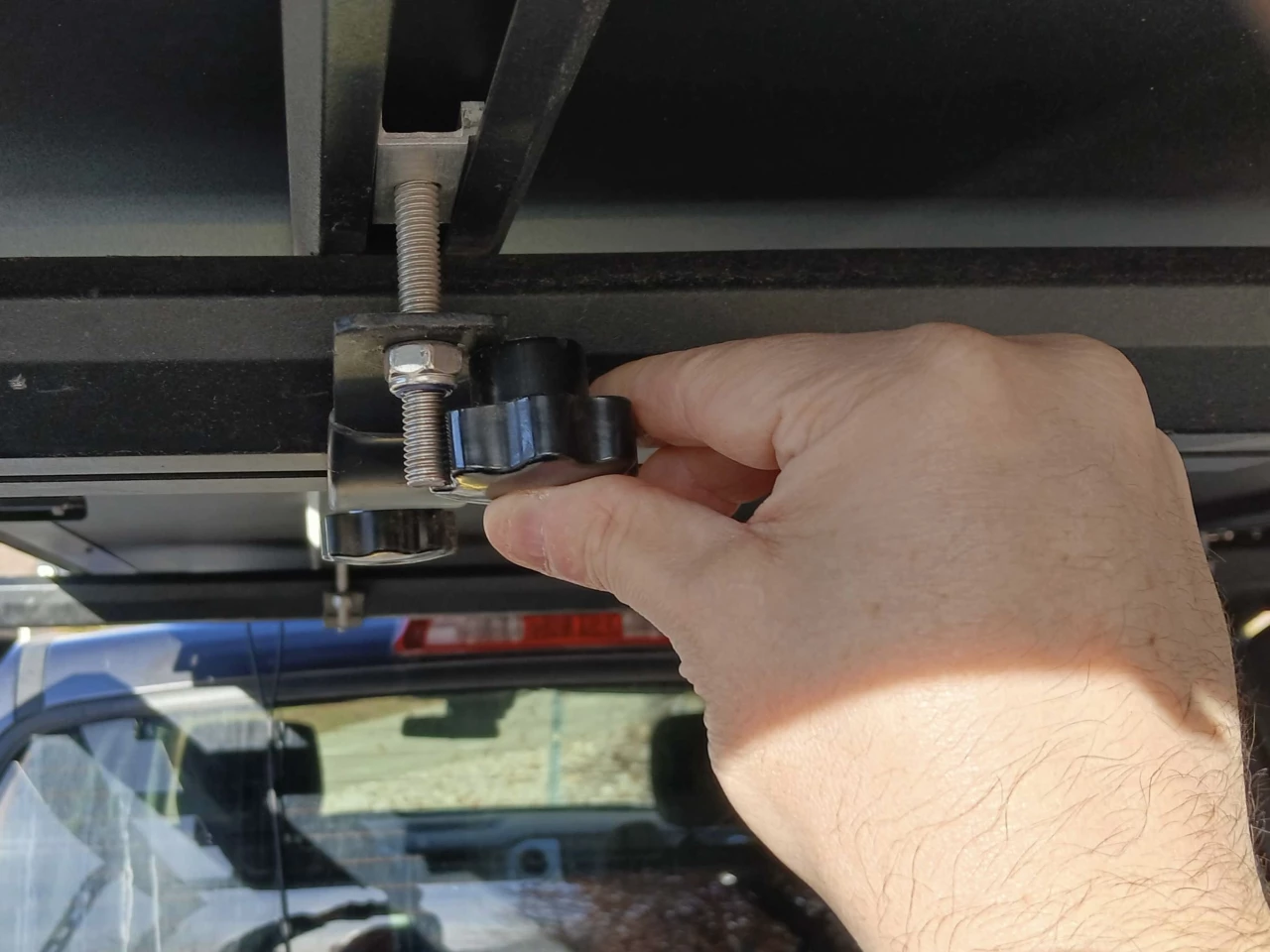
Topoak includes both large, gear-like quick-release nuts and smaller anti-slip metal nuts. It says to install the hand-turned quick-release nuts first, then the metal nuts, but because our crossbars are apparently a little thicker than others, we had to do it in the opposite order.
CC Weiss/New Atlas
The company says you can just use the anti-slip nuts without the quick-release ones, but we threw the hand-tightened quick bolts on after, figuring the combo might deter a thief who thought he found an easy, hand-loosened lift only to then get to the metal nuts. Not a huge deterrent, but it couldn’t hurt.
The drive
As is probably the case for most rooftop tents, far more of my time with the Vision XL has been spent in the driver’s seat below it than sleeping inside it. The truck is my everyday driver as well as a camping/biking/snowboarding shuttle. I don’t have much garage space to store an RTT, so my plan was always to keep the Vision XL mounted for the duration of testing.
I expected that big, vertical front-end to suck money out of my wallet by way of decreased fuel economy, but I guess I was overthinking it. Or I’m just used to $100+ fill-ups for my EPA-estimated 15-mpg-combined Tundra with 5.7-liter V8. My daily driving is a mix of open country roads at 60 mph+ (96.5 km/h+) and slower stop-and-go traffic, and I typically hover right around that 15-mpg figure.
I haven’t obsessed about it, but it’s looking like I’m still getting right around the same 15 mpg with the Vision XL mounted. I thought for sure I’d be dying to take it off to save gas money, but it hasn’t made the big, devastating impact I was expecting. A pleasant surprise.
The setup
After a couple planned camping trips got cancelled because of illness, I finally got to use the Vision XL for actual camping, rather than just shuttling around town for no reason. I try to make a fall break camping trip annually, and it might just be my favorite trip of each year – changing leaves contrasting with the already brilliantly colored mountains and monoliths of Southern Utah, nice moderate weather that trends toward clear and sunny, and none of the campfire restrictions that can make summer campsites a little darker, duller and chillier.
My family headed down to do a multi-day mountain biking trip at a newly developed trail area outside St. George, with plans to camp alongside the trail system on a primitive plot of US Forest Service land.
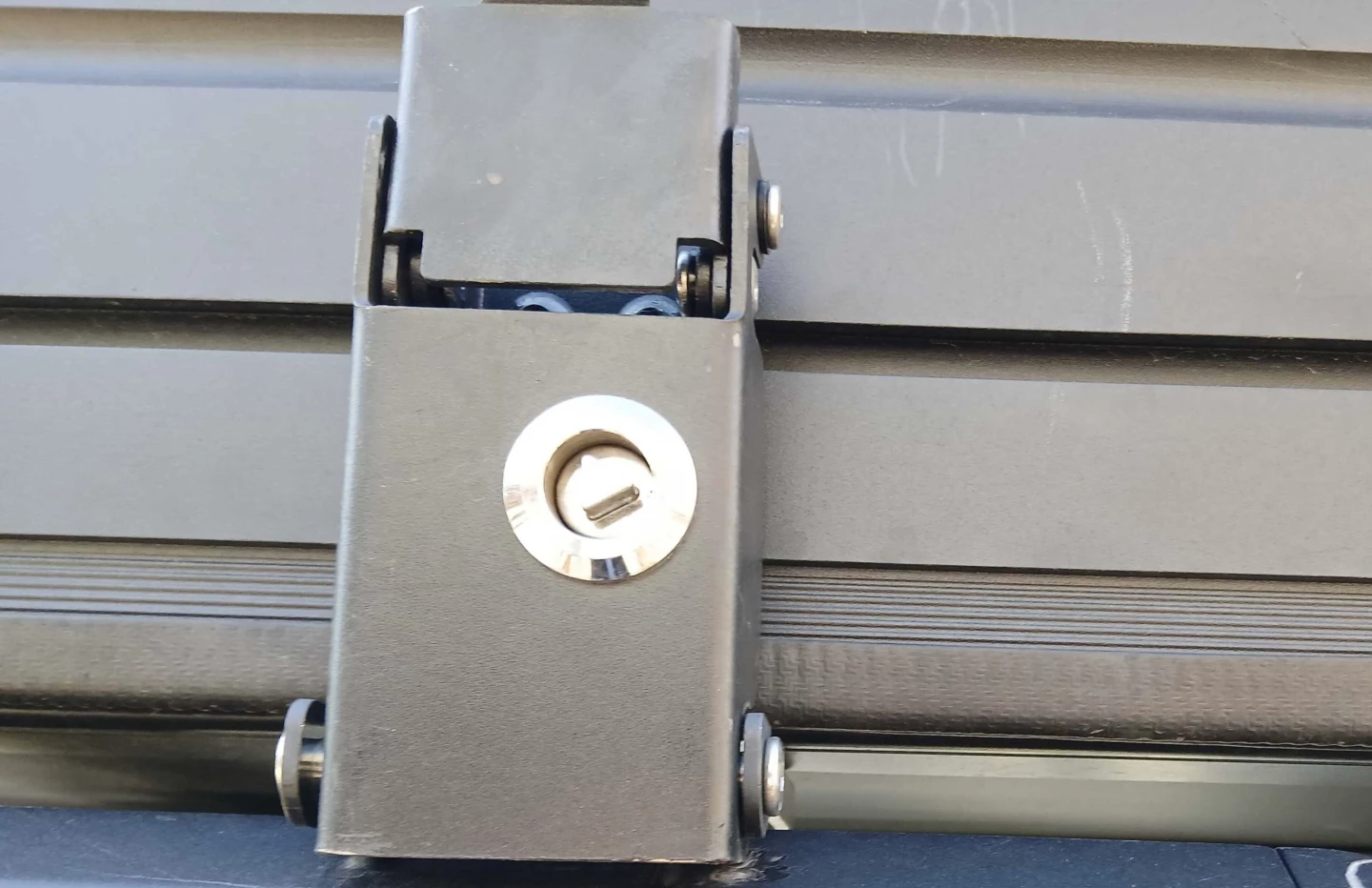
Everything was going smoothly until the last slow-going 2-mile stretch of dirt road leading to the camping and trail area. Immediately, my stomach dropped to my ankles upon a sobering realization: the KEY!?! I had mindfully packed all the usual camping gear, extras for primitive camping, and mountain bikes – even remembering a few things I usually overlook – and strapped everything down tight enough to ship intercontinentally. But I’d forgotten the damn key to open the little triangular locks on the tent latches.
CC Weiss/New Atlas
I started to feel sick well beyond just the mix of poorly paired rest stop snacks and Dr. Pepper smashing like storm waves around my stomach. Here we were 5 1/2 hours into the drive, several miles down a narrow dirt road, and facing the prospect of spending the night in the car, sleeping outside, backtracking to a hotel … I wasn’t even sure yet. And while we still had a couple of hours to work with, dusk was hovering quietly. Did I just screw up the entire trip by forgetting a small but mandatory piece of equipment?!
I assured myself that I had most certainly left the second of the two keys that came with the tent in the glove compartment or center console when I first mounted the tent. That would have been the logical thing to do. I’d just have to rifle through and find it when we got there and that would be that. Close one, but it’s good to be a high-functioning, responsible adult.
Or not. Fast-forward to reality: 30 minutes after shifting into park on a beautiful hunk of grassland between mountains and red rock basin, and with the contents of the glove compartment, console and every small nook and cubby emptied onto the seats, the Decked drawers in the pickup box wide open and rummaged – No. Tent. Key.
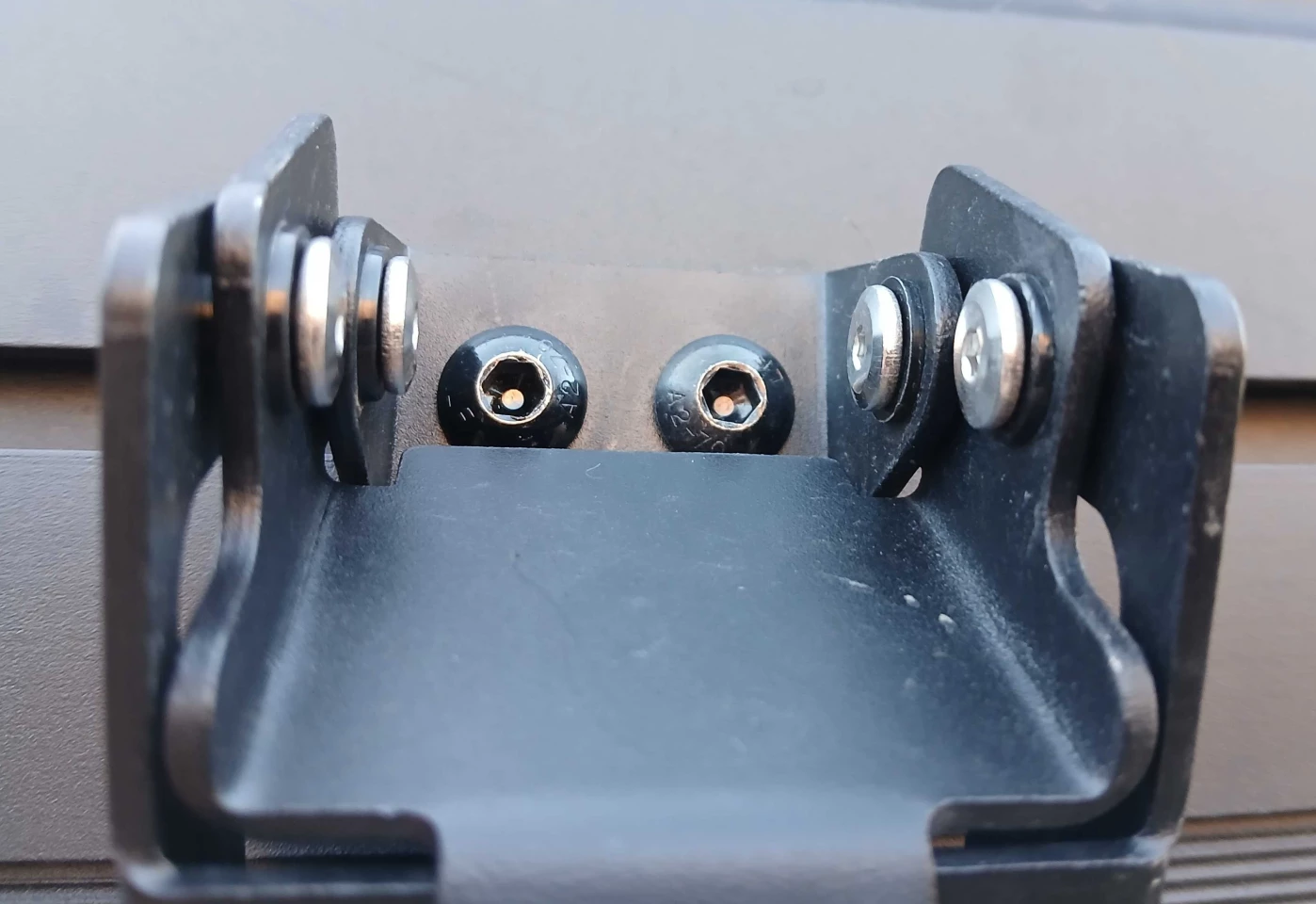
I was never sure exactly why Topoak had secured the latches to the tent with hex bolts, instead of something more fixed like rivets, but now I was extremely glad it had. I was ultimately able to loosen the bolts, pull the latches open and free the hardshell, bypassing the locks all together. And, somewhat uncharacteristically, I realized this before trying to smash the locked latches to bits with a tire iron or scavenged rock – a high-functioning, responsible adult after all.
CC Weiss/New Atlas
It probably quadrupled setup time or more, but we were back to the cozy night of RTT sleep we had planned all along.
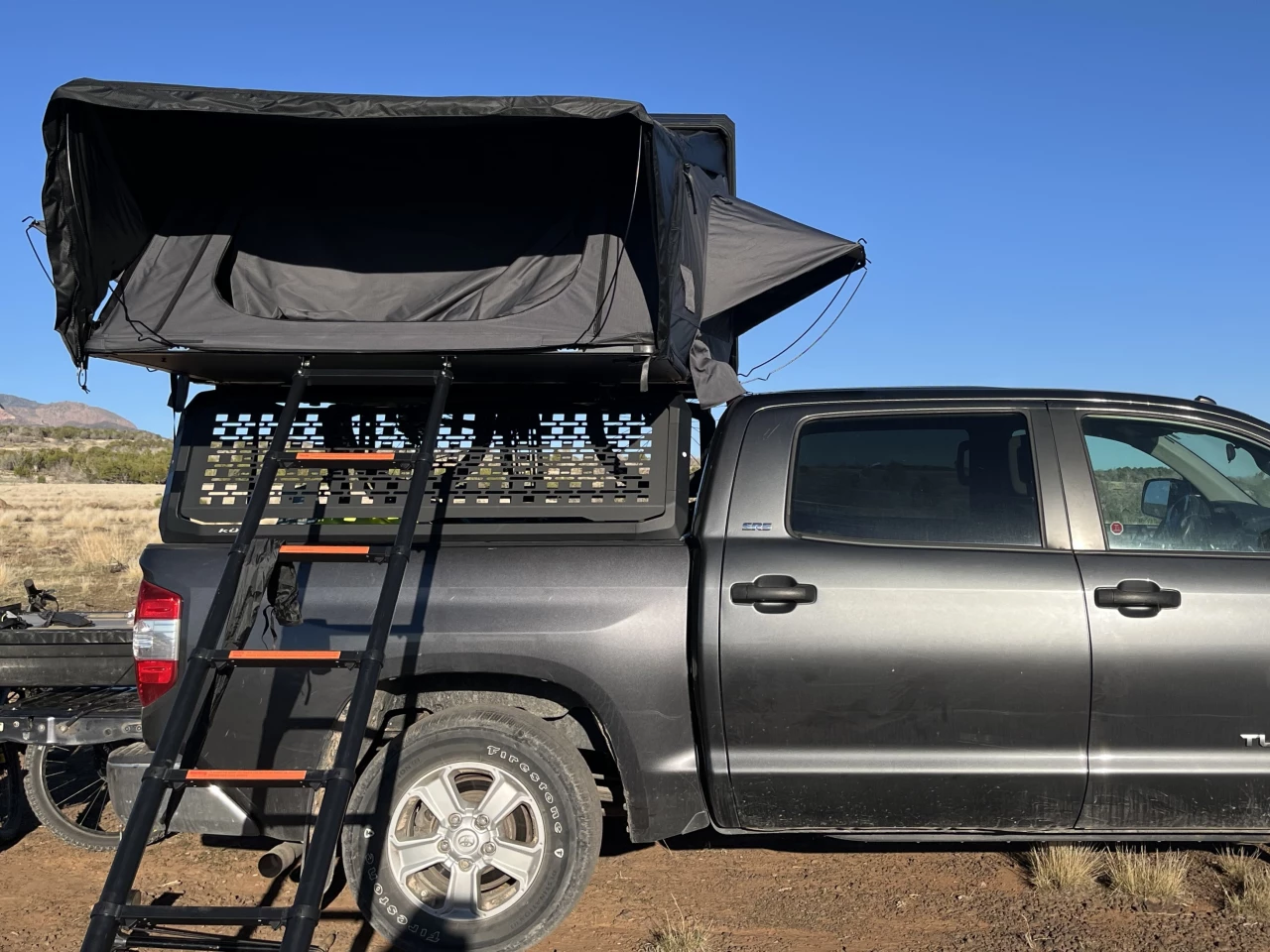
Beyond that hiccup, setup is breezy. The hardshell takes a little push before the struts take over and open it into full lean-to position. Then, the extended floor panel folds out as you pull and extend the telescopic ladder out and down. After that, you simply adjust the ladder to stand stably on the ground and level the tent floor out, ensure the rungs are locked in place, and climb up to install the thin, pliable metal rods that keep open the awnings over the entry and side windows.
CC Weiss/New Atlas
The only way you’re getting the Vision XL set up in Topoak’s claim of 30 seconds is if you leave those awning rods alone and just do a quick, partial setup by dropping the ladder and climbing inside – a good option for late, drowsy nights without much wind. Otherwise, you can expect to spend a few minutes getting everything in place.
The campout
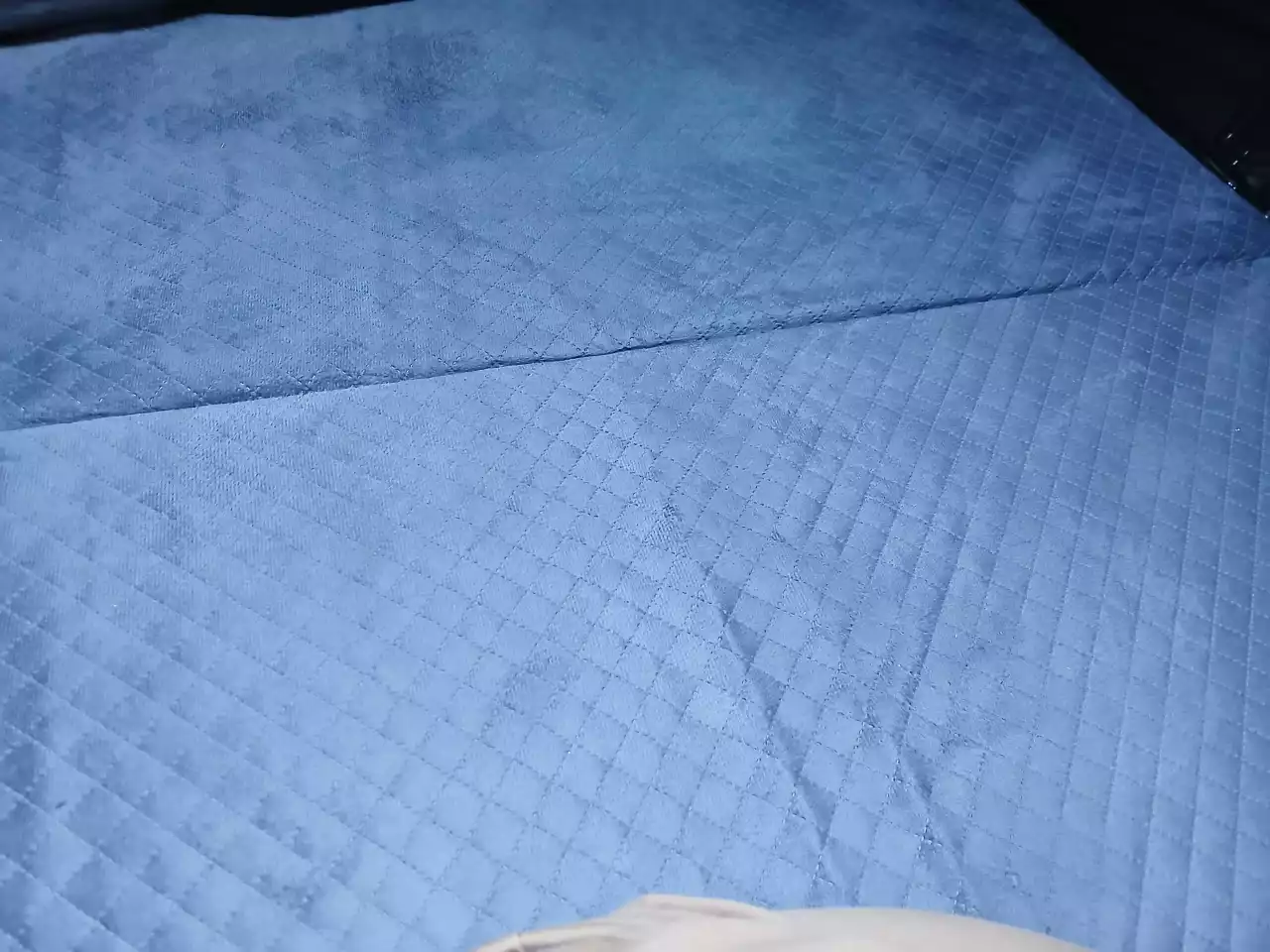
With all those standard features, I knew Topoak had to have cut costs somewhere, and I quickly found that somewhere when surveying the interior. I had read some less-than-flattering reviews about the thin, hard 1.6-in (4-cm) foam mattress and agreed that it was lacking in comfort, even by RTT mattress standards.
We still slept better than we would have on a ground tent with rocks and twigs poking through the floor – at least the Vision XL is level and uniform – but we weren’t exactly comfortable. And after a long day of biking, it wasn’t at all the cushy bed you want to drop aching muscles and bones on.
CC Weiss/New Atlas
On the upside, the felty soft-touch fabric covering the mattress is nice – superior to the rougher, noisier nylon that sometimes serves as an RTT mattress cover. That same fabric lines the inside of the hardshell, but while it looks like quilted padding, it’s really just thin, cheap fabric with little insulating value.
The interior offers plenty of storage space with a removable multi-compartment organizer that straps to the inside of the hard top, internal side pockets, and the aforementioned shoe bags that hang to the sides of the ladder. A skylight is always a nice feature for falling asleep while gazing at the stars, and the mesh windows with zippable black-out panels provide flexibility for quick adjustment, even while half asleep. There’s also a pair of foldable transparent plastic window panels that Velcro over the window cutouts for enjoying views with weather protection.

CC Weiss/New Atlas
All in all, the Vision XL made for a solid night’s sleep well better than we’d have expected in a ground tent. But we would recommend using a thin inflatable pad or soft topper on the standard mattress or just replacing it with a new mattress. We plan to do just that for future trips.
The teardown
Our last morning, we stayed a little longer than planned into the first day of hunting season – which is all but a calendar-printed holiday in these parts. While I’m generally happy to share the bounty with other public land users, the kids got seriously freaked out when echoes of gunfire drew closer … like just across the dirt road. With zero bright orange clothing or equipment, we decided it best to pack up and move along to a busier trailhead outside popular hunting grounds.
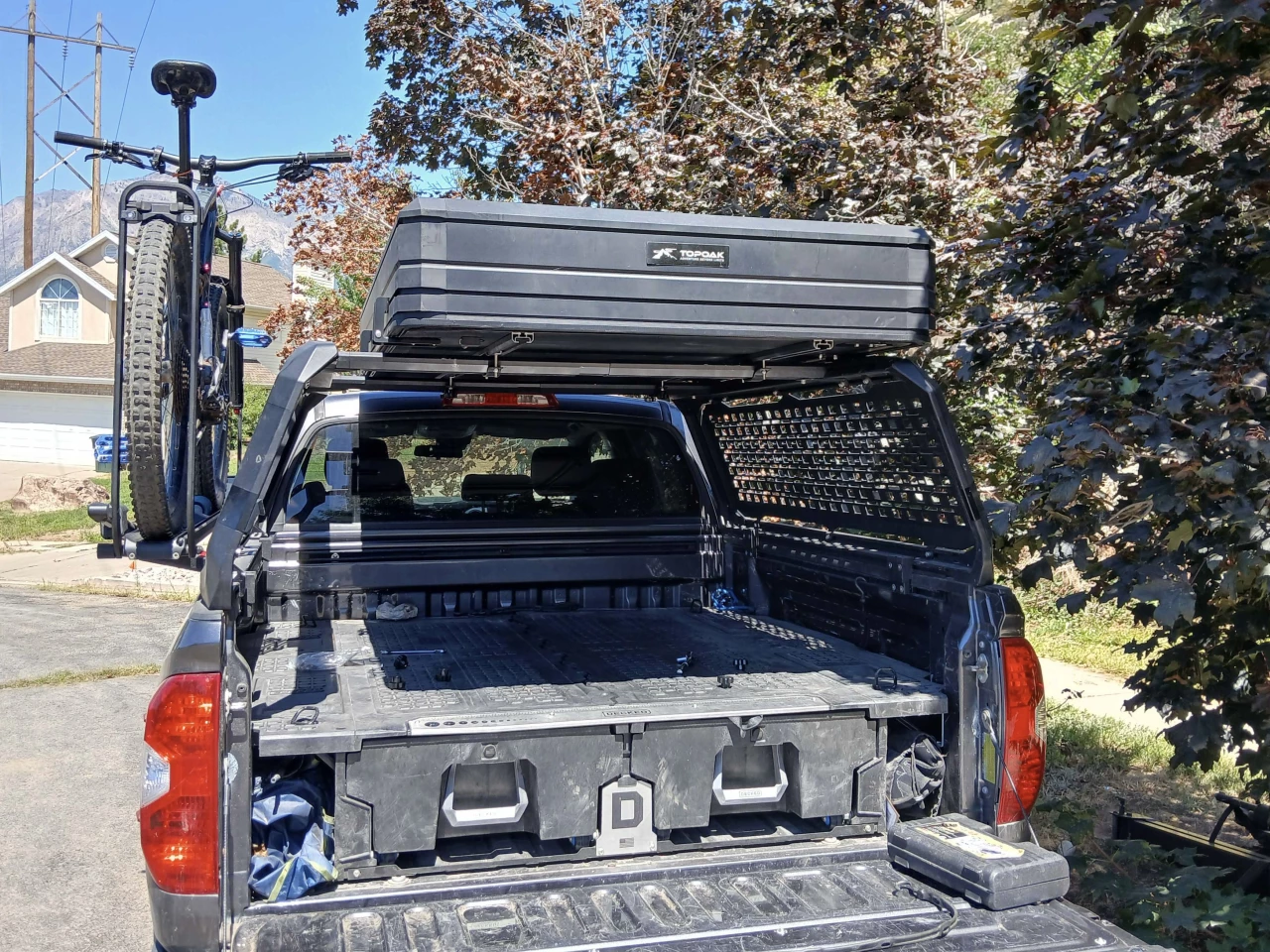
Because of the gunshots and nervous kids, we were trying to pack everything – bikes, luggage, furniture, cooking gear, bathroom tent and more – as quickly and efficiently as possible. The Topoak was quite cooperative in this endeavor, its ladder collapsing via push tabs as I lifted it to leverage the floor extension back into the main tent body on the rooftop.
CC Weiss/New Atlas
The tent’s hard cover pulls down with an integrated strap and hard grab handle, and the only real trick to packing it all up is ensuring that all the side and front fabric is fully tucked in so the hard lid doesn’t close with anything dangling out. You’ll also be letting air out as you compact everything down, and sometimes it takes a couple tries to get all the fabric in, air out, and lid closed and latched.
We had to stand on the latch-side tire to fully push the tent down and close and lock the latches. A set of vehicle side steps or maybe a folding stool would make it a more sure-footed task.
Our breakdown took a few minutes longer because I had to reattach those four latch bolts I had removed. Minus that, breakdown should take five minutes for one or two people, and the only reason it might take that long is because it takes a few tries to get all the fabric inside box. With a little experience, it’ll probably go even more quickly.
The price
The Vision XL wears an MSRP of US$1,998 and is currently on sale for $1,868 until Christmas, maybe longer if they extend the sale like they did after Cyber Monday. Beyond being less than half the MSRP of the $4,395 fiberglass-shelled iKamper Skycamp 3.0, Topoak’s four-person tent is also half the price of the $4,145 aluminum-shelled Roofnest Condor Overland 2 XL Air (on sale now for $3,523).
Having noted the differing sleeping areas, we haven’t seen anything to suggest that the extra couple thousand brings a whole lot of value beyond a more recognizable name on the side of the shell. Yes, the 2.5-in-thick foam mattress on the Skycamp 3 and the 2-inch self-inflating foam-core mattress on the Condor should be nice upgrades over the travel dog bed-thin mat in the Vision XL, but that’s ultimately a cheap fix that’ll cost far less than 2 grand.

Topoak
Roofnest’s tent shares some of the features of the Vision XL, including HVAC ports, integrated LED lighting and a skylight panel, but crossbars for the tent roof cost an extra $170. The Skycamp 3.0 has a skylight, but few of the Vision XL’s other features, and iKamper doesn’t even recommend mounting crossbars on top of its fiberglass shell, let alone include them as standard.
The 23Zero Armadillo Horizon 3 sizes closest to the Vision XL in terms of sleeping area, but prices in a different bracket at $4,295 (on sale now for $3,436). That model runs pretty closely to the Vision XL in terms of features, with an aluminum shell, crossbars, HVAC port, electrical hookup and lighting, stargazer panel, and loads of interior organization. But it’s still more than double the MSRP, and even comparing sale prices, it’s an extra $1,568.
Pricing gets more competitive when dropping downmarket to compare the Vision XL with three- and four-person expandable hardshell tents from other budget brands.
Overland Vehicle Systems (OVS) has become a staple in the budget overland market, hawking a very wide range of products, including an extensive RTT selection. The generously sized HD Bundu we mentioned earlier is currently its cheapest advertised among several three- to four-person expandable hardshell models, pricing pretty closely to the Vision XL at $2,000. But that price comes courtesy of a generous sale, and the MSRP is actually $3,200. It, too, comes with a nice array of features, including interior lighting, a dog ramp and two hanging shoe bags.
At that sale price, the HD Bundu competes pretty well against the Vision XL, and we might choose it for the extra sleeping space. But it does not include an electrical hookup or an HVAC port, and features an ABS plastic shell, not an aluminum one. The plastic ratchet straps also appear much flimsier than Topoak’s metal ones. There’s discrepant information on crossbars, but none of the photos or setup instructions show them.
Ironman 4×4 also offers some of the better prices on the overland market. Its aforementioned Ursa 1300 three-person tent retails for $3,000, has a sleeping area 10 inches narrower than the Vision XL and has an ABS shell.
Bottom line
Honestly, we don’t think it’s even a close call: the Topoak Vision XL is the best value we’ve seen on the three/four-person expandable hardshell market, the type of product that should get other companies upping their game and/or lowering their prices. Tents like the OVS HD Bundu can give it a run for the money at drastic discounts, but not at head-to-head MSRP pricing.
Further considerations
Topoak RTTs are subject to a $299 shipping fee when ordered directly through the company. You can save the fee by picking the tent up yourself at its warehouse in Eastvale, California (LA/Anaheim area). You could also order the tent from a retailer with a lower shipping fee or even free shipping (the Vision XL is not currently available through Amazon, but other Topoak tents are advertised there with free delivery).
Delivery fees vary by manufacturer or retailer for the other tents mentioned. IKamper charges a flat $199 freight fee for shipping in the contiguous US, while OVS advertises free shipping on orders over $100, including RTTs.
Of course, all those prices are “as of publishing” and subject to change thereafter.
The Vision XL comes with a three-year warranty. While we didn’t need to test that warranty or use customer service at all, the reviews we’ve seen for Topoak’s customer service have been largely positive. We do take Web reviews with a big grain of salt since they’re easy to manipulate.
Topoak has also mentioned working to expand its retailer network in the US, so it might have an increased physical presence in the future, which could provide another useful outlet for saving on shipping, warranty repairs and general customer service.
We plan to keep testing the Vision XL to see if we notice any premature wear and tear or anything else that might make a deep cut into that value proposition, but so far, we’re quite impressed with this little brand we hadn’t heard of a year ago.
Since the Vision XL comes with claims of four-season design, we also hope to test it for winter camping in the coming weeks to see how it holds up in the cold. We’ll have a follow-up review or update once we do.
Product Page: Topoak (Click to change from “L” to “XL” just above the “Order” button)
New Atlas may receive commission if you purchase through our links

