


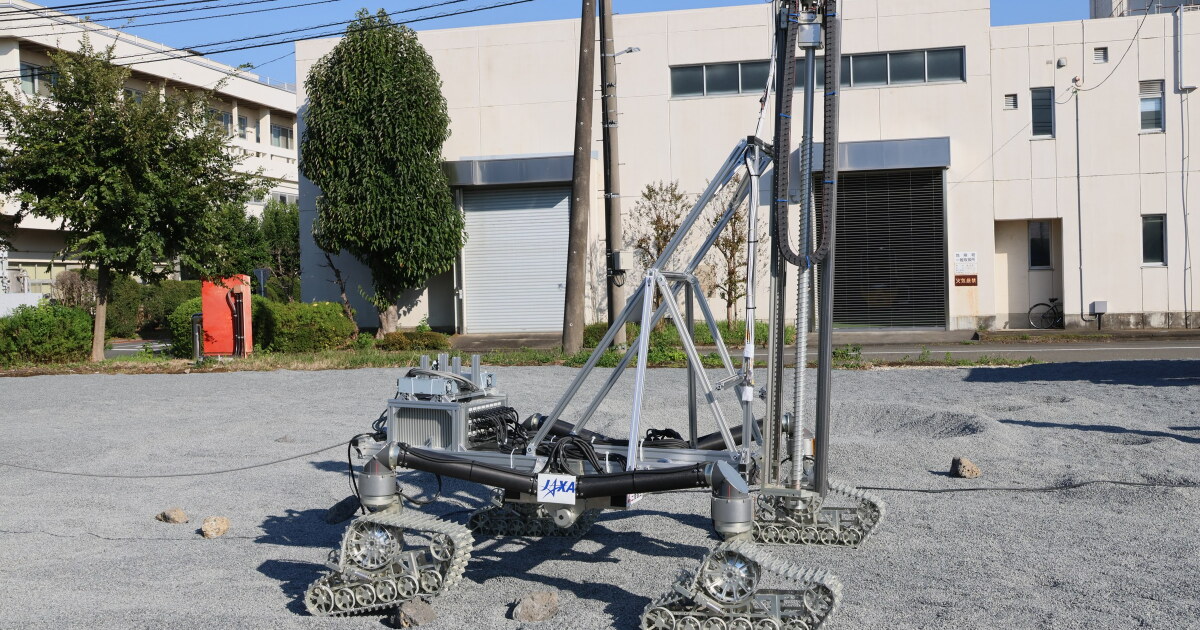
If we are ever going to live on the Moon, we’ll need water. Tons of water: to drink, to shower, to split into oxygen to breathe, and to make rocket fuel for the trip home or on to Mars. JAXA has just shown a test model of the four-legged rover that will go and find out how much water there really is at the south pole.
The Japan Aerospace Exploration Agency (JAXA) showed a ground test model of the rover to reporters at its Chofu Aerospace Center, in western Tokyo. The robot crossed rocks and a fake crater on a course of gravel, covering about 59 ft (18 m) at roughly 1.2 in (3 cm) per second.
The rover is Japan’s half of LUPEX (Lunar Polar Exploration), a joint mission with India’s space agency, ISRO, which is building the lander. Both are intended to launch on a Japanese H3 rocket bound for the Moon’s south pole between April 2028 and March 2029.
JAXA
“We ultimately want to use lunar water for rocket fuel,” project manager Takeshi Hoshino told reporters. Carrying water from Earth is too expensive, but if engineers manage to split lunar ice into hydrogen and oxygen on the Moon, they can create rocket propellant directly in space. “That’s why a key objective is to produce fuel on the Moon for future missions, whether returning to Earth or heading onward to Mars,” he said.
Water is why the south pole is the most desired real estate on the Moon. Some of its craters never see sunlight, and JAXA says it is highly likely that water has survived in them near the surface. NASA wants to land Artemis astronauts in the region, and China wants its Chang’e 7 probe to touch down there, though it postponed the launch in August. “Drilling technology will also help build bases on the Moon,” Hoshino told Jiji Press (my translation).
The problem is that no one knows how much water there is at the south pole, where exactly it is, or in what form. JAXA calls it “still a mystery.” One of the few hard numbers comes from a single spot: in 2009, NASA crashed its LCROSS probe into the polar crater Cabeus and found about 5.6% water by mass in the debris.

JAXA
JAXA will pick the exact area on the Moon’s pole and the stops along the way before landing. The plan is to choose somewhere with long hours of sunlight. This will allow the rover to explore more on its own and survive the freezing lunar nights, two of the skills JAXA wants to prove. The mission should last at least three and a half months, and possibly up to a year, according to JAXA.
Moving around our natural satellite is going to be hard. The 926-lb (420-kg) rover has to cross loose dust and rocks without bogging down or tipping over, so JAXA’s engineers have designed each leg to steer on its own and spread its weight to keep it from sinking. They have already tested it climbing slopes with a single leg, driving nonstop on two or moving in a vacuum, Hoshino said.
Finding water won’t be easy either. Ice is hard to spot directly, so the rover will use a NASA neutron spectrometer to look for hydrogen hiding under the surface. The rover is also equipped with an ISRO ground-penetrating radar that can peer into the layers below, and imaging spectrometers from JAXA and ISRO to read the ground by the way it reflects light. If hydrogen shows up, the rover is equipped to dig in the ground and take samples.
LUPEX 3D Image 2024
Those samples then go to REIWA, which Hoshino calls the mission’s centerpiece. There are several instruments inside it: LTGA heats the soil in a sealed chamber and weighs it. If there is weight loss, the team can estimate how much water it held before heating. TRITON identifies the gases that boil off, while ADORE detects water using light. The European Space Agency (ESA) adds one more to the rover, EMS-L, an artificial nose that sniffs the thin gas around it.
LUPEX may not be the first to find out, though. NASA cancelled VIPER, its own ice-hunting rover, in 2024, then brought it back a year later. If NASA confirms the order, Blue Origin could land it near the south pole in late 2027.
Either way, finding water is only step one for JAXA. After LUPEX, it wants to pull water out of lunar soil and, later, build plants on the Moon that refuel spacecraft.
Source: JAXA

