


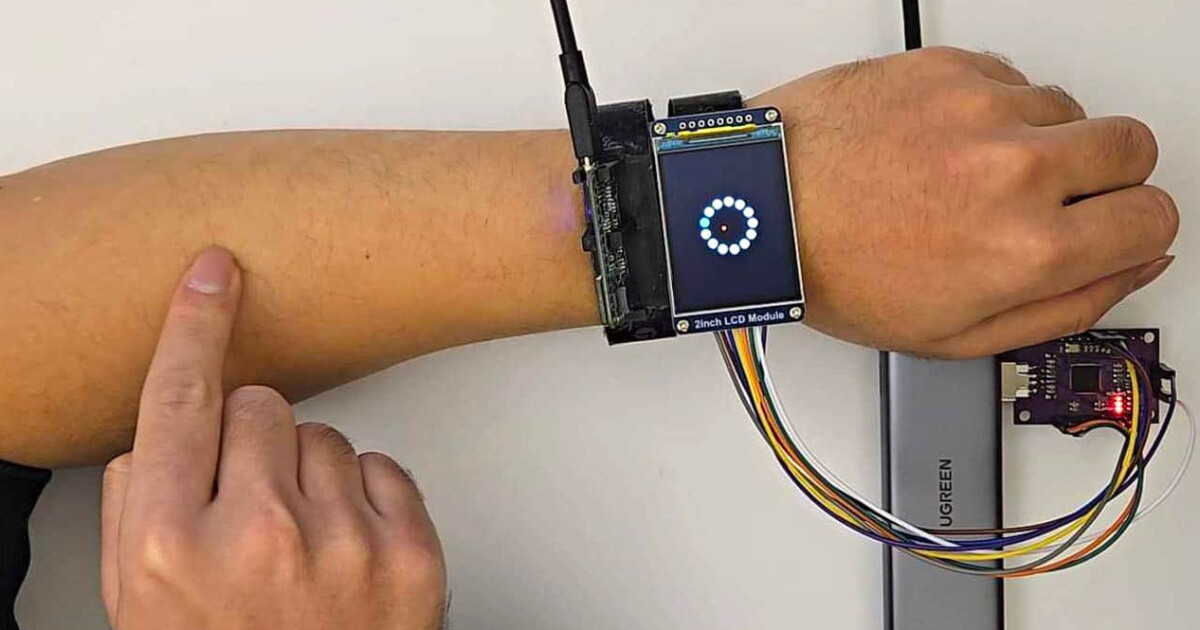
Smartwatches have evolved from basic timepieces, calculators, and fitness trackers into powerful devices that can also make calls, play videos, handle GPS navigation, and so much more. Great stuff. The problem is that we want even more smartphone functionality – plus touch navigation – on screens typically smaller than the average human thumb. Researchers at North Carolina State University have developed technology that takes the screen-size limitation out of the equation, turning the wearer’s arm into a functional trackpad that controls the watch.
“Smartwatch screens are too small for the touch interactions people use every day on phones and laptops, such as two-finger scrolling, pinch-to-zoom, or pressing harder to trigger a different command,” says Chenhan Xu, the study’s corresponding author. “Our goal was to develop a small, wearable technology that would provide that level of interactive control for users.”
Enter EpiPad, a wearable system that turns the forearm’s skin into a touch-sensitive input surface using a miniature millimeter-wave (mmWave) radar and machine learning. Instead of cramming multiple fingers onto a tiny watch face, you can tap, swipe, scroll with two fingers, pinch to zoom, and press harder to trigger different commands, all on your forearm, much like you would on a laptop trackpad. The system can even distinguish between lighter and heavier presses, adding another level of control without requiring any electronics to be attached directly to the skin.
“With the EpiPad, a compact millimeter-wave radar worn on a wristband reads the tiny dents fingertips make as they press the skin, so the system tracks multiple fingers and how hard each one presses,” says Yuliang Fu, the paper’s first author and a PhD student at NC State. “We want users to interact with their smartwatch in a way that feels familiar, and EpiPad gives people the input expressiveness they would have when using a MacBook trackpad.”
The technology consists of a compact radar sensor array mounted on a wristband, along with associated electronics and a signal-processing system that uses lightweight machine learning models to interpret finger movements. The existing prototype looks like a wristband with a circuit board sticking out of it, so it isn’t exactly something you would proudly wear outdoors. However, the actual radar sensor array measures just 5 × 4 mm, small enough to potentially fit inside a conventional smartwatch.
So, how does it work?
Millimeter-wave radar operates by transmitting high-frequency electromagnetic waves and analyzing the signals reflected back from nearby surfaces. When someone places a fingertip on their forearm, the skin deforms slightly. Sliding a finger, tapping repeatedly, or pressing harder produces different movement and indentation patterns that alter the reflected radar signals. EpiPad uses these changes to detect finger activity without requiring a conventional touch-sensitive surface.
Now, collecting radar reflections is one thing; they still need to be translated into meaningful commands. EpiPad uses a processing pipeline built around lightweight machine learning models to interpret the signals, estimate finger positions, recognize gestures, and distinguish different pressure levels. This allows the system to recognize multi-finger movements and pressure-sensitive commands rather than simply detecting whether someone has touched their arm.
To test their proof-of-concept design, the researchers conducted experiments on 20 participants, evaluating gesture recognition, finger-position tracking, and pressure detection. Following calibration, EpiPad achieved 92.8% gesture recognition accuracy, 90.2% force detection accuracy, and a ranging precision of 10.2 mm on previously unseen users. These results suggest that the system can recognize a variety of familiar trackpad inputs with reasonable reliability.
“This approach could let future smartwatches, and screenless wearables such as AI glasses, use the wearer’s own skin as a full touch surface,” says Xu. This could be particularly useful for increasingly compact devices that need sophisticated controls but have little or no room for a touchscreen.
It should be noted that using the human body as an electronic interface isn’t an entirely new idea.
Back in 2010, researchers at Carnegie Mellon University developed Skinput, a wearable system that turned the arm and hand into touch-sensitive controls. It used acoustic sensors to detect the characteristic vibrations produced when someone tapped different parts of their body. EpiPad builds on this broader concept with its radar-based sensing that supports continuous finger tracking, simultaneous multi-finger gestures, and force-sensitive interactions, bringing the experience closer to that of a conventional laptop trackpad.
Another potential advantage is cost. According to the researchers, the functional components, including the radar sensor array, are relatively inexpensive and could cost less than US$10 when incorporated into wearable devices at scale.
For now, EpiPad remains a research prototype, and its performance in everyday conditions outside the laboratory has yet to be established. The researchers are open to collaborating with industry partners to explore how to miniaturize the technology and incorporate it into next-generation wearables.
A paper on the research was published in the journal Proceedings of the ACM on Interactive, Mobile, Wearable and Ubiquitous Technologies.
Source: North Carolina State University

