


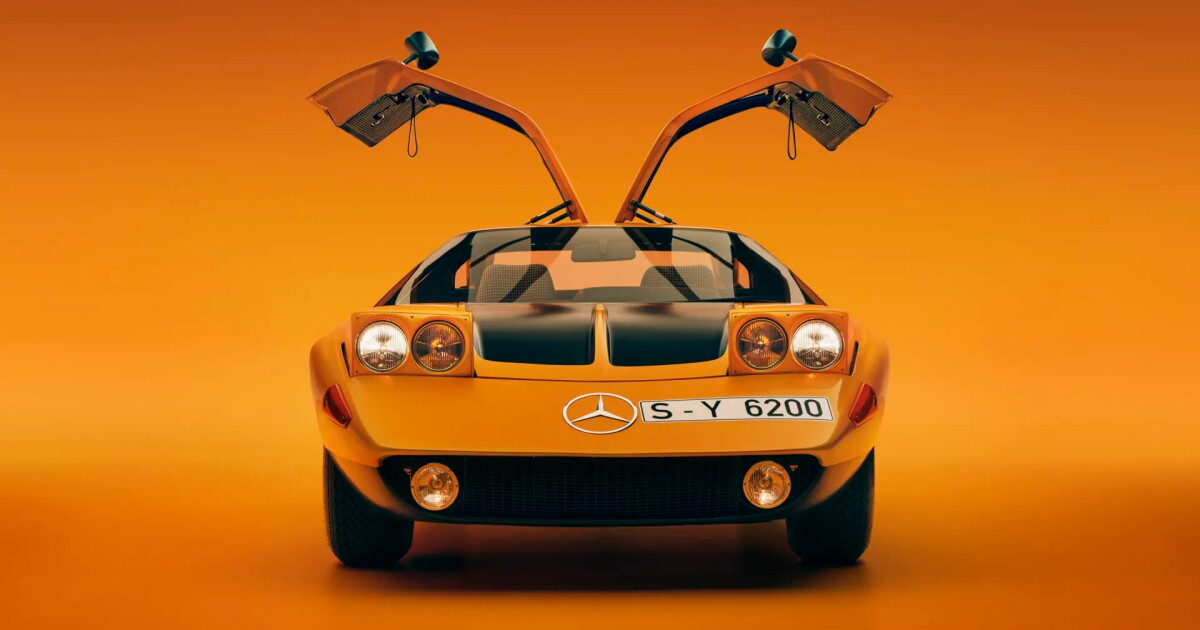
The Mercedes-Benz C 111-II was a gullwing-doored experimental supercar with a four-rotor Wankel engine that packed 345 hp and could reach 186 mph (300 km/h). It debuted in 1969, with only 17 examples built across the C 111 generations … and only 13 surviving today. One of those 13 is finally headed to auction.
That’s almost ironic, considering prospective buyers reportedly sent blank checks to Mercedes-Benz in hopes of securing one back in the day. But instead, the company chose to keep the cars for its experimental program, never really letting the C 111 into the hands of the public.
The car that’s heading to auction is not some museum-bound piece either. Known internally as Car 33, it retains its original four-rotor Wankel engine. And it’s recently been restored to running condition. So, if you’ve got a particularly unhealthy amount of money burning a hole in your pocket, February 3, 2027, might be a date worth circling.
Mercedes-Benz originally envisioned the C 111 as a spiritual successor to the iconic W198 300SL Gullwing of the 1950s. The two-seat sports car brought together a mid-engine rotary powerplant, a lightweight fiberglass body, and the marque’s signature gullwing doors.
Mercedes-Benz / RM Sotheby’s
An upgraded C 111-II followed at the 1970 Geneva Motor Show, boasting a 2.4-liter, four-rotor Wankel engine. However, the 1973 oil crisis, coupled with the growing expense of meeting stricter emissions regulations, put an end to any plans for production.
Mercedes continued experimenting with the platform, though, creating several more prototypes, including the diesel-powered C 111-II-D in 1976 and C 111-III in 1978.
Just 17 examples were built, 13 of which survive today. Until now, every one of them had remained in Mercedes-Benz’s collection.
Mercedes says that the unit bound for auction began taking shape in March 1970 and originally wore 8-by-15-inch aluminum-alloy wheels. The company also developed lighter, wider magnesium alternatives measuring 10 by 15 inches and 13 by 15 inches for circuit duty. Both wheel sets will accompany the car at auction, although the magnesium pair is now considered display-only due to its age and condition.
In August 1970, the automaker installed the 345-hp Wankel in the car’s mid-mounted position. Weighing 2,734 lb (1,240 kg), the C 111-II was capable of reaching a top speed of 186 mph (300 km/h) and a 0-to-60-mph time of 4.8 seconds.

Mercedes-Benz / RM Sotheby’s
It sported a five-speed manual transmission, anti-lock brakes, twin fuel tanks, and a Becker Europa radio. But the C 111 was never driven on public roads; rather, it was used specifically as a test car.
Mercedes used a glass-fiber-reinforced plastic (GFRP) body mounted on a sheet-steel underbody structure to help keep weight down. The low-slung wedge-shaped silhouette measures just 44.1 in (1,120 mm) tall, with a 103.1-in (2,620-mm) wheelbase.
Its gullwing doors are an unmistakable nod to the legendary 300 SL, while revisions to the front fenders, roof, and rear deck on the C 111-II improved outward visibility compared with its predecessor. Underneath, the car gets an independent suspension setup at both ends.
The front uses double wishbones, while the rear employs a more elaborate multi-link arrangement with three transverse links and two longitudinal links per wheel. Coil springs work alongside gas-pressure shock absorbers, with anti-roll bars helping control body movement. The braking hardware comes in the form of disc brakes at all four corners.

Mercedes-Benz / RM Sotheby’s
Inside, the C 111-II continues to carry a lot of period character. The cabin features sports seats complemented by a four-spoke steering wheel. A vertically mounted Becker Europa radio adds another distinctly 1970s touch.
The car had been worked on to return to running condition in 2024 after being restored at the Mercedes-Benz Classic Center in Fellbach, Germany. And I’m glad Mercedes chose to retain the original patina – right from the Weissherbst orange paintwork to the houndstooth fabric seats – rather than making it look factory-fresh.
Keep in mind that the powertrain did need a comprehensive overhaul. Mercedes says the odometer read barely 15,388 miles (24,766 km) as of October 2026.
Mercedes is teaming up with RM Sotheby’s to find a buyer for the C 111 in Paris. The sale is scheduled to take place alongside Retromobile Paris, with registered participants able to bid either at the venue or over the phone. RM Sotheby’s president Gord Duff believes the C 111-II could fetch considerably more than its €25-million estimate. That’s around US$27.5 million.

Mercedes-Benz / RM Sotheby’s
The money raised from the sale will go toward the continued development of the Mercedes-Benz Museum. Mercedes has also agreed to a contractual restriction preventing it from selling another C 111 for the next 25 years.
Source: Mercedes-Benz

