


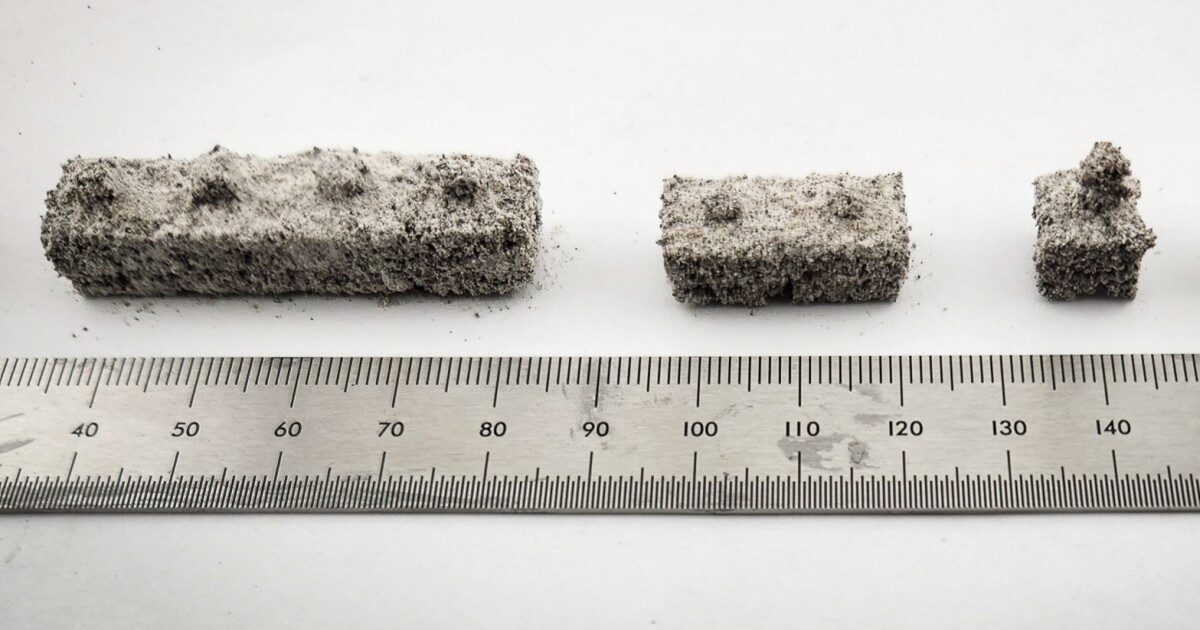
If astronauts are going to spend much time on the Moon, they need to be able to build relatively permanent structures there … yet without bringing along heavy materials. A new technology could help, by allowing them to create Lego-like building blocks from nothing but moon dust.
One of the key considerations in space travel is to keep the cargo load as light as possible, in order to minimize fuel consumption. So, needless to say, the last thing you want to be loading into a spaceship are a bunch of heavy sacks of cement.
That’s why various groups of scientists have been looking into methods of building structures utilizing the regolith (lunar soil) which is already present on the surface of the Moon. The problem is, some of those methods still require a binding agent to be added to the regolith, and that substance still has to be brought along from Earth.
In an effort to use nothing but regolith, a University of Arkansas team led by assistant professor of mechanical engineering Wan Shou turned to 3D printing.
More specifically, the scientists turned to a type of 3D printing known as laser powder bed fusion. In a nutshell, this involves using a laser to selectively sinter powder that has been spread out in a flat bed. As that bed is gradually lowered and more powder is added, objects are progressively built up one layer of fused powder at a time.
Although metal powder is usually used in laser powder bed fusion, in this case the researchers swapped in Lunar Highlands Regolith Simulant, a commercially available material based on regolith samples collected during the Apollo missions.
It was found that even a relatively low-power laser was sufficient to sinter the simulant, allowing the team to print centimeter-scale Lego-like blocks that could be fitted together to form larger structures. And importantly, these blocks could be formed without any added binding agent.
“There’s nothing else it’s binding to. The regolith powder is binding to itself,” says Cole McCallum, first author of the study.
That said, at this point the blocks do still have quite low compressive strength, sitting at 3.4 MPa (megapascals) – by contrast, residential concrete is around 25 MPa. Nonetheless, Shou is confident that once more research is conducted, the technology could have valuable applications in the microgravity environment of the Moon.
A paper on the research was recently published in the journal NPJ Advanced Manufacturing.
Source: University of Arkansas

