


Usually, 80th birthdays are pretty staid affairs. A time for looking back. Lots of memories. Taking stock of the past. Going quietly into the twilight years.
Fender turned 80 this year, and apparently didn’t get that memo, because the company ended its celebratory year with a flurry of new series and collaborations.
For starters, there’s the comprehensively updated American Professional range, which re-imagines the brand’s famous line-up of guitars. Then there are collaborations with Pokémon and Godzilla, a signature Jaguar bass from Blink-182’s Mark Hoppus and a signature Jazzmaster from Kim Gordon of Sonic Youth.
The company closed out the year with two big ticket items, both recently launched with much fanfare in Tokyo at the Fender Flagship Store in Harajuku.
Fender
The first is a collaboration with the George Harrison estate and Dark Horse Records, the label he started in 1974 following the breakup of The Beatles.
“George played many different iterations of Fender guitars over the space of his career, from the rosewood Telecaster, which of course he played on the rooftop at Apple, to the hand-painted Strat he called Rocky,” says Edward ‘Bud’ Cole, Fender CEO. “We have massive respect for George’s legacy, and now with what Dhani is doing with Dark Horse. We’ve had a collaborative relationship with Dhani for some years now, so this is the logical next step.”
Dhani is Dhani Harrison, George’s son, who now heads Dark Horse Records. Sitting in the Custom Shop room on the third floor of the Fender Flagship store, I have to keep reminding myself not to call him George – it’s uncanny how similar he is in the way he looks, the way he speaks, and his dry sense of humor.
And his relationship with Fender guitars also goes way back. In fact, his first Stratocaster came to him from a guy called Eric.
Surname? Clapton.
“Back in 1991, when I was 13, Eric went on tour with my dad, and he gave our family two of his signature Fender Stratocasters,” Dhani remembers. “My dad took the red one, and he gave me one in 7UP green. From that moment I became obsessed with Fender guitars, and Strats in particular. I still play that guitar and I use it on a lot of my records.”

Barry Divola/New Atlas
Dhani is a prolific artist in his own right. His recording debut was when he appeared on – and helped Jeff Lynne with the completion of – his father’s posthumous 2002 album Brainwashed.
He formed his own band, thenewno2, in 2006, and kicked off his solo career in 2017 with the album In Parallel.
He’s also very active in the world of soundtracks, working on films (Beautiful Creatures, Cut Throat City, Matangi/Maya/MIA) and TV series (The Divide, Outsiders, The Case Against Adnan Syed). He has guested on albums by artists as diverse as UNKLE and Perry Farrell, and his latest project, Dragonflies, is a collaboration with Radiohead producer Nigel Godrich.
In 2020, Dhani revived the Dark Horse label. His father originally signed up an eclectic roster and was responsible for bringing the music of Ravi Shankar to world notice. The apple does not fall far from the tree. Dhani has signed up a diverse range of artists, including Cat Stevens, Billy Idol, Steve Perry, Benmont Tench (of Tom Petty’s Heartbreakers) and Jon Lord (of Deep Purple), as well as reissuing the work of Billy Preston, Joe Strummer’s post-Clash catalog, and all of his father’s solo work.
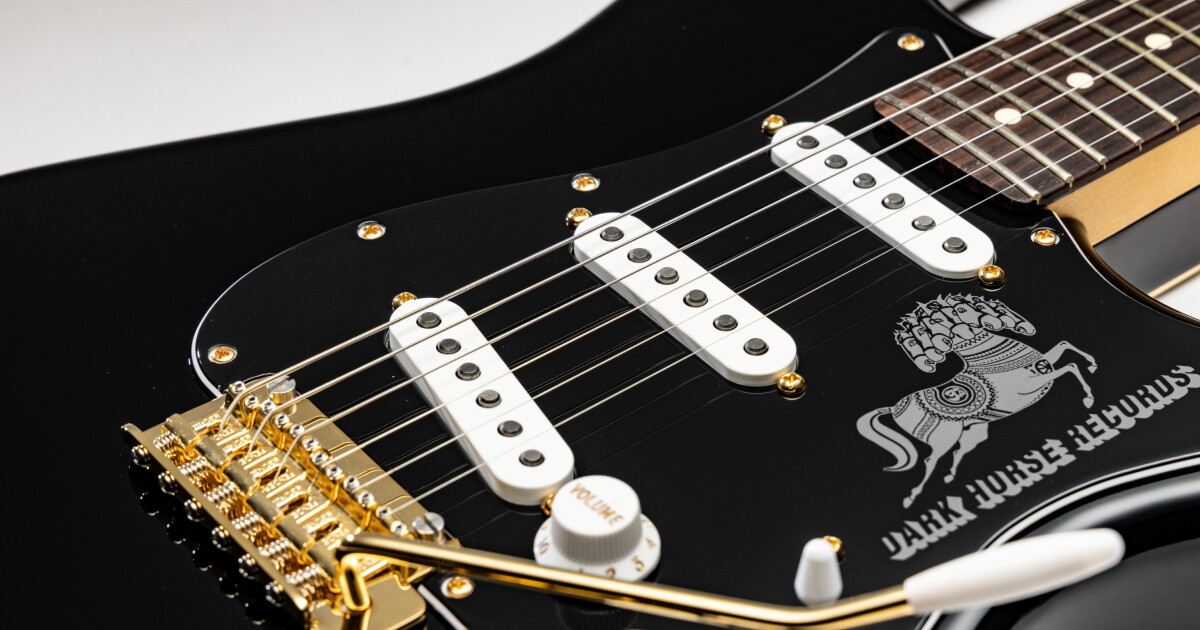
For the collaboration with Fender, Dhani wanted to highlight the logo his father used for Dark Horse when he established the company.
“He originally found it on a tin of tea when he visited India,” he says. “It’s a seven-headed flying horse in Hindu scripture named Uchchaihshravas. He turns up in a number of different tales, and he’s faster than the wind and is generally a badass.”

Barry Divola/New Atlas
Tellingly, the horse is traditionally white, but George made him black, and named his label Dark Horse as an allusion to the fact that he was making his mark as “the quiet one” and the often underestimated or overlooked songwriter in The Beatles.
The guitars in the range are available in black, orange and Olympic white, with a small Dark Horse logo on the face, and a large one spread across the back. The hardware is in gold, the body is alder, it has a modern C-shaped neck and three Player Series Alnico 5 Strat single coil pick-ups with a five-way switch. Plus, the neckplate bears an engraving of George’s signature.
There’s also a range of accessories, including guitar picks and straps, and t-shirts and jackets, some of which feature archival photos of George.
At the launch that evening, a couple of hours after our interview, Dhani also spoke about his love of Japan, and why he wanted to do this here.
“Japan is my favorite place,” he said. “I first came here when I was 13, and then it took me 30 years to come back again. I don’t know why it took me so long. I was always obsessed with the culture, the language, the anime, the film-making, the literature, the art and the food. Now I come here every year, and I just spent a month traveling around and visiting temples.
“I know Fender has a big presence and history here, and it’s one of their biggest markets, so when we started talking about this collaboration we threw everything into it. So many people come to Japan and take from the culture, but we wanted to give something back, especially to Japanese fans of my father’s music, because they are really loyal.”

Barry Divola/New Atlas
Five days after meeting Dhani Harrison, I’m sitting in the same space at the Fender Flagship Store with a knight. Like Fender, he also turned 80 this year.
Sir Paul Smith looks a good 15 years younger than his eight decades, and of course the famous English fashion designer is wearing his own brand – a double-breasted navy-blue suit over a white western style shirt, with his signature striped socks peeking out above black sneakers.
Smith has a long and deep association with music. At the age of 18 he designed a pair of crushed velvet flared pants for Jimmy Page (“I remember he had a 24-inch waist,” he says with a smile), and the two began an enduring friendship that has lasted over 60 years.
He was also mates with David Bowie.
“David used to call me Smithy,” he tells me. “He started out as a customer, but then we got to know each other and became friends. The thing I loved about him was that he was such a curious person and he had an unusual way of looking at the world. He would visit me in my office, which is full of stuff, and he’d pick up a book or an object and say, ‘Tell me all about this.'”
There’s a story about Bowie one day walking into Smith’s store in London and buying one of every shirt in his size. Those suits that Bowie, Reeves Gabrels and Tony and Hunt Sales are wearing on the cover of the 1989 Tin Machine debut album? All designed by Paul Smith. And at the end of his life, Bowie asked Smith to design the t-shirt for his final album, Blackstar, which was released two days before his death in January 2016.

Barry Divola/New Atlas
Members of The Beatles, with whom he’s also been close, have worn Paul Smith over the years, and he designed a limited-edition cover for the Rolling Stones’ 2023 album Hackney Diamonds.
When Smith appeared on the long-running BBC radio show Desert Island Discs, he said that he could have just chosen Van Morrison songs for his list because he is such a huge fan. He’s also a long-time follower and admirer of Bob Dylan, “but with both Van and Bob, if they’re in a good mood, the shows are amazing, but if they’re I in a grumpy mood, it’s not good.”
He casually mentions that Morrison once bought his house in London.
“I got a call a few days later saying that Van couldn’t get any hot water,” says Smith. “I thought, ‘Oh, here’s a good chance to go around and meet him.’ So I went around and showed him how to switch on the immersion heater and said, ‘There you go, you can have a bath now.'”
He can speak at length about seeing Jimi Hendrix play one of his very first shows in England in 1966, or being dumbstruck by seeing Talking Heads in 1977, before they had even released their debut album.

Fender
So, as both Fender and Smith were turning 80 in 2026, it seemed a bit of a no-brainer they would collaborate, especially as Smith’s association with Japan is as strong as Fender’s. He has rockstar status here – it accounts for 40% of his sales and is his biggest market.
“I first came here in 1982, and at one point I was coming out four times a year,” he says. “And as I’ve worked with so many bands over the years, when this conversation came up with Fender, it just seemed to be such an obvious thing to do it, and to do it here in Tokyo. They’re 80 years old, I’m 80 years old, and they still have such an important name and have kept their standards high.”
He decided to use a Telecaster for his signature guitar “because it was the original Fender guitar and had its 75th anniversary this year, and of course that’s what Jimmy (Page) used to play.”
Smith is famous for many things when it comes to fashion – popularizing boxer shorts and the Filofax in the ’80s; making his mark with suits that were “classic with a twist,” cut smartly and comfortably, but with brightly colored or strikingly patterned linings; and, most famously, for using stripes in many of his designs, which have become his trademark and calling card – and, at one time, an albatross.
“Any logo can become a blessing and a curse,” he says. “With the stripes, I became so associated with them that I pulled them at one point. That was a costly, stupid thing to do, so I brought them back but reimagined them.”
Part of that reimagining is bringing his signature style to a number of iconic brands – Mini cars, Anglepoise lamps, Leica cameras, Pinarello bicycles and more. The multi-colored stripes are boldly there on the Made In Japan Paul Smith Telecaster, a rainbow of color positively vibrating against the face and the back of the guitar’s alder body.

Barry Divola/New Atlas
The Tele has a maple neck with a rosewood fingerboard and a modern C-shape profile. The pickups are modified, there’s a vintage-style three-saddle bridge and the neckplate bears the unique Paul Smith logo.
There’s also a range of picks and a strap (striped, of course), along with a clothing collection that Smith says, “is inspired by the 1960s rock posters from Haight-Ashbury and San Francisco and the whole psychedelic summer-of-love era.”
At the launch that evening, Ed ‘Bud’ Cole presented Smith with a one-of-a-kind Stratocaster, custom-made and hand-painted especially for the designer, incorporating his color palettes and featuring a psychedelic design. It will be added to his archive, a vast collection of objects that reflects his wide interests, from art to vintage cameras to racing bicycles to rabbit figurines.
When I asked about whether he played guitar himself, Smith laughed and said, “I don’t have a musical bone in my body, even though I’m a huge music fan.”
He joked that he’d leave the music to that other famous Sir Paul, and stick to being a designer.

