


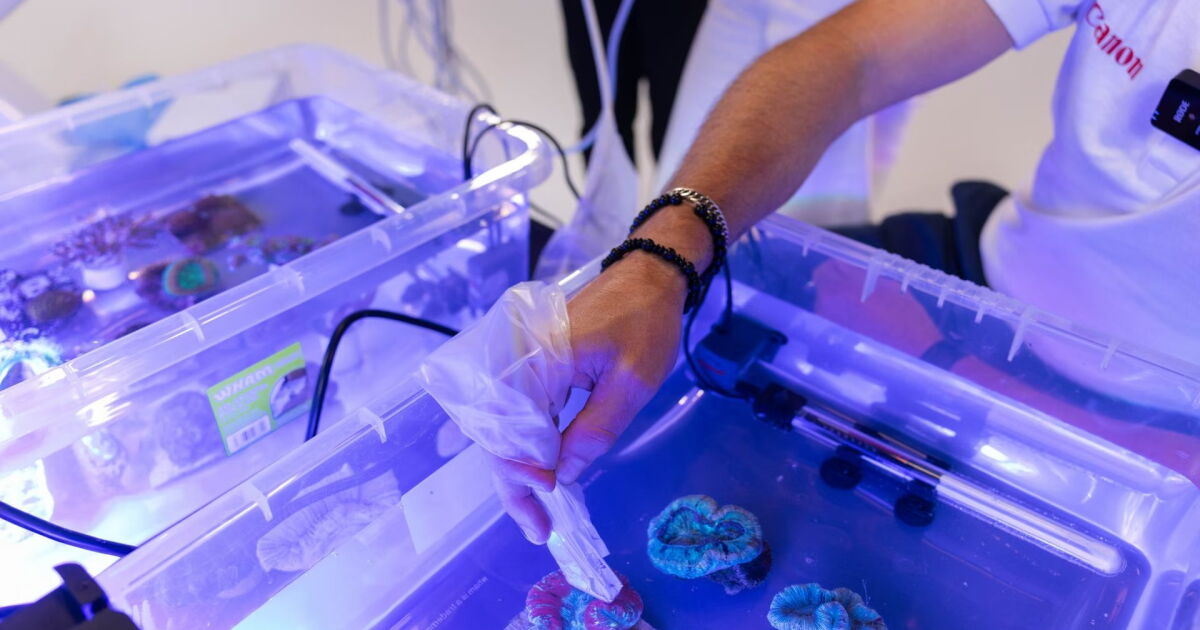
Ultrasound scanners usually spend their days giving expectant parents a first grainy look at their baby. Now Canon has pointed one of its machines at coral to see if it’s egg-laden, and to maybe help with its reproduction issues too.
Coral reefs cover just 1% of the ocean, yet shelter at least a quarter of all marine life. But heatwaves are bleaching corals faster than many can recover. Even the ones that pull through can pay for it in eggs. Researchers at the Australian Institute of Marine Science found that colonies of a common branching coral produced 21% fewer eggs after badly bleaching in 2020, but they had to dissect samples to count them.
In what Canon calls a world first, scientists at Coral Spawning International (CSI) used a medical scanner to spot eggs developing inside living corals underwater, without cutting into them.
Canon
The experiment, part of Canon EMEA’s World Unseen initiative, used an Aplio i700, an ultrasound platform built for hospitals. Its high- and ultra-high-frequency probes, coated in gel and wrapped in a protective sheath, scanned six species of large polyp stony (LPS) coral from Australia, the Caribbean and Indonesia, fully submerged in shallow tanks.
That, according to the researchers, was new territory even for the sonographer. “I’ve never scanned through salt water and certainly never scanned a coral,” says Sally Davey, clinical product specialist at Canon Medical Systems UK.
Coral eggs are tiny. They can be “as small as 300 microns,” says Jamie Craggs, co-founder of CSI. Until now, finding out whether a coral was carrying them meant damaging it. “Traditionally, in the case of branching corals, we would need to break a branch off to determine the reproductive status,” Craggs explains. “For LPS corals, we cut into a certain number to check for gametes.”
A World First: Scanning Corals with Ultrasound
The team fragmented one species, Trachyphyllia geoffroyi, and compared what was on screen with macro photographs of the tissue. “I am now able to definitively verify that I can observe oocyte [egg] development in the ultrasound scans,” says Craggs. “It was as clear as day!”
Knowing when coral is about to spawn is key to restoration. A common approach, coral gardening, grows fragments cut from the same colonies, so new reefs end up as clones. Breeding corals sexually adds genetic diversity, but only if you catch each colony at the right moment, which in the wild may come around just once a year. That’s the work that groups raising coral babies depend on.
“Corals still hold so many secrets, particularly when it comes to the complex processes that drive their reproduction,” says Craggs. “As we continue monitoring them through spawning, we hope to build an increasingly detailed picture of how different coral species reproduce.”

Canon
It’s early days, though. So far only T. geoffroyi has been checked against the traditional cut-and-look method, and the results haven’t been published in a peer-reviewed paper. Whether the scans can actually predict spawning will be decided over the next six months. The corals will be isolated daily, and the team will record when they release their gametes, then work back to the scan dates.
If it works, the scanner may not stay in the aquarium for long. According to Davey, the experiment “opens opportunities in fields such as minimally invasive surgery and diagnosis of dermal conditions.”
Source: Canon

