


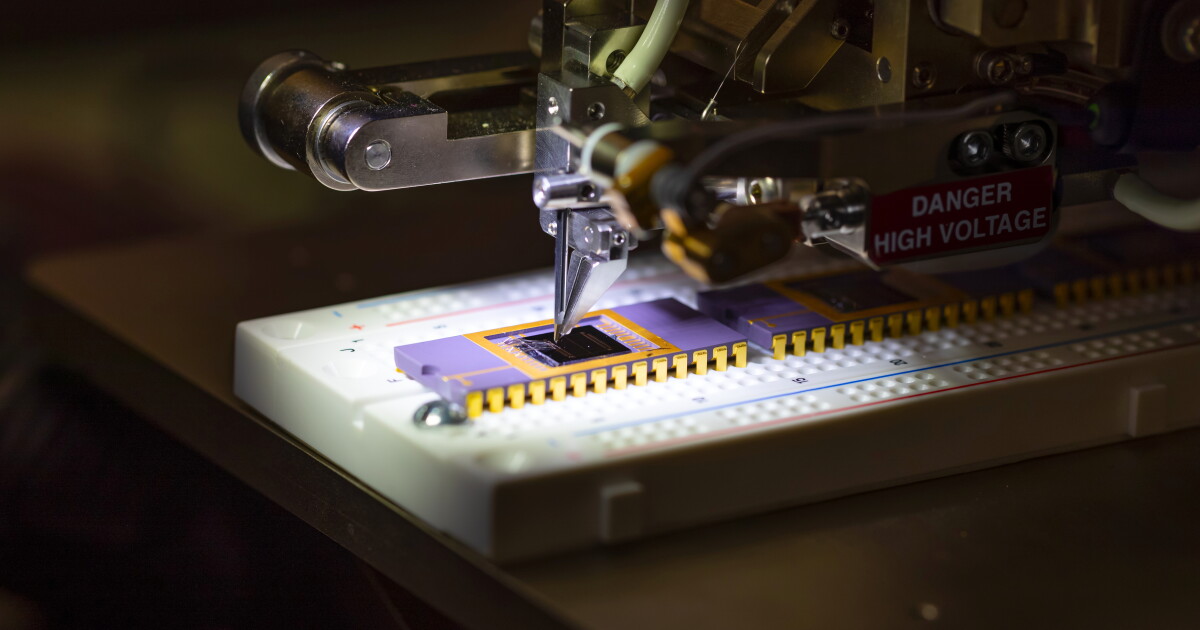
Thor, the Norse god of thunder, is famous for conjuring electricity from thin air. It turns out you don’t necessarily need a magical hammer to do this, as scientists have created a device that harvests electricity from radiation in its environment.
Researchers at the University of Arkansas and the University of Michigan have developed a graphene-based energy harvester that generates electricity by harnessing ambient radiation from nearby electrical wiring.
They demonstrated the technology with a battery-free temperature-sensing system, comprising the energy harvester, power conversion circuitry, energy-storage capacitors, and an ultra-low-power temperature sensor. The system functions wirelessly, generating the electricity to power the sensor via electromagnetic induction.
So, how does ambient radiation from electric wiring end up powering an independent device? Electric current flowing through a wire generates a magnetic field around it. With alternating current (AC), the field continually changes direction and strength as the current oscillates. In the US, where the researchers developed their system, this happens at 60 Hz (60 cycles per second). These changing magnetic fields carry energy.
The researchers figured out how to capture some of that energy and convert it into electricity sufficient to power a tiny temperature sensor. They fabricated an inductor from graphene and incorporated a steel core to improve its ability to capture the magnetic field. When placed near a power cable, the fluctuating magnetic field passes through the inductor and induces a tiny alternating voltage across it. This phenomenon is the same basic principle of electromagnetic induction behind conventional transformers and generators.
Now, this tiny electrical signal isn’t immediately useful for powering electronic components.
For starters, it’s alternating current, while the sensor requires direct current (DC). Its voltage is also way too low to power anything reliably. This brings us to the second part of the researcher’s device: the power conversion circuit and the energy storage.
The researchers developed a circuit, based on a Cockcroft-Walton voltage multiplier, that rectifies the AC signal into DC and progressively increases its voltage to levels suitable for the sensor electronics. Instead of using a conventional rechargeable battery, the system stores the harvested electricity in three capacitors. These capacitors gradually accumulate electrical charge. According to the researchers, the harvester replenishes the stored energy faster than the temperature sensor consumes it.
At this stage, even after all the tweaks, the electricity is still too low to power standard electronics. To address this limitation, the researchers took a “cut your coat according to your cloth” approach. They designed a custom ultra-low-power temperature-sensing system that operates at the nanowatt scale, consuming just billionths of a watt. For context, it technically consumes about 30 million times less power than a single AirPod.
Now, although the graphene inductor harvests energy relatively slowly, the researchers say it can replenish the capacitors faster than the sensor drains them. This allows the system to keep operating as long as sufficient electromagnetic energy is available. The capacitors also store excess energy, allowing the sensor to keep functioning even when the nearby electricity supply is interrupted. According to the researchers, the stored charge could keep it running for at least 24 hours, and possibly up to a week.
The inductor adds charge to these capacitors at a slow rate,” says Prof. Paul Thibado, the graphene energy harvester inventor. “But it’s faster than the rate the sensor uses up the charges from the capacitors. So even if the power went out, it can still pull a charge from the capacitors. The way ours are set up, it can easily last 24 hours – probably a week even.”
Russell Cothren
In summary, the researchers created a temperature-sensing system that runs on an infinitesimal amount of electricity drawn from ambient radiation by a dedicated graphene energy harvester. As long as there’s electricity in nearby wiring, the standalone system can continue its temperature-sensing duties indefinitely.
A perfect example of an application for the system is a large industrial facility with thousands of temperature sensors monitoring machinery, pipes, and the environment in general. Normally, these sensors need wired power supplies, with the complexity they bring, or batteries that eventually require replacement. With the researchers’ device, a plethora of sensors can work without a single wire or ever having to recharge.
Now for the clarifications and caveats.
First, the harvester demonstrated needs sufficiently strong changing magnetic fields near electrical wiring. It cannot simply generate electricity anywhere. Furthermore, the researchers haven’t shown that the system can start entirely on its own from a completely discharged state. The capacitors were initially charged and the processor programmed before operation. Lastly, the system’s nanowatt output can hardly power anything but the dedicated sensor. So, don’t get excited about a near future where your phone charges itself from thin air.
While they are working with temperature sensors as a proof of concept, the group envisions the system’s application in a wide range of low-power sensors for uses such as “product tracking, atmospheric monitoring, logistical fleet management, soil and wearable fitness monitoring, and medical tracking,” among others.
The researchers are also working on harvesting electricity from other sources such as acoustic, nonlinear, solar, thermal, kinetic, and ambient radiation, with the overall goal of developing autonomous sensor systems that draw power from multiple sources in the environment.
A paper on the study was published in the Journal of Vacuum Science and Technology.
Source: University of Arkansas

