


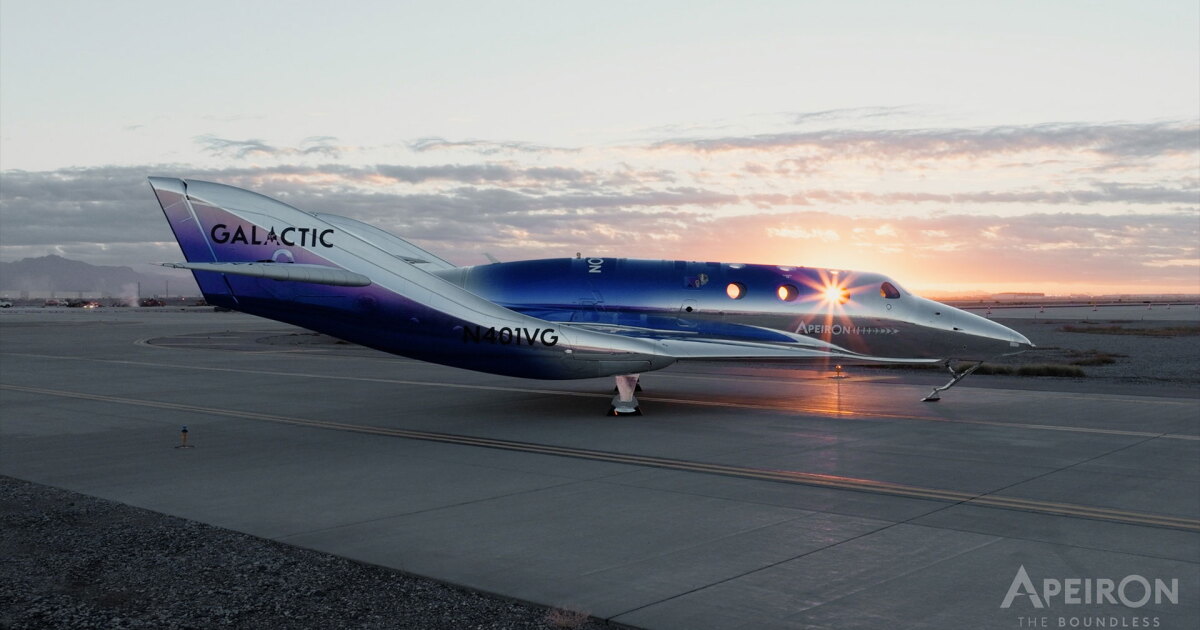
Virgin Galactic hasn’t flown anyone to space since June 2024. On Wednesday it finally showed off the spaceship it hopes will change that. Called Apeiron, it is designed to carry six passengers to the edge of space twice a week, for more than 500 missions.
The company unveiled the first of its next-generation Delta-class ships at its factory in Mesa, Arizona. The name Apeiron, ancient Greek for boundless, was selected through a public vote with participants from 83 countries.
A few hours after the announcement, the spacecraft left Phoenix-Mesa Gateway Airport sandwiched between the twin fuselages of Eve, the company’s carrier aircraft, and landed at Spaceport America in New Mexico about an hour and a half later. It was a captive-carry flight, so the spaceship was along for the ride rather than flying on its own.
Meet Spaceship Apeiron
On paper, the big change from its predecessor, VSS Unity, is the workload. Unity carried four passengers and flew seven commercial missions in about a year before it was retired. At its planned pace, a Delta ship would match that whole commercial career in less than a month.
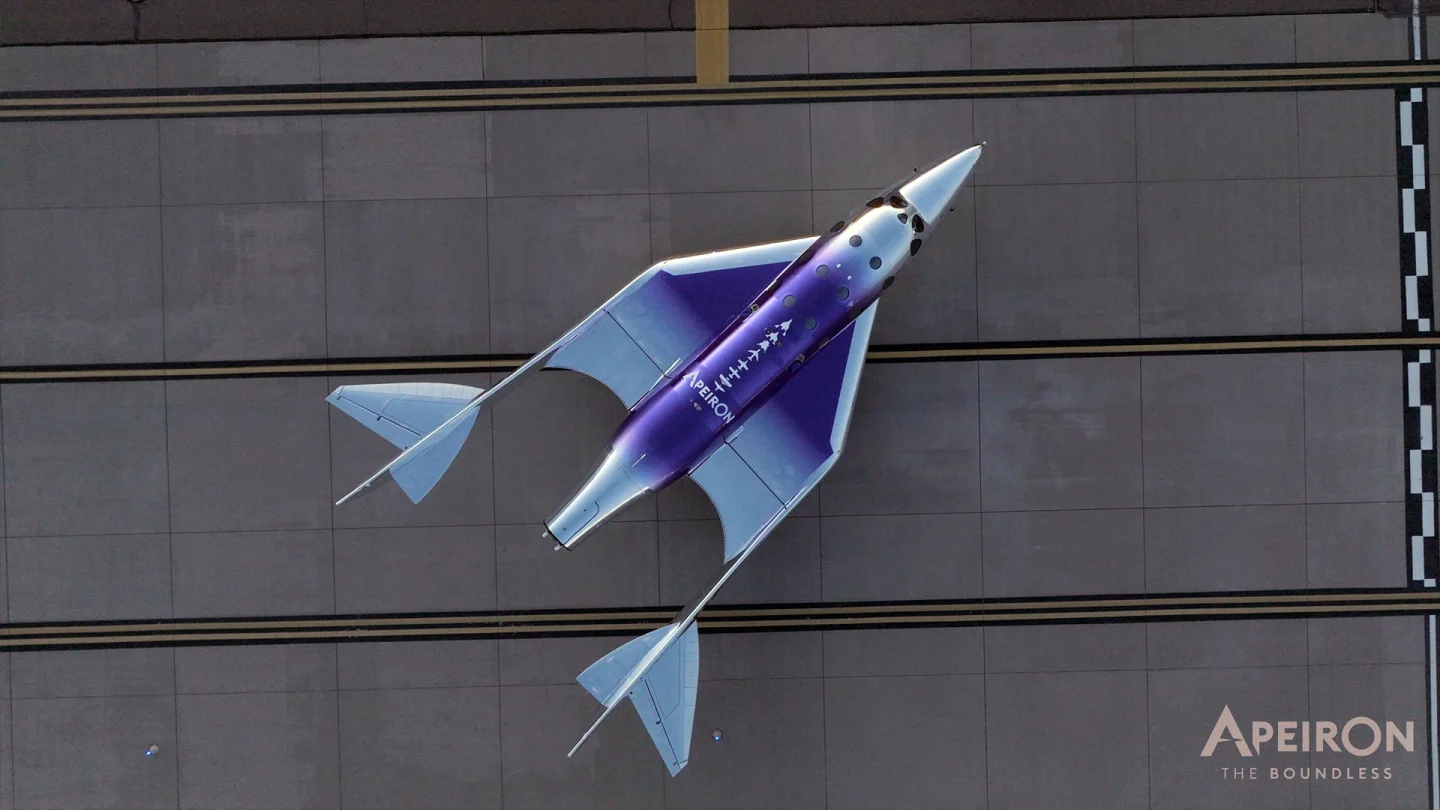
The propulsion method stays the same. Eve hauls the spaceship to about 45,000 ft (13.7 km) and lets it go. That’s still airliner territory, not space. Once released, the spaceship lights its rocket and climbs on its own, then glides back down to the runway after a few minutes of weightlessness.
How high Apeiron will go is something its powered test flights still have to show. Unity reached 55 miles (88.5 km) on its first tourist flight in August 2023. That’s above the 50-mile (80-km) line US agencies have long used to recognize spaceflight, though short of the 62-mile (100-km) Kármán line used by the Fédération Aéronautique Internationale.
Virgin Galactic
To build ships that can survive that kind of punishment, Virgin Galactic brought in outside help. Bell supplies the feather – the tail section that swings up to slow and stabilize the ship on reentry – along with control surfaces, while Qarbon Aerospace builds the fuselage and wing. Virgin Galactic keeps the design, integration and final assembly.
Of course, rolling a spaceship out of a hangar is the easy bit. Engineers at Spaceport America still have to finish integrating and validating the avionics software before glide and rocket-powered test flights can begin. Virgin Galactic now expects its first commercial flight in early Q2 2027, with a second ship following in late Q2 or early Q3. That’s the latest in a string of slips. When Unity retired, the company was aiming to fly Delta this year, and as recently as August it was still talking about February 2027.
Meanwhile, Virgin Galactic’s bank account is running its own countdown. The company made next to no money (US$134,000 in revenue) in the second quarter of 2026 while losing $56 million, and it expected to burn through up to $100 million more in the following quarter.
Virgin Galactic
Customers, at least, don’t seem to be the problem, even at eye-watering prices. As of June, around 675 future travelers were waiting in line with reservations worth some $203 million in expected revenue. The company’s latest batch of seats sold out at $750,000 each, and the next ones will cost more – around $850,000, according to Space.com. “Demand’s not a problem; they just need to get flying,” Chad Anderson of venture firm Space Capital told the Los Angeles Times. “It’s a question of whether they can do it every few days, like an airline.”
Its main rival is sitting this one out too. Blue Origin paused its New Shepard flights in January for at least two years to focus on its lunar plans, so when Virgin Galactic does return, it may have suborbital tourism largely to itself.
The company says it will share more about the flight test program during its third-quarter earnings call in November. After that, Apeiron has to prove it can do what Unity never managed – fly often enough to make the whole thing pay.
Source: Virgin Galactic

