


In the final weeks of the Second World War, a team of Germany’s most gifted scientists threw itself into a last-ditch effort to make an atomic weapon.
It was known as the B8 pile – a landmark experiment informed by years of research under the direction of none other than the renowned Nobel Laureate, Werner Heisenberg.
Heisenberg claimed in a 1947 Nature paper that B8’s uranium and heavy water reactor was merely “insufficient”, failing to ignite in a self-sustaining chain reaction for want of a little more uranium.
A study led by University of Maryland materials scientist Timothy Koeth now claims Heisenberg’s project had virtually no hope of success, requiring 20% more uranium and 80% more heavy water than was available to Germany at the time.
Short of developing a god-like level of coordination and oversight, Hitler would have been far from making the weapon of weapons during the conflict.
Long before the famous Manhattan Project was established in early August 1942, another effort to weaponise half a century of advances in physics was underway. Within months of nuclear fission’s first experimental observations in 1939, Germany was investigating its practical applications in what would become known as Uranprojekt.
The outbreak of war that September turned the research towards more destructive outcomes, with numerous early reactors, or “piles”, being built in Leipzig, Berlin, and Gottow to study the phenomenon.
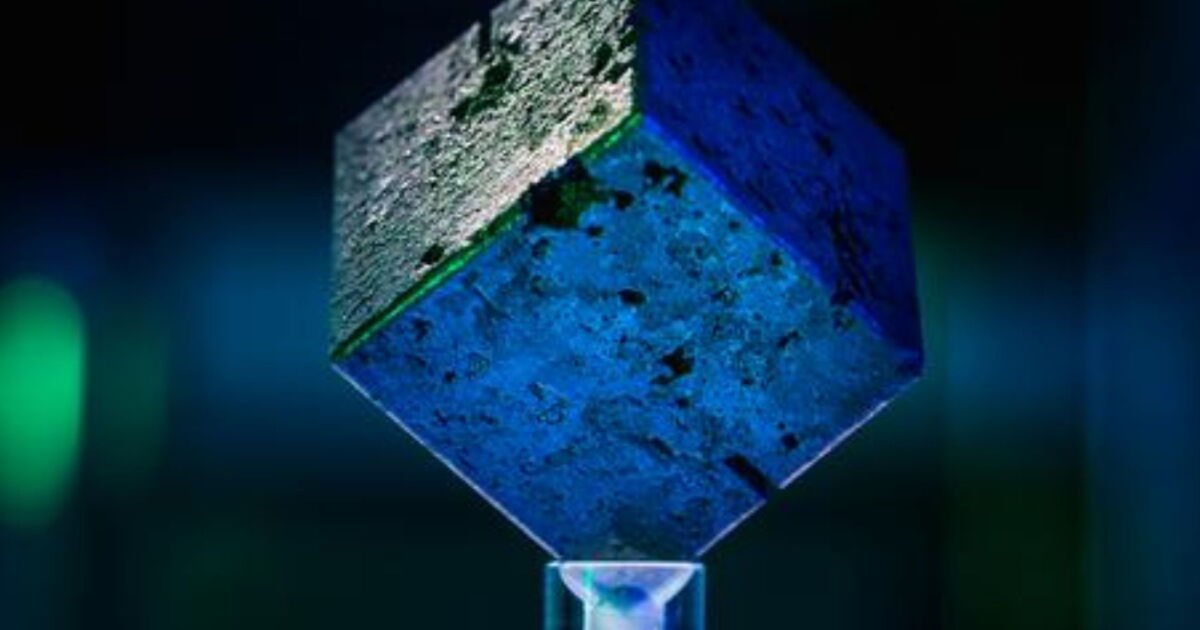
Berlin’s pile number 8, or B8, was a chandelier of 664 uranium cubes arranged in concentric rings within a pool of heavy water, surrounded by a wall of graphite.
The theory was pretty straightforward. Natural uranium contains a mix of isotopes, of which only a tiny fraction can sustain an explosive chain reaction. Inserting neutrons into the uranium mix forces some of them to transform into a more reactive material, such as the isotope plutonium-239.
Uranium’s massive nuclei emit neutrons simply as they decay. Each freed neutron can potentially trigger further decay in surrounding atoms, but only when they move slowly enough for nuclei to grab hold. Hydrogen atoms with an extra neutron – the kind found in “heavy” water – provide enough of an obstacle course to put the brakes on the speeding particles without soaking them all up. Surrounding the setup with graphite sends stray neutrons back into the game.
To produce the plutonium, this process needs to be self-sustaining, meaning every neutron’s release has to trigger the release of at least one more.
Despite being Germany’s most advanced nuclear pile, B8 fell short of the critical 100% mark even as Allied forces marched on the German capital.
To Heisenberg, it may have been a matter of needing more materials. Its supply of heavy water had come from a single plant in Norway that was destroyed in 1944.
Yet Germany’s meager amount of uranium ore had been divided between different piles in the project.
“In practice … since more [heavy water] was not available, uranium would also be brought into the graphite reflector, which would probably have been sufficient to reach criticality,” Heisenberg speculated in his letter to Nature.
Ever since, researchers have wondered … what if?
Most of Uranprojekt’s cubes have vanished over the years, disappearing on a post-war black market. But not all. In 2013, Koeth received one as a birthday present. Intrigued by its history, he and fellow researcher Miriam Hiebert did the math on Germany’s stockpiles and figured there may have been enough there for them to have achieved criticality, had they pooled them in one place.
After further research, Koeth isn’t so sure.
A more thorough study involving two of the cubes and historical documentation showed Heisenberg’s sums were accurate – B8’s neutron multiplication factor was a few short of the 100 needed for a self-sustaining reaction. The entire experiment would have required twice as much uranium to work, and more than double the volume of heavy water.
There simply wasn’t enough of either scattered across the piles, the team found. Even a few tweaks on the experiment to substitute the heavy water for a layer of graphite would have failed, given the purity of the materials available.
Did Germany ever have a chance at building an atomic bomb? That might be a harder question to answer. In another universe, with different minds and a higher prioritisation of the project, some might argue it was possible.
Thankfully, that isn’t the universe we live in now.
This research was published in PNAS Nexus
Source: Eurekalert

