


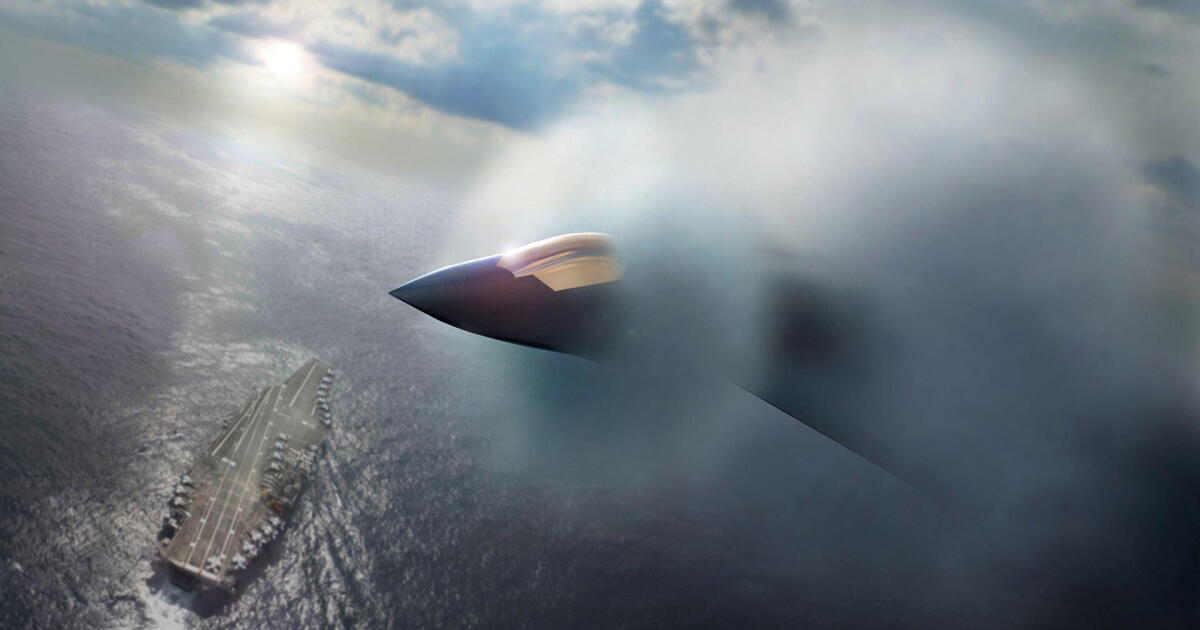
Boeing has been awarded a US$20-billion contract by the US Navy to develop the super-secret F/A-XX 6th-Generation fighter plane. The question is, what’s under the covers for this aircraft that we’ve only caught glimpses of?
It may seem a bit redundant that the US Navy wants its own state-of-the-art fighter while the US Air Force is developing one as well. Surely, the more efficient and economical approach would be to build a common fighter with a naval variant.
In fact, there’s more to it than traditional inter-service rivalry, though I wouldn’t rule that out. The sticking point is one of missions. The Air Force wants a fighter that is a dedicated air superiority interceptor while the Navy needs a multi-role fighter that can operate from carriers, conduct strike missions, and engage surface targets.
The carrier requirement is especially important because taking off and landing on a ship’s deck requires a much more robust airframe with an engine that can handle catapult launches, wire-arrest landings, and is resistant to the corrosive effects of saltwater spray. All that means heavier construction and a sturdier undercarriage, which affects things like takeoff weight and operational range. It also means a larger payload bay and room for more fuel tanks.
But now that Boeing has stolen a march on rival Northrop Grumman for the contract, what will the supersonic-cruise F/A-XX look like?
Boeing
That is a very good question.
Though some concept drawings were released by the company shortly after the project began in 2008, more recent renditions have been little more than hints showing the craft as an outline in the haze, with only the nose and cockpit showing clearly. Worse, a lot of details about the F/A-XX are highly classified, so we’re in the position of the viewers of a television series full of mystery boxes.
One of the released renders shows the aircraft on a carrier deck standing in a cloud of catapult steam. However, we can see that the airframe is noticeably broader than many fighter planes, confirming the larger internal volume for weapons and enough fuel for a range of 700 nautical miles (805 miles, 1,296 km).
There are also chines running along the fuselage, which provide better aerodynamics, with lift being particularly improved for carrier operations. They also improve stealth by deflecting radar signals. There’s also a suggestion of forward-mounted canards, which are interesting. On the one hand, such control surfaces can reduce stealth, but they are also critical for low-speed pitch control and stability during carrier approach, so there’s a trade-off.
Another thing that stands out in the renders is the cockpit. The low-profile bubble canopy and blended upper fuselage has the disadvantage of limiting the pilot’s rear vision, suggesting that the F/A-XX has an advanced sensor suite and helmet-mounted display to provide the pilot with “invisible aircraft” vision where it seems like one is looking straight through the fuselage in any direction.
Then there’s what isn’t there. That “what isn’t” is the empennage. That is, the rear stabilizer with the rudder. This panel of metal sticking up out of the aircraft is a perfect right-angle surface for reflecting radar, so military aerospace engineers prefer to replace this with elevons and other control surfaces in the wing to perform the same functions as a conventional tail.
As for the rest, we’ll have to wait and see.
“It’s an honor to be selected to produce the Navy’s first sixth-generation platform,” said Steve Parker, president and chief executive officer, Boeing Defense, Space & Security. “Backed by decades of work, bolstered by game-changing innovations and solidified by the investments we’ve made in new facilities uniquely suited to build multiple products with next-generation capabilities, our dedicated and talented team is ready to execute this critical program.”
Source: Boeing

