


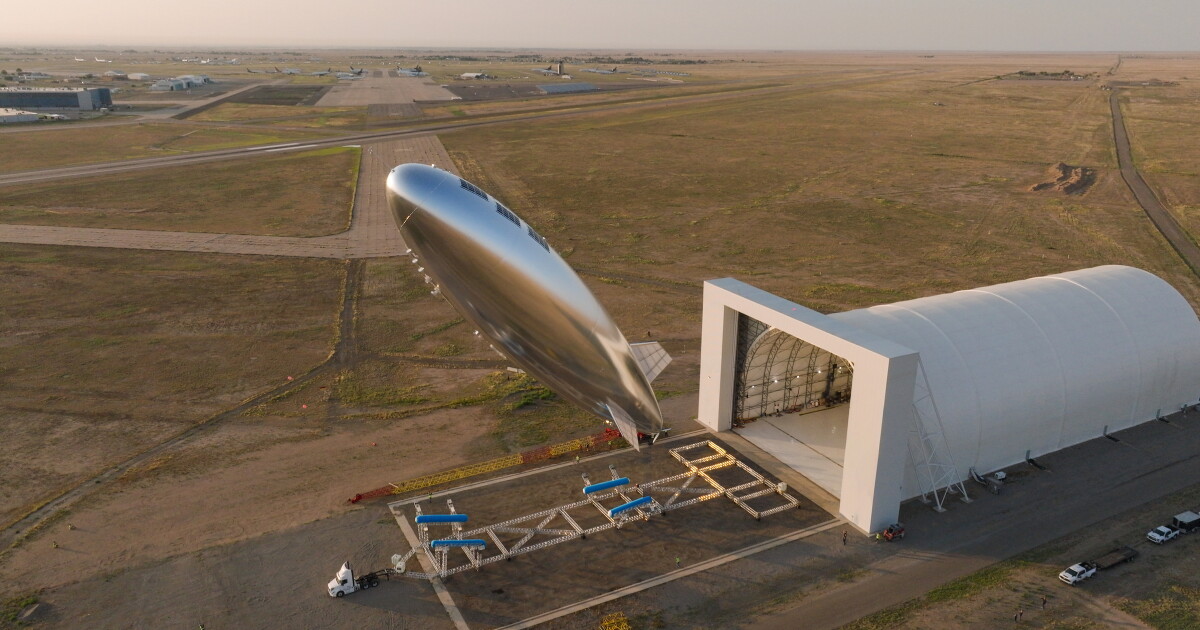
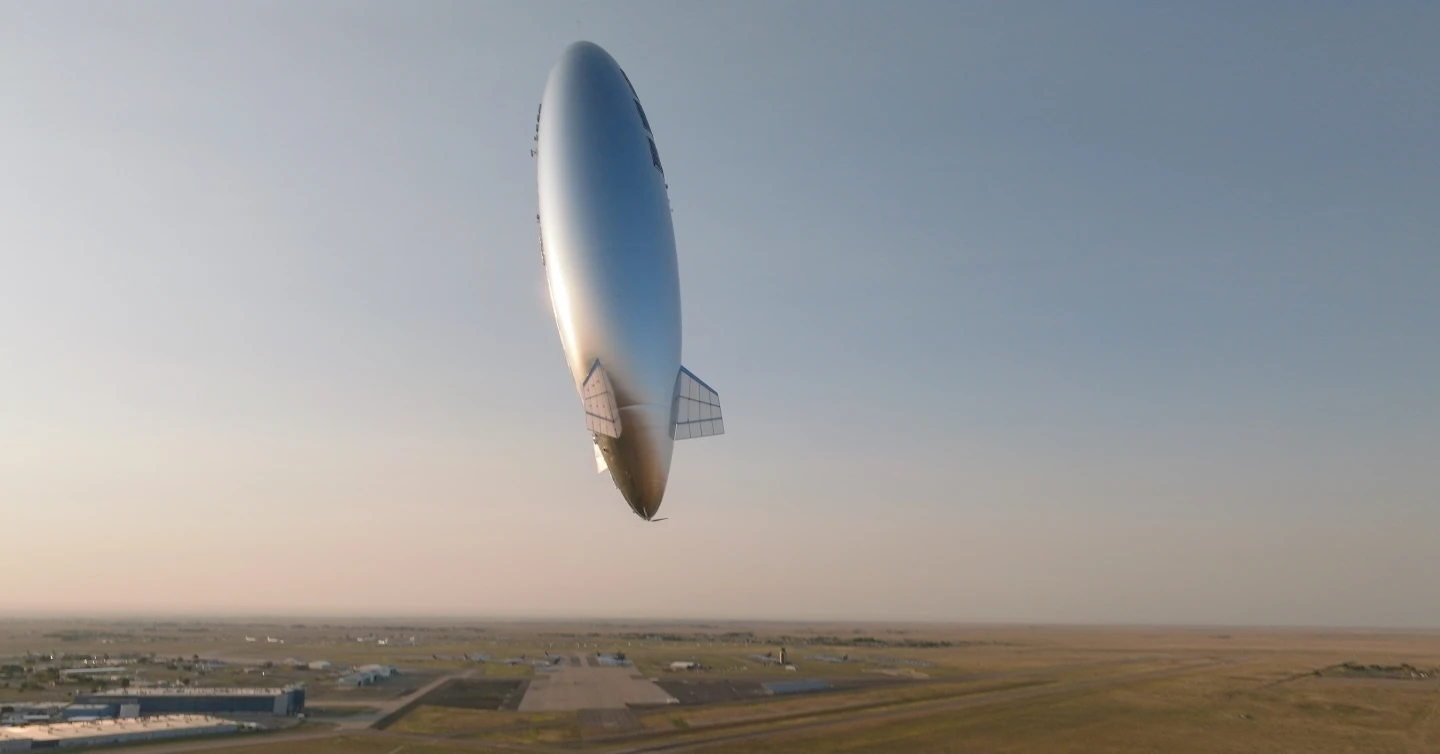
An unmanned Sceye airship flew from New Mexico to Japan and back, beaming mobile cell service to ordinary phones from the stratosphere. Still a test, but SoftBank – one of Japan’s major mobile carriers – eyes commercial service in Japan from 2027.
The company’s mission, called Service Test 1 (ST1), lifted off on August 9 from Roswell, New Mexico. The airship reached Japan 13 days later and covered nearly 30,000 km (18,600 miles) in total. It returned to the continental US on September 4 and landed on September 5 near Sceye’s headquarters in Moriarty, New Mexico.
This class of technology is known as a HAPS, or high-altitude platform station. It’s essentially a cell tower that hovers in the stratosphere, the layer of atmosphere above where commercial airliners fly.
Sceye
According to Sceye, the craft spent more than seven days over Japanese airspace. It flew at 16.5 to 17 km (about 54,100 to 55,800 ft) and maintained a station-keeping radius as small as 5 km (3.1 miles) around its target operating area off Cape Muroto.
It carried SceyeCELL, which is the actual cell tower. Working through the core network of Japanese carrier SoftBank Corp., it delivered mobile broadband directly to unmodified devices. SoftBank teams sent messages, made calls, browsed the web and played video outdoors, under trees and indoors.
“That demonstrated how the stratospheric layer can extend an existing mobile network,” Sceye CTO Johnny Truong tells me by email. The companies say performance matched ground towers and interference with them was reduced. The team also tested a disaster alert system and communication with drones, part of a plan for a three-dimensional network.
Sceye
In what the companies call a world first, they put a server and part of the mobile network’s “brain” (the core that routes calls and data) on the airship itself. Phones no longer had to send data to faraway servers and wait for an answer. The airship handled it up there and sent the reply straight back. Average response time was 68 milliseconds, more than 40% lower latency than the remote route, according to Sceye.
The company says each platform at full deployment would cover the area of about 500 ground towers. Truong cautions against reading that as a crowd limit. The figure “is not a measure of network capacity or the number of people who can use the service simultaneously,” he adds. Performance will depend on available radio frequencies, the link back to the core network and how many people are online at once.
Sceye isn’t pitching a replacement for satellites or ground networks. Truong describes ground networks as high capacity where people cluster, satellites as wide-area coverage, and the stratospheric layer as a bridge for places that are hard or expensive to serve. The next big goal is linking satellites to the platform by laser. From there, data would drop to the ground by laser light in clear weather and by radio when clouds get in the way.

Sceye
ST1 offered a first taste. SoftBank, Hitotsubashi University and Japan’s National Institute of Polar Research fired laser pulses at the craft, which carried an institute-designed reflector. The team continuously received the returning light while the airship drifted. The data on light lost along the way will help shape future onboard optical hardware.
Sceye isn’t floating alone up there, and not everyone is betting on blimps. Airbus subsidiary AALTO flies Zephyr, a solar-electric plane with fixed wings that cruises above about 18 km (60,000 ft). AeroVironment and SoftBank are developing Sunglider, a solar-powered flying wing. Britain’s Stratospheric Platforms is testing hydrogen-powered craft.
Sceye’s counterpunch is that a lighter-than-air airship can carry bigger antenna arrays than its winged rivals. Truong compares the platform to a geostationary satellite that is 1,800 times closer and much cheaper, though the company hasn’t offered figures to check that. There’s no pricing or coverage plan yet, and no comparison with Starlink or other existing systems.
The plan is to sell through carriers such as SoftBank, which says it aims to move toward commercial service in Japan from 2027. Truong says the focus now is “serving more people for longer periods.”
Source: Sceye

