


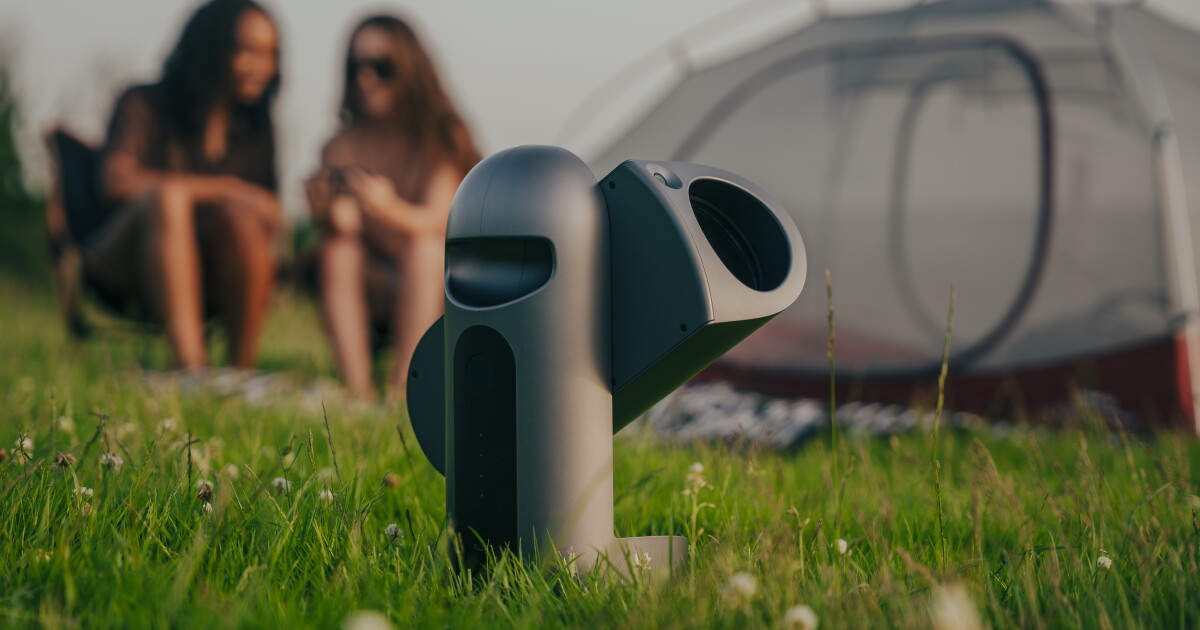
Draco, DwarfLab’s new smart telescope, solves deep-sky astrophotography’s oldest headache with a sensor that physically spins to cancel out star trails caused by Earth’s rotation. It needs no equatorial mount, no guide scope, and no polar alignment. Just a bigger 90-mm lens and a bet that raw aperture beats miniaturization.
Smart telescopes have mostly competed on convenience: point, tap, and let an app do the rest. What they’ve traded away is the raw light-gathering power serious deep-sky work needs, since a bigger mirror or lens usually means a bigger, pricier mount to keep it steady. Draco is DwarfLab’s attempt to have both. It’s the company’s first real swing at matching entry-level telescopes on optical power, without asking a beginner to learn what an equatorial mount even is.
The mechanical trick Draco uses to solve field rotation, the slow twisting of the sky’s image that causes those star trails, is almost backward. Instead of relying on a motorized mount to track the sky, its CMOS sensor physically rotates to cancel that rotation out, right at the image plane. That’s backed by continuous star drift correction and a precision drive. Together, they let Draco shoot single exposures up to 300 seconds in its simplest altitude-azimuth mode (it points up and sideways rather than tracking Earth’s rotational axis) without smearing stars into streaks.
DwarfLab
It’s a clever workaround, but it’s also a fix for a problem DwarfLab’s own compact design helped create: a lighter, simpler mount is easier to sell but harder to keep steady during long exposures. The rotating sensor solves that trade-off in hardware. Photographers who still prefer the traditional approach can switch on an optional equatorial tracking mode or dig into Pro Mode for manual control over exposure and gain, from 1/10,000 of a second up to that 300-second ceiling.
The new telescope weighs approximately 5.5 kg (12.1 lb). The Dwarf III weighed 1.35 kg (3 lb), and the Dwarf Mini, launched in late 2025, dropped that further to 840 g (1.85 lb). Draco keeps the same one-tap simplicity that defined those earlier models, just with a much larger optical system. It carries a 90-mm lens with a 340-mm focal length and an f/3.8 focal ratio, folded into a body just 386 mm (15.2 in) long. Small enough for a suitcase, but designed on the idea that more glass, not less weight, is what actually improves the images.
That f/3.8 speed isn’t just a spec sheet number. DwarfLab says it gathers roughly 2.2 times more light than a typical f/5.6 setup. In real terms, that means shorter exposure times to pull a clean image out of a faint galaxy or nebula and fewer hours standing in the cold waiting for enough photons to hit the sensor.

DwarfLab
Its 77-Wh battery runs up to five hours per charge, depending on imaging mode and conditions, and it carries an IP56 rating for dust and water resistance, operating from –20 °C to 45 °C (–4 °F to 113 °F).
Draco’s main camera uses a 50-megapixel, 1/1.3-inch sensor that does double duty. For deep-sky targets, it bins pixels 2×2, merging four into one, to boost light sensitivity at the cost of resolution (roughly 12 MP). For the Sun, Moon, and planets, it flips to full native resolution to catch fine detail like lunar craters or Saturn’s rings.
DwarfLab has opened pre-orders for two versions. The Standard Edition (US$1,299) bundles a dual-narrowband H-alpha plus OIII filter (tuned to the exact wavelengths hydrogen and oxygen gas emit in nebulae) with a built-in solar ND filter, covering nebulae and casual solar imaging in one box.
The SHO Edition ($1,499) swaps the internal solar filter for a built-in S II plus OIII filter, adding sulfur to the mix so it can automatically capture and combine all three gases for the blue-and-gold Hubble Palette look. It still comes with an ND filter for solar imaging, but as an external accessory rather than a built-in one, so it has to be attached by hand. Proof that not everything can be automated, at least not yet.
Source: DwarfLab

