


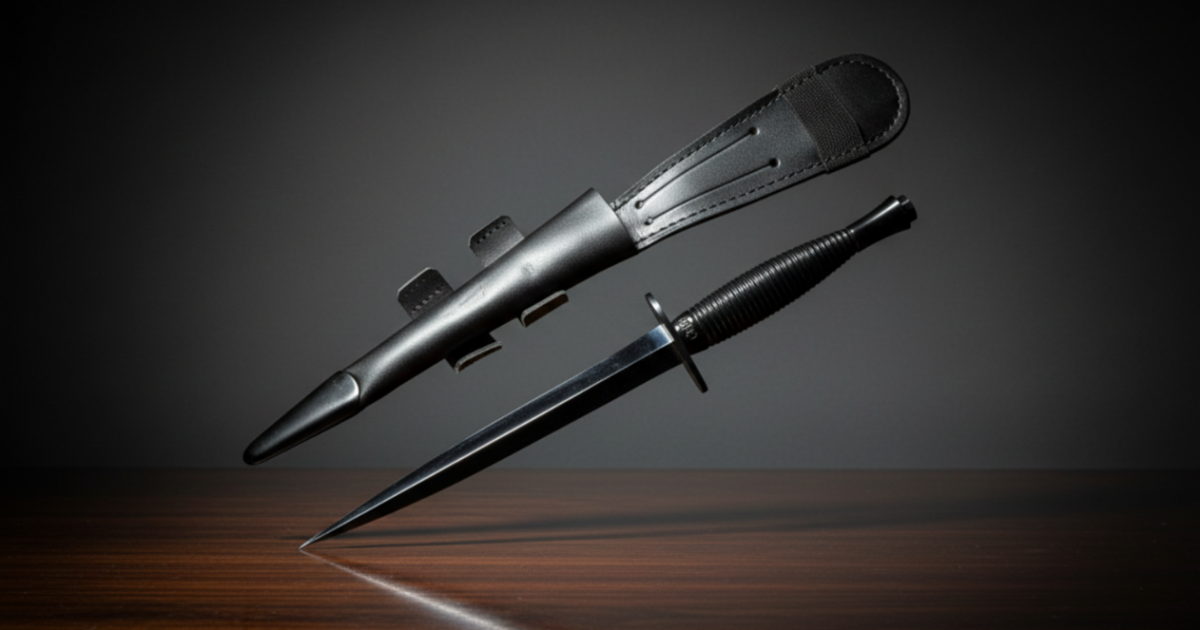
When we think of game-changing weapons, it brings to mind hydrogen bombs, ICBMs, nuclear submarines, hypersonic missiles, and lasers. But one of the most significant weapons was a knife. New Atlas looks at the legendary Fairbairn-Sykes fighting knife.
On June 4, 1940, Britain stood alone against Nazi Germany with its back to the wall and little to fight with. While the Royal Navy still commanded the seas, Britain itself had few options.
On May 10, the so-called Phoney War came to a frightening end. The land forces of Germany, France, and Britain had been facing one another since war was declared on September 1, 1939, until the standoff became something of a grim joke. The punchline became a very unfunny one when the Wehrmacht launched its blitzkrieg campaign in May, overrunning Belgium and the Netherlands in a matter of days.
David Szondy/New Atlas
With the fall of France becoming a certainty, Britain ordered the evacuation of the British Expeditionary Force. What was left of the RAF fighter squadrons flew home while the Army units plus what was left of the French Army fell back on the beaches of Dunkirk on the Channel coast.
What followed was eight days of evacuation by the Royal Navy aided by a fleet of small private boats that crossed the English Channel to aid in getting the men off the beaches. When Operation Dynamo ended on June 4, 1940, 338,226 Allied troops had been rescued.
It was a defeat that, in many ways, felt like a victory, but the fact of the matter was that the Army had to abandon all of its equipment and weapons on the beaches. It appeared as if Britain had no choice but to go entirely on the defensive and await the threat of a certain German invasion.

Crown Copyright
However, the new Prime Minister, Winston Churchill, had other ideas. On the very day the Dunkirk evacuation was completed, Churchill declared that Britain would go on the offensive and take the war to the enemy as soon as possible in the form of “specially trained troops of the hunter class,” who would carry out raids on the European coast. The goal was to strike terror in the hearts of the enemy while giving reassurance to the people back home.
The next day, the first of the British Commando units were proposed and then established, along with secret training camps around the country on June 14. This was followed by the creation of the Special Operations Executive (SOE) on July 22 to handle espionage and resistance agents, and the first raids were already being carried out.
There was only one small hitch. The Commandos and Special Ops agents were practically unarmed. Returning raiding parties had to hand over their Thompson sub-machine guns to the outgoing lot and the usual backup sidearms were missing entirely. The arms shortage was so bad that the government asked American and Canadian sport shooters to donate their arms to Britain’s Home Guard.

David Szondy/New Atlas
What was needed was a cheap, effective weapon that could be produced quickly and in large numbers with the scarce resources available in a country committed to total war. Unfortunately, military knives of the time were mainly repurposed WWI trench knives or heavy utility blades, plus whatever else happened to be available.
That is where the Fairbairn-Sykes knife comes in.
William Ewart Fairbairn and Eric Anthony Sykes were two former officers of the Shanghai Municipal Police (SMP). In the 1930s, Shanghai was an international city where foreign nationals congregated for trade and other reasons. It was also the focal point for the rising power of the Chinese Nationalists, and Communists mixed in with the feuding warlords until it became one of, if not the, most violent and crime-ridden cities on the face of the Earth.

David Szondy/New Atlas
To cope with this, Fairbairn and Sykes used their experience of hundreds of close-quarter combat incidents to develop new police techniques that continue to this day in modern SWAT teams. They learned to train police officers in hand-to-hand combat that combined many forms of martial arts under highly realistic simulations, including the use of knives as a way to quickly neutralize violent offenders.
They even developed a new knife with a fixed, short, stabbing blade that could easily be concealed and then brought into action quickly.
These Shanghai knives became the inspiration for the Fairbairn-Sykes knife when the two returned to Britain in 1940 to help in training the new Commando force. As part of this, they collaborated with the Wilkinson Sword Company in London to design a specialized combat knife.

Crown Copyright
The new knife had to meet a number of specifications.
First, the knife had to be able penetrate deep into its target, even through heavy winter clothing, to deliver a blow that would quickly incapacitate. This resulted in a 7-inch (18-cm) stiletto-style, double-edged blade with a diamond cross section that tapered to a needle-sharp point made for stabbing and thrusting rather than cutting.
Second, the blade needed to be smooth so it could be inserted and removed quickly and without resistance, so the edge was unserrated, with the cross section meant to minimize friction so little force was needed to use it.

David Szondy/New Atlas
Third, it had to be designed for very precise control, yet able to be switched between grips or even tossed to either hand at a moment’s notice without a thought, so it had to be very light. This resulted in the center of gravity being placed at the junction of the blade and the crossguard behind which was a “Coke bottle”-shaped handle that allowed for a precise pencil or fencing grip.
Fourth, the handle needed to be patterned for a secure grip even in dirty, wet conditions, so checkering or deep ribbing was added to the alloy metal. In addition, the crossguard had to be wide enough to prevent the user’s hand from sliding onto the blade by accident.
Since the Wilkinson Sword Company had a reputation for fine craftsmanship because it started out making, well, swords, the Pattern One Fairbairn-Sykes knives created in November 1940 and entering production in January 1941 were exquisite handcrafted items. The Pattern One had a hand-forged steel blade with a flat ricasso with the Wilkinson logo and F-S etched in acid on it, an S-shaped crossguard, and a brass Coke-bottle handle with hand-cut cross-stitching.

David Szondy/New Atlas
It came with a leather sheath with a nickel-plated brass tip to protect the needle-sharp dagger point from damage and the wearer from the dagger point, and a snap fastener to keep the hilt in place during energetic activities.
The Pattern One met most of the requirements, and over 7,000 were produced. The main problem was that, though it was a very good knife, it was also very slow and expensive to make, relying heavily on expert craftsmen to do the job. They were also a bit on the costly side at 13 shillings and 6 pence. That’s about US$65 in today’s money, which was far too much for a nation at war.
This led to the Pattern Two, which was ordered in August 1941. The mandate was that the Pattern Two be cheaper and quicker to produce, with a simplified design so it could be farmed out to other companies.

Crown Copyright
The Pattern Two differed from the Pattern One in that the ricasso was removed and the blade was ground all the way to the hilt, though the acid-etched logo was often retained. In addition, the crossguard was straightened and oval-shaped. Meanwhile, the grip was still the same shape and made of brass, but the cross-stitch pattern was cut by machine rather than hand. As with the Pattern One, the grip ended in a round top nut, which secured the rat-tail tang to the grip, though the fitting was now done by cutting off the tang to length and cutting in the screw to take the nut.
Another change was to the sheath. Like the Pattern One sheath, it had little leather tabs on the side, so it could be sewn to a soldier’s battledress, but the securing snap was replaced with an elastic band. This was a simpler and more secure replacement, though the elastic did tend to perish rather quickly in wet or tropical conditions.
It’s estimated that about 38,000 of the Pattern Two were made by October 1943, when production started on Pattern Three, which is the design we’re most familiar with today.

David Szondy/New Atlas
The most distinct change in the Pattern Three was that it now became standard to chemically blacken the knife so it wouldn’t catch the light and ruin the Commando’s day. It also made it look as scary as all get out.
The other distinction was that the handle was now made of a zinc alloy and was cast with parallel ribs in concentric rings. This was both easier to make and gave a better grip with gloves or wet hands. In addition, the pommel nut was modified to fit mass production.
And the production was mass, reaching 200,000 by the end of the war. But even this figure is likely conservative, as wartime manufacture was distributed across numerous contractors in Sheffield and beyond, with clones and adaptations produced in the United States, Canada, Australia, and clandestinely in occupied Europe.

David Szondy/New Atlas
Part of the reason for this was that many Allied forces adopted the Fairbairn-Sykes knife, especially the Americans. The American Office of Strategic Services (OSS) issued its own direct clone (the OSS Dagger), while the US Marine Raiders developed the Raider Stiletto, a closely inspired design tailored to their own specifications.
Special needs also led to a number of variants of the knife. Due to brass shortages, some knives had to be made with wooden handles, out of compressed leather washers, or bakelite plastic.
More exotic variants were made for the SOE. These include what were called “suicide knives,” which had a secret compartment in the handle that held a vial of cyanide in case an agent was captured. This was discontinued when SOE chiefs realized that a dagger would be the first thing taken from a prisoner. Other secret variants included simplified, unsharpened ones to be dropped to resistance fighters that would hide their origin, as well as special small versions or ones with rings in the handle so they could be sewn into clothing or boots.

David Szondy/New Atlas
But the knife was only half of the equation. Fairbairn and Sykes also realized that training was just as important, operating under the premise that there aren’t dangerous weapons, only dangerous men and women.
Called Defendu, the fighting technique with the knife was a combination of fierce aggression, speed, and strength to subdue an opponent as quickly as possible. The training also involved using real knives as much as possible to get recruits used to the sharp blades and to instill the needed fighting ethos.
Without going into the unpleasant details (trust me on this one), Defendu taught the Commandos and others how to close with and neutralize sentries and other enemy soldiers as fast and as silently as possible by striking at vulnerable regions with a single blow delivered with frightening efficiency.

Crown Copyright
It may seem appalling to modern readers, but all of these techniques were made public in eye-raising detail in a bestselling paperback you could buy at any newsagent’s. I had a copy myself.
And people complain about the internet.
It also led to some famous individuals having some rather arcane knowledge. While he was working on The Lord of the Rings trilogy of films, Christopher Lee, who was playing the evil wizard Saruman, was supposed to be stabbed in the back with a dagger. When director Peter Jackson told Lee to cry out, Lee, who had been involved with British special forces and knew his way around a Fairbairn-Sykes knife, replied, “Have you any idea what noise a man makes when he’s stabbed in the back? Because I do.”
There’s no answer to that.

Crown Copyright
The Fairbairn-Sykes knife was by no means a perfect knife. It had its inherent flaws, such as the fact that the Coke bottle grip was too symmetrical, so it was hard to judge which way the blade was angled in the hand. The tang had a tendency to work loose, and the sheath would often be less than secure, letting the knife fall out during a parachute drop. Many of the blades made late in the war were rushed through production, and many slipped through that were too brittle or too soft.
It also suffered from being too specialized (a general note to any tool designer). Yes, it was very good as a fighting knife, but it was also expected to act as a general service knife, to which it was very ill-suited. That wicked blade might have been great for combat or scaring the life out of people, but it was also delicate and the tip had a habit of snapping when put to hard work. Also, the lack of serrations to reduce friction made it dreadful for cutting through parachute cord and other fibrous material, which annoyed the Paras and miscellaneous spies being dropped behind the lines no end.
It also turned out to be less than ideal for butchering game and other camp chores. The butchering thing was a major complaint because the Commandos were expected to live off the land after their first day’s rations ran out.

David Szondy/New Atlas
Nevertheless, by the end of the war, the Fairbairn-Sykes knife had seen service with the SAS, the SBS, the Paras, the US Marine Raiders, the US/Canadian First Special Service Force, the US Army Rangers, the Chindits, and others. It earned legendary status and remains embedded in military heraldry worldwide – most notably forming the central feature of the SAS badge.
Official production fell off to almost nothing after the war, which isn’t surprising, since there might have been as many as a million floating about with many never issued. However, it still showed up on the battlefield for decades and special issue ones continued to be made as awards or memorial items, including a solid gold one as part of the Commandos’ memorial at Westminster Abbey. Today, replicas of various degrees of accuracy are readily available.
In 1951, Lieutenant Colonel Terence Otway, DSO, who commanded the British 9th Parachute Battalion on D-Day, said, “The knife was never meant to open tin cans or chop wood; it was an instrument of silence and speed. When you held it in the dark, you knew exactly what it was made for.”
I suppose that’s the best testimonial a knife, or any tool, can ever receive.

