


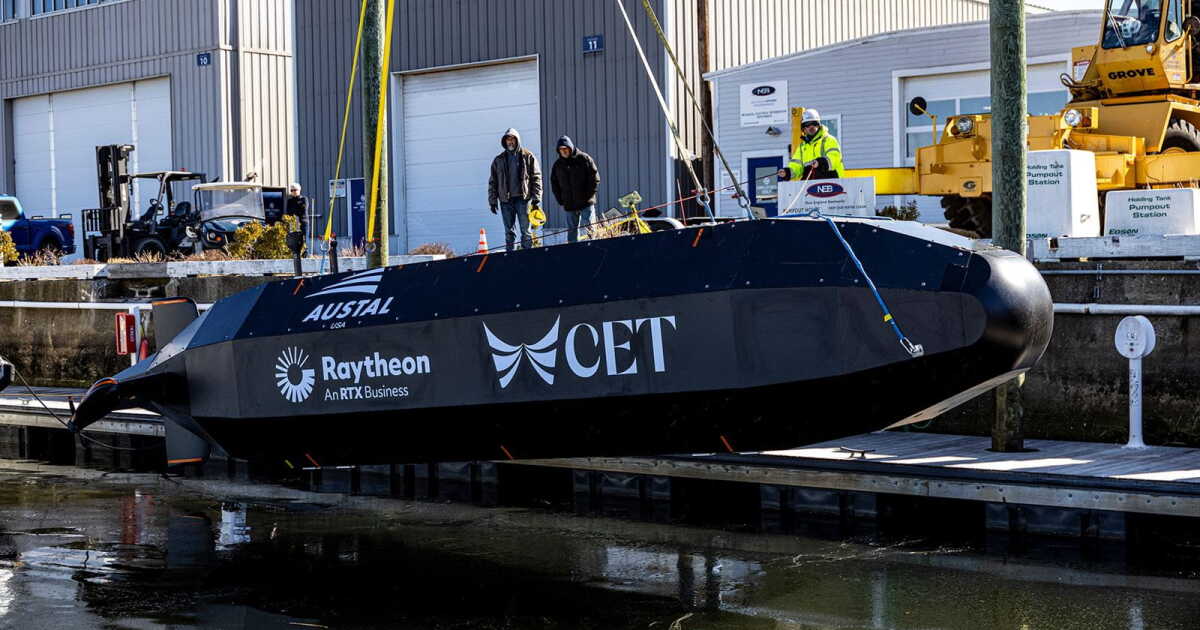
The US Navy scored a first as it carried out a submerged undersea launch of its new low-cost, long-endurance unmanned undersea vehicle (UUV) called HADALUS at Portsmouth, Rhode Island, where the vessel performed a series of sea trials.
Autonomous submarines have been around for some years now and are central to the modernization programs of the major naval powers. By building submarines that can operate on their own don’t need crew spaces, life support systems, and the pressure hull, many more such boats can be built at a fraction of the cost their crewed counterparts.
In addition, such subs can be used for boring routine patrols or be sent into hostile environments without risking sailors or much more valuable platforms. The result is to create a robotic fleet that would be a massive force multiplier and allow for a much larger area of ocean to be patrolled at one time.
Primary contractor Raytheon and partner Composite Energy Technology (CET) developed HADALUS in under 18 months from conceptual sketch to functioning prototype. CET provided the composite vehicle structure and Raytheon handled the mission systems, sonar, electronics, and launcher integration, mission systems, sonar, electronics, and launcher integration. The 34-ft (10-m) vessel features a 6-ft (1.8-m) cross section, over 2,000 nautical miles (2,300 miles/3,700 km) of endurance, and is designed to cost roughly one-third to one-fifth of comparable long-endurance UUVs.
However, such vessels can’t just be given the “go” order and steam out of port. Currently, such UUVs are placed in the water from a dock or a surface ship, but to be practical and to maintain stealth, they need to be deployable from attack or ballistic submarines, hence the recent tests.
Possibly for security reasons, the craft from which the HADALUS was released has not been identified. During the demonstration, the boat conducted end-to-end operations where it showed its ability to detect, reacquire, and act against a target in a single mission while maintaining a high degree of stealth.
“This demonstration is an important step in a broader roadmap to deliver autonomous, end‑to‑end undersea capabilities that are far less detectable than surface platforms,” said Jen Gauthier, vice president of Naval Systems & Sustainment at Raytheon. “By tightly coupling design, integration and at‑sea experimentation, we’ve proven we can bring new autonomous solutions to the fleet quickly and cost-effectively.”
Source: Raytheon

