


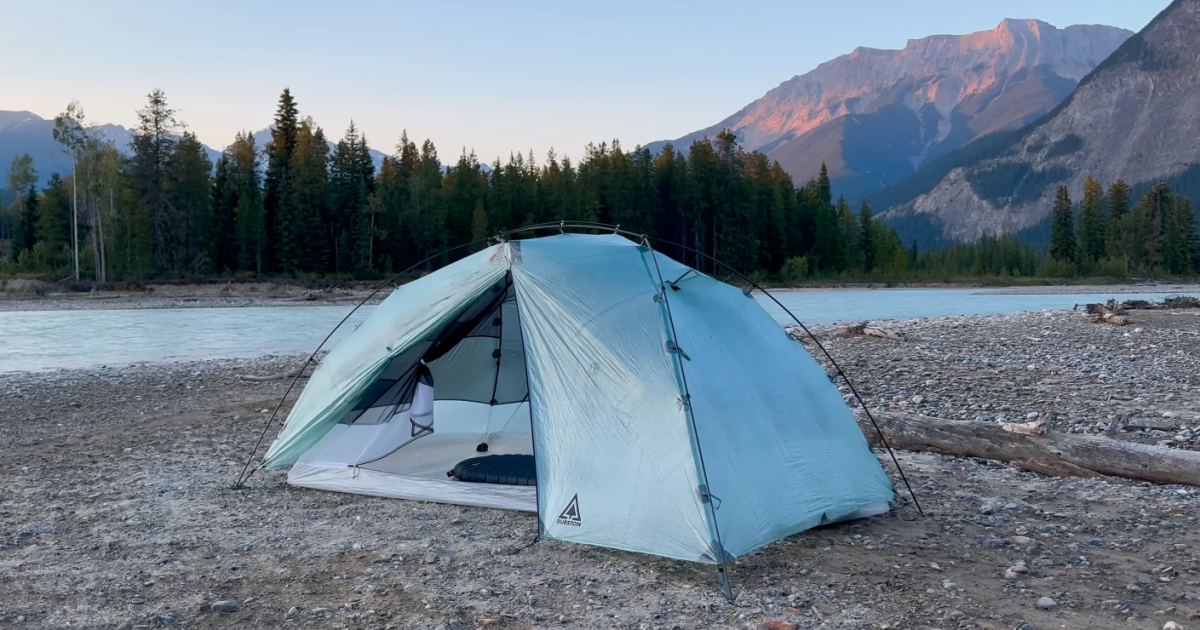
When ultralight backpacking boutique Durston Gear launched the X-Dome 1+ freestanding tent in 2024, anyone familiar with the brand knew it wasn’t going to be the lightest in the series. That’s because Durston has an established history of going even lighter (and more expensive) with Dyneema “Pro” models of its shelters. So we’ve been waiting, and now it’s here: The X-Dome Pro 1+ debuts to claims of being “world’s lightest freestanding double-wall tent,” and it looks like an exceptional piece of gear for any backpacking or ultralight kit.
We feel like we’ve rehashed the same story about the surging trend of fully freestanding ultralight backpacking tents a few times now, so we’ll leave the full spiel to our past articles like this one. Suffice to say, Durston was one of the names that kicked off the ongoing surge, and it now stakes its claim on developing the lightest double-wall tent of the bunch.
Durston Gear
Indeed, the X-Dome Pro’s neatly inventoried 1.7-lb (27.5 oz, 780-g) weight undercuts every other freestanding solo tent we’ve looked at, save for the Samaya Ultra1, which uses a mountaineering-targeted single-wall construction that lacks the benefits of Durston’s double-wall design. Durston manages to edge out the recently launched Hyperlite Crosspeak 1 by just over an ounce.
Durston is well known for constructing tents with sil-polyester in place of more traditional sil-nylon, but it still knows that for the lightest possible builds, it needs help from stronger-than-steel Dyneema Composite Fabric, an ultra-high molecular-weight polyethylene with lightweight fibers spaced out to the point you can nearly see right through it.
In fact, Durston says Dyneema packs roughly half the weight of other ultralight tent fabrics while delivering more robust strength, fast-drying waterproofing and non-sag integrity. The latter is critical in preventing pockets of pooling water, maintaining a taut outer skin that doesn’t flap around in the wind, and keeping the rainfly from sticking to the inner tent and leading to interior moisture.

Durston Gear
Both the X-Dome Pro 1+’s fly and tub floor are made from various grades of Dyneema, and Durston complements the bonded Dyneema construction with its latest Easton carbon fiber pole system. Extra-lightweight YKK interior zippers are said to reduce weight by 40% in comparison to heftier zipper hardware.
We thought Durston might size the Pro model down, even by just a smidge, to further boost weight savings, but it does no such thing. The Pro shares the same exact dimensions and geometry with the original X-Dome 1+, ensuring the same level of comfort at camp.
The 1-person+ designation indicates the tent is larger than the typical ultralight solo tent and more in line with what some manufacturers label a two-person tent. Durston notes that it offers plenty of space for a single person up to about 6.3 feet (192 cm) in height plus their backpack. The tent can accommodate two people “in a pinch.”

Durston Gear
Comparing the X-Dome Pro 1+ to the aforementioned Hyperlite Crosspeak series, the Pro tent’s 23.5-sq ft (2.2 sq m) floor area lands smack in the middle of the 18.6-sq ft (1.7-sq m) Crosspeak 1 floor and 28.4-sq ft (2.6-sq m) Crosspeak 2 floor sizes. The Pro’s 50-in (127-cm) head-area width is wider than the Crosspeak 2’s 48-in (122-in) spread, but the Pro floor tapers considerably more over its 85-in (216-cm) length , thinning to 29 inches (74 cm) at the foot compared to the Crosspeak 2 at 45 in (114 cm).
Remember, the X-Dome 1+ weighs a full ounce less than the Crosspeak 1 despite its larger sleeping area. It weighs a full 6.5 oz (184 g) less than the Crosspeak 2.
Over top that trapezoidal floor, the X-Dome 1+ Pro also has a generous 42-in (107-cm) interior peak height designed for sitting up comfortably, even atop a thick sleeping pad. Durston spreads the ceiling height out via its extended single-pole roofline and a spreader crossbar.

Durston Gear
The double-wall design with fully independent fly and inner tents improves ventilation while helping to abate interior condensation. It also makes for flexible setup. Users can pitch the fly first, then use it as cover while pitching the inner tent, attach the fly and tent together and pitch them as one, or pitch the inner tent and then attach the fly. In warmer, staler weather, users can open the offset fly zipper and roll one or both pieces of door fabric open to increase airflow. Magnetic toggles make for fast, single-handed tie-off.
When closed, the fly extends to create a roomy vestibule covering 9.2-sq ft of ground for storing a backpack and footwear. Pole sleeves at the ends of the crossbar let users install trekking poles, bolstering structural integrity. Durston notes its testing showed the tent could handle winds over 62 mph (100 km/h).

Durston Gear
The X-Dome Pro 1+ is designed for backpacking and bikepacking and packs down to an easy-carry size of 19 x 4.5-in (48 x 12 cm). While it doesn’t require staking, you’ll probably want to throw a few stakes down if the leaves are rustling even a tiny bit. The package includes eight stakes plus stuff sacks that bring total tent weight up to 29.1 oz (825 g). (Note: The previously listed Hyperlite Crosspeak peak weights are without stakes, so the comparisons are based on equal component sets).
Good news and bad news as far as pricing. The bad: It’s high – US$849 high. Worse, while the X-Dome Pro 1+ just launched a couple weeks ago, it sold out immediately.

Durston Gear
The good: Durston is planning a couple big production drops in the near future. It’ll start with the original $419 X-Dome 1+ on Tuesday, August 18 and follow up with a larger round of X-Dome Pro 1+ tents this fall (northern hemisphere). That gives you some time to ponder whether the 7.2-oz (204-g) weight savings between the Pro and original X-Dome 1+ are worth over double the price.
You can drop your email into the notifications box in the source link to ensure you don’t miss your next chance to buy the Pro.
Source: Durston Gear

