


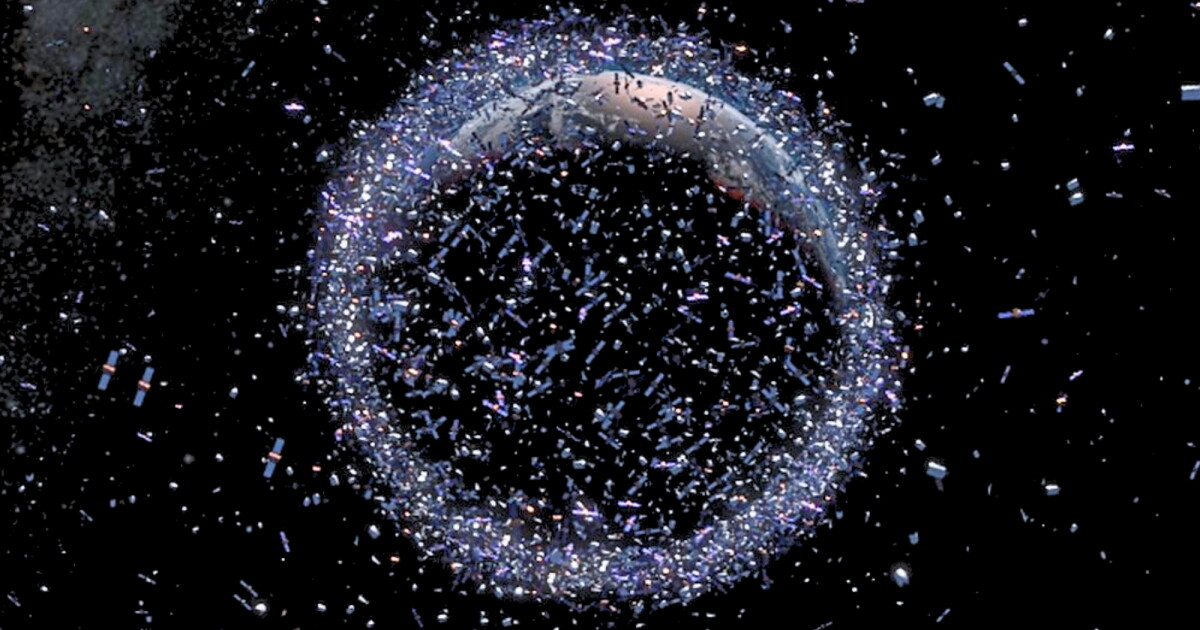
For the first time, a European Southern Observatory (ESO) study has quantified the threat to astronomy posed by a large number of highly reflective satellites planned to launch in the coming years.
In the paper, published in Astronomy & Astrophysics, ESO astronomer Olivier Hainaut argues that no more than 100,000 faint satellites – invisible to the naked eye – should orbit Earth.
Enforcing that guideline would preserve the darkness of the night sky and allow astronomers to continue cutting-edge science using modern telescopes.
Instead, there are existing proposals for more than 1.7 million satellites. These would have “devastating consequences for astronomy,” Hainaut claims.
The most disruptive of these, he argues, will be Reflect Orbital’s mirror-like satellites, which are designed to beam concentrated sunlight down to Earth at nighttime.
The growing satellite problem
Ever since SpaceX first started launching its Starlink internet satellites in 2019, astronomers have voiced their frustration and concern over the growing satellite problem.
Due to the long exposure times required to view distant objects, the satellite trains resulted in long streaks of light across observations.
Today, the number of satellites orbiting Earth currently stands at around 14,000, with the vast majority being Starlink satellites.
That number is expected to rise dramatically in the coming years, further impeding scientific discovery.
“Until now we have managed, but it’s getting worse,” Hainaut explained in an ESO statement. New proposals are set to take the challenges of ground-based astronomy “beyond the limit”.
F. Kamphues, ESO/M. Kornmesser
SpaceX, for example, aims to launch a million more satellites into Earth orbit, including large orbital AI data center networks. US startup Reflect Orbital, meanwhile, aims to launch a constellation of large mirror-like satellites to beam solar power to Earth at night. These would be the brightest satellites ever sent to Earth’s orbit, and Reflect Orbital aims to launch up to 50,000 by 2035.
Amazon has plans to launch more than 3,000 of its Amazon Leo internet satellites. In contrast, planned constellations such as E-Space’s Cinnamon and China’s CTC-1 and 2 could add hundreds of thousands more satellites into orbit.
In an interview with Refractor, University of Regina astronomer Samantha Lawler, who was not involved in the ESO study, said “satellite companies just keep asking for more, bigger, brighter, lower satellites, and it’s hard to keep up.”
“I am really impressed with Dr. Hainaut’s paper,” Lawler added, “though I am sad that it took him away from doing valuable astronomy research instead.”
“That’s one thing that makes me so angry about the situation in orbit,” Lawler continued. “Astronomers are constantly asked to quantify their data losses, while also having to try to continue doing their normal science work with continuously degrading sky conditions due to all the new satellites.”
Not a bright idea
For his study, Hainaut, who has worked as an astronomer for ESO for over 30 years, set out to simulate the locations, motion, and brightness of all existing and planned satellite constellations.
His findings showed that ESO’s Very Large Telescope (VLT) at Paranal Observatory in Chile, for example, will suffer field-of-view losses of up to 28% due to SpaceX’s planned satellites.
The US National Science Foundation’s Vera C. Rubin Observatory, meanwhile, could have several hours’ worth of observations rendered useless every night.
Hainaut also highlighted Reflect Orbital’s potential impact, as the company aims to launch the brightest satellites ever.
Their satellites’ beams will span at least five kilometres on Earth’s surface. To anyone within the beam, the satellite will reflect sunlight four times brighter than a full Moon.
Even to observers outside that reflection, each satellite would be as bright as the planet Venus. According to Hainaut, hundreds of the satellites could eventually be visible even from a light-polluted city like Munich, Germany.
As Lawler explained to Refractor, “last week, the FCC approved Reflect Orbital’s plan for the first of tens of thousands of space mirrors, which will not only be destructive to astronomy, but possibly dangerous to anyone looking through a telescope or operating an aircraft or car at night who could be flash-blinded by their beam.”
On top of that, “taxpayer-funded astronomy research is facing existential threats from for-profit private companies’ plans in orbit.”
Saving astronomy
Hainaut’s study also accounted for the overall brightening of the night sky. Even satellites too faint to be observed directly produce a ‘diffuse’ lighting effect. The brightest satellites, meanwhile, scatter their light in all directions. Overall, Reflect Orbital’s satellites alone could make the night sky up to four times brighter, according to Hainaut’s study.
Only by limiting the total number of satellites in Earth’s orbit to a maximum of 100,000, and a visual magnitude of 7, can we prevent a “devastating” scenario for astronomy, the astronomer concluded.
“This is not a hard number, like 99,999 is good and 100,001 is bad: clearly I’d prefer 50,000,” Hainaut said. “But 100,000 causes losses at about the level of other technical losses, such as equipment failure.”
Not only do bright satellites ruin astronomical observations, but we also know very little about the environmental impact of thousands of satellites eventually burning up in our atmosphere once they run out of the fuel required to boost their orbits.
A worst-case scenario could also see satellites collide with one another, causing a destructive, cascading effect known as Kessler Syndrome. To make matters worse, NASA has previously warned that satellite constellations could impede its ability to detect potentially hazardous asteroids headed towards Earth.
As Hainaut put it, “Low Earth orbit is a celestial seashore that provides immense value to modern life, from global connectivity to our clear access to the Universe. However, we must manage the footprint of mega-constellations—from the light pollution affecting astronomy to the atmospheric effects of satellite re-entry—to ensure this resource remains pristine and accessible for future generations.”
This research was published in Astronomy & Astrophysics.
Source: European Southern Observatory
Fact-checked by Mike McRae

