


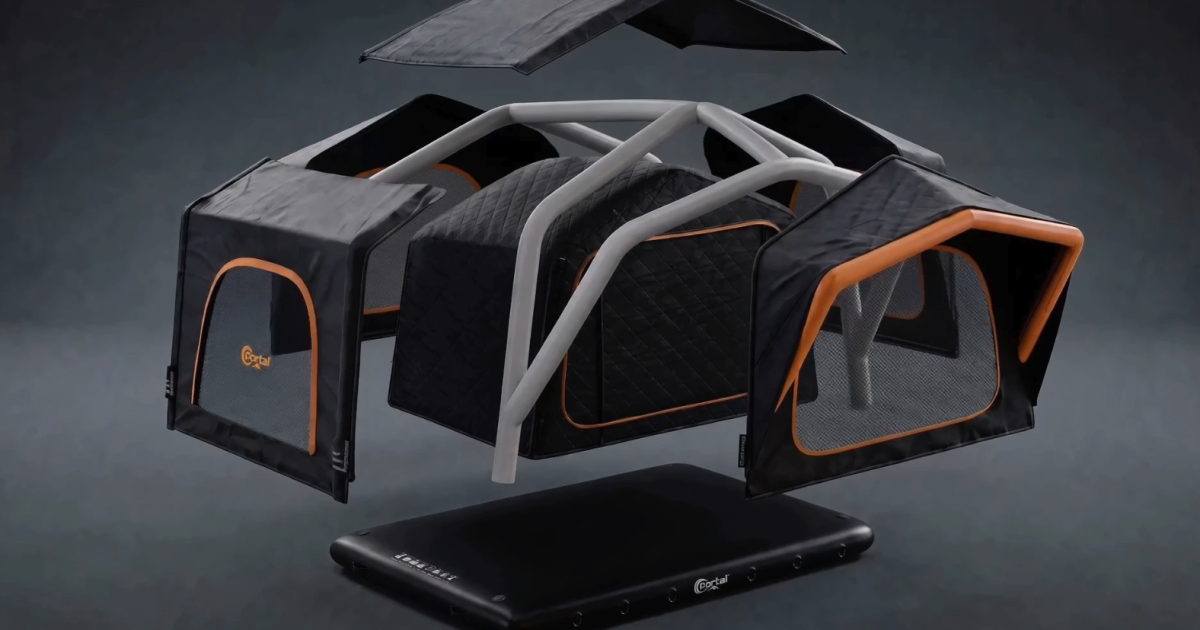
Inflatable construction has long been making lighter rooftop tents. The latest generation is so light and packable, it’s not even meant to ride to camp on the roof. The Portal Outdoors Nomis One finds its way to that category with a split-body design that carries in the trunk then inflates and hoists onto the roof or pickup truck bed in about 10 minutes. It delivers what might prove one of the market’s best combinations of fuel economy-maintaining driving aerodynamics and comfortable above-ground camping.
Headquartered in Hong Kong, Portal Outdoors was founded back in 2011. It really picked up steam in the US market during the great outdoor boom of the 2020 pandemic and established itself as a more well-known brand offering all kinds of outdoor and camping gear, from tents and furniture to inflatable paddleboards and cargo wagons.
Portal hit Kickstarter a few days ago to introduce the Nomis One inflatable rooftop tent (RTT), blowing past its goal in a matter of hours. With the new tent, it aims to distill the convenience and comfort of rooftop camping into a lighter, more packable design that avoids RTTs’ biggest pitfalls.
Portal Outdoors
Portal follows in the vein of Groenberg, which introduced the Weekend rooftop tent last year, offering a blend of lightweight in-vehicle carry and rooftop camping. Like Groenberg, Portal plants its tent atop a rugged inflatable base, but it diverges from Groenberg’s hard-frame design in completing its tent with a fully inflatable body comprising waterproof 300D Oxford fabric draped over an air-beam frame. An available cotton interior insulator is sold separately for those who want extra warmth.
The deflated tent body secures to the AeroDeck, and the owner then inflates the base on the ground and slides the tent onto the roof where it snaps into place via two-part mounting brackets attached to the crossbars vehicle roof rack. He or she then completes setup by inflating the tent body. Portal says the whole setup process can be done in under 10 minutes with an optional electric pump that allows for hands-free inflation.

Portal Outdoors
That 10-minute estimate is slower than the quick setup for a hardshell rooftop tent but about comparable once you factor in installing the various awning struts over an RTT’s doors and windows. I’d say 10 minutes is comparable to what it takes to expand the four-person Topoak Vision XL, get the ladder secured on the ground and install the six awning struts on the door and two side windows. I can do it in just a couple minutes by skipping the awning struts, but then I’m left with less ventilation and the potential for loose awning fabric to flap around in the breeze all night.
The Nomis One features an inflatable door awning and weatherproof window panels in place of awnings, eliminating the extra time for strut installation.
In theory, breakdown could be a big selling point for the Nomis One since you simply open up the individual tent frame and base deflation valves, but we’ve wrestled with enough inflatable outdoor equipment to know it often requires all kinds of rolling, flattening and wringing to get air out to the point that the deflated item fits comfortably in a duffel bag or trunk compartment. So … we’ll see.
At the least, it does eliminate the need to carefully stuff all the fabric inside a soft or hardshell cover, a sometimes tedious process for traditional rooftop tents. On the downside, there’s no leaving your sleeping bags and pillows inside so you’ll have to unload them separately. The tent body and floor combine for a weight of 45.8 lb (20.8 kg), not including the ladder, pump or optional inner tent.

Portal Outdoors
It may be called the Nomis “One,” but the tent is designed to sleep two to three people. The AeroDeck is specced to support up to 550 lb (249 kg) and offers an interior floor space of 80 x 52 in (204 x 131 cm). We don’t particularly like the idea of plastic mounting brackets – no matter how “heavy duty” – but presumably they’re reliable enough for keeping the tent securely in place during camping since it’s not meant to be left on while driving. The Nomis One can also be set up on the ground or on a pickup truck bed.
In addition to its waterproof outer fabric, the tent includes large mesh windows with zippable waterproof covers. The mesh features a privacy tint that lets you see out clearly while partially obscuring visibility from the outside.

Portal Outdoors
In some ways, tents like the Nomis One and Groenberg Weekend seem like the best of both worlds, getting you camping up off the hard, cold, uneven ground without the weight, difficult mounting and aerodynamics penalty of standard rooftop tents. On the other hand, they take away benefits like quick setup and always-there rooftop availability. They tend to land somewhere in the middle on price, costing well more than a basic ground tent but less than most other rooftop tents.
Groenberg got the pricing about right during its own crowdfunding launch, with a ~$580 starting point landing the Weekend tent in between an affordable ground tent and a four-figure rooftop tent. Some campers might have found that too much of a premium over inexpensive ground tents, but those looking closely at rooftop tents that quickly climb to $2,000, $3,000 and beyond should find it much more attractive. However, it doubled that pricing for standard retail, shaking up the cost/benefit analysis considerably.
Portal follows suit. An early bird ledge level of HK$5,872 (approx. US$750) reserves the complete tent itself, while HK$7,048 (US$900) gets a package with the tent, telescopic ladder and electric pump. The ladder and pump can also be added individually, as can the quilted insulator tent.

Portal Outdoors
Both prices seem fairly reasonable for a tent that splits the advantages of ground and rooftop camping. However, while Portal doesn’t plan to double pricing for standard retail, adding the estimated $350 and $500 for the tent and full package, respectively, might push its prices too high. At least they will for us – at $1,400 for the complete package, you’re getting back up to standard RTT pricing territory.
Kickstarters have shown the Nomis One plenty of love at the early bird marks, though, lifting the campaign to over $60K – five times its goal – in just a few days. If everything else works to plan, Portal will begin sending out backer units in January 2027.
Source: Portal Outdoors

