


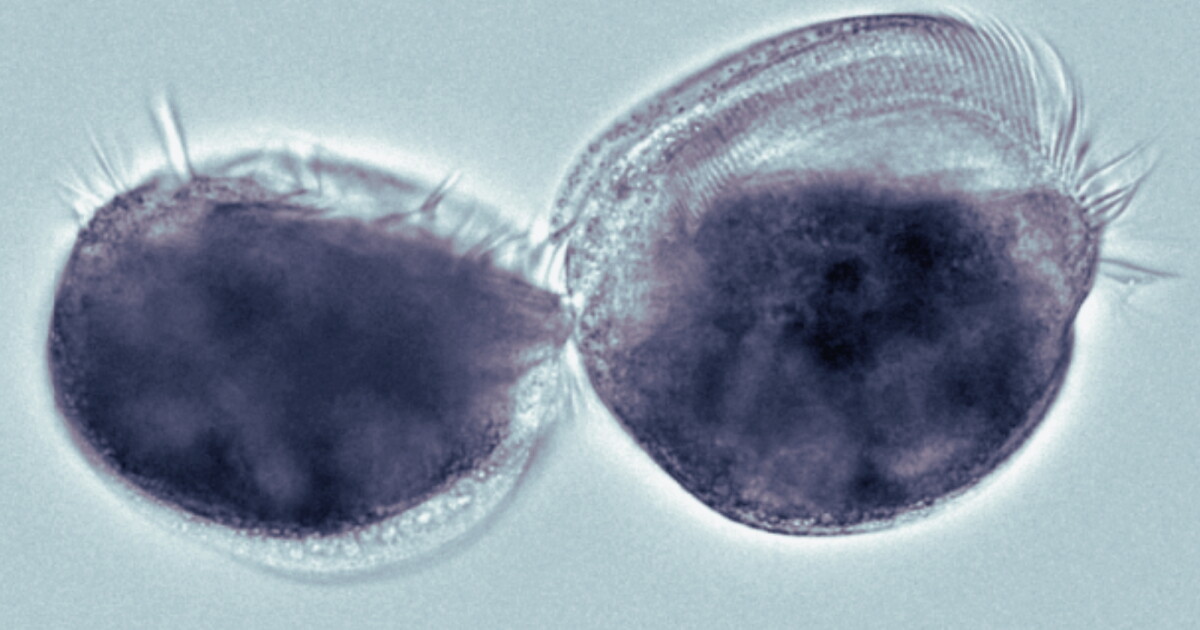
In cloned populations of a newly described single-celled protist, a few cells undergo a voracious transformation. They metamorphose into much larger “supergiants” that shift their shape, alter their movement, and begin hunting and eating their own genetically identical relatives.
“When you are looking down the microscope and seeing just how different the two developmental stages are, and how voracious the supergiants are, it is amazing to see,” a cell biologist, Patrick Keeling at University Boulevard in Canada, told Refractor in an email.
Why they do this isn’t clear, with researchers ruling out factors such as food shortages and overpopulation.
The microbe in focus is a type of ciliate called Euplotes gigatrox, which typically lives as a small, elongated cell that filter-feeds on bacteria by generating water currents with hair-like structures called cilia. The cannibalistic transformations have been well documented in other ciliate species; however, in this species, the transformation is dramatic.
In a study published in Proceedings of the National Academy of Sciences, Keeling and his colleagues report that under certain conditions, some E. gigatrox develop into cannibalistic giants more than twice as long as their normal counterparts, with larger bodies and enlarged feeding structures.
But supergiants do not filter-feed. Under the microscope, the researchers observed these supergiants running over smaller kin and engulfing them whole at the rate of one every 10 minutes.
During this transformation, the cells tightly regulate the developmental stages through distinct gene expression levels. In the supergiant phase, over 42% of the identified genes are differentially expressed between the developmental stages.
Once the transformation is complete, the cell is entirely morphed for hunting. But there is a cost attached to being a cannibal. Though supergiants move faster than normal cells, they only walk along surfaces in circulatory paths. Meanwhile, the normal cells can swim long distances on their own.
The co-author of the study, Ben Larson at Rensselaer Polytechnic Institute, says that the metabolic cost of maintaining the large body size increases. But the ability to eat larger prey items might pay off in terms of reproduction.
It is important to note that the observation was made under captive settings, but “the fact that cannibalism transitions seem to have independently evolved in several ciliate lineages does suggest that these types of transitions may be adaptive and may occur on a somewhat regular basis during the life cycles of these organisms,” Larson told us.
As for why only a small fraction of cells become cannibalistic, Larson suspects that there may be an evolutionary balance point based on some tradeoffs and constraints. Since one cannibal cannot devour another cannibal, and if all E. gigatrox cells are transformed into supergiants, “they would immediately run out of food. Then cannibalism is a bad strategy,” he adds.
The researchers also found that this cannibalistic transformation is reversible. The supergiants can propagate their supergiant form by dividing equally, or revert to normal morphs by undergoing asymmetrical cell divisions.
A single supergiant can produce up to nine normal cells within just 24 hours. However, the cells recently reverted from the supergiant state do not have the potential to form supergiants compared to cells produced by normal morphs. The study hypothesizes that the supergiant reversion may trigger a cool-down period.
This could also help explain a potential reason for the cannibal Hulks as “a low-probability life history transition” that occurs after an increase in numbers when there’s a chance they’ll chew through smaller prey.
“Cells can display some remarkably sophisticated forms and functions, including sometimes uncannily animal-like behavior such as walking and hunting,” says Larson. “These sorts of complex cellular architectures and behaviors can be found in nature all around us.”
“The microbial world is a strange and alien place right here on Earth where all sorts of crazy things are happening that rival the best nature documentary you ever saw,” Keeling concludes.
The study has been published in the journal Proceedings of the National Academy of Sciences.
Fact-checked by Mike McRae.

