


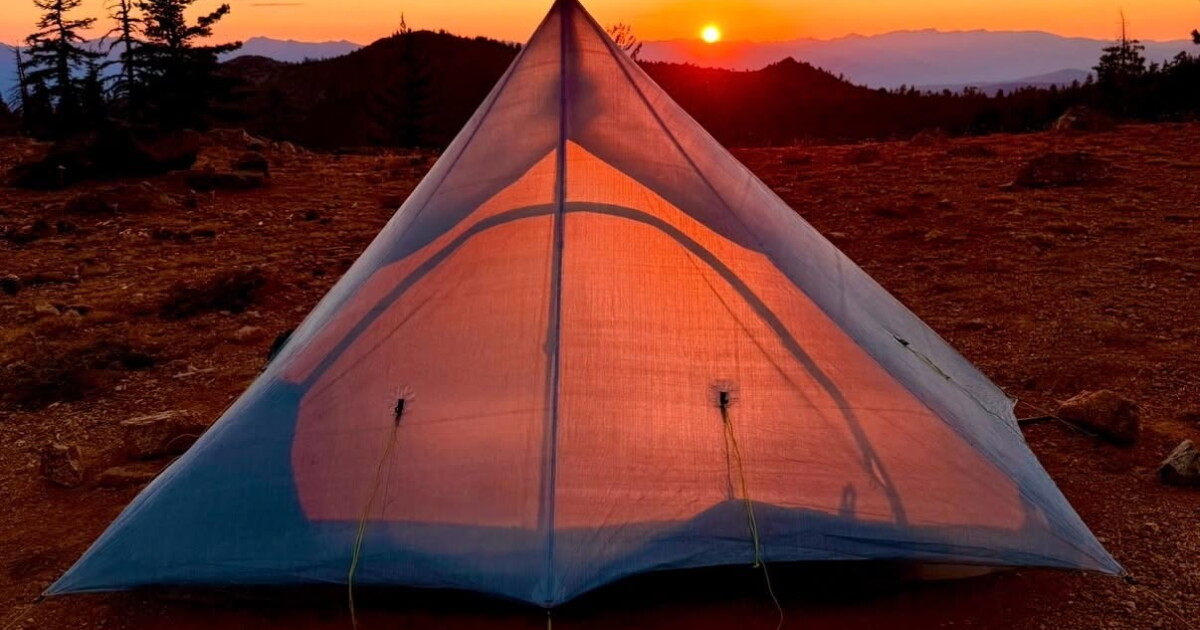
Stepping away momentarily from the ultralight freestanding tents that have really been having their moment in recent years, Zpacks presents its latest non-freestanding backpacking tent. Pitched with a single pole, the new Plex Solo Pro pulls out all the stops in furnishing backpackers and other deep-backcountry explorers with an ambitious blend of featherlight packability and camping convenience.
At first “Pro” struck us as indicative of the lightest possible tent in a Plex family that also includes the Plex Solo Classic. But that’s more the nomenclature that Durston Gear uses for its Dyneema-bodied tents. Zpacks uses Dyneema across its entire lineup and applies “Pro” a little differently.
The Pro model actually weighs a few grams more than the Plex Solo Classic, which Zpacks points to as the “lightest full-featured one-person tent in the world.” But the Pro still manages to limbo well under the 1-lb (453-g) bar at a listed base weight of 13.2 oz (374 g). Its real advantage comes in tacking on a few convenient features the 12.3-oz (348-g) Classic lacks to offer a well-rounded combination of camping ease of use and barely-there carry.
Zpacks
Specifically, Zpacks changes up the zipper design from Classic to Pro, adding flexibility for fully opening and closing the Pro doors during fast-changing weather. The inner mesh design swaps out the Classic’s arched door zipper for a wider opening split-L that includes a single zipper down the center and two lower zips that run most of the length of the tub floor.
This zipper design creates two triangular doors that can be rolled up and tied back via magnetic toggles for unimpeded ventilation. Campers can open one or both, depending on how much breeze they want to let in, a particularly valuable capability to have in hot, stuffy, and/or variable weather at camp.

Zpacks
Like the Plex Solo Classic, the Pro features a hybrid single/double-wall construction with the inner front front mesh sewn directly to the Dyneema waterproof body that makes up the rest of the exterior. This design delivers more ventilation and adjustability than a full-blown single-wall tent without the excess weight of a complete double-wall design with fully removable rainfly. A vent at the top of the outer zipper further improves airflow.
The storm door on the Pro gets a major upgrade over the Classic, featuring a center zipper to close shut for confident weatherproofing. The Classic, on the other hand, saves weight by omitting the zipper and using an overlapping design that requires staking into place via the guy line. You’ll still want to stake out the closed Pro doors for the most stable wind and weather protection and to create a vestibule, but the zipper makes it easier to quickly close the tent off when a fast-approaching storm rolls in. It also looks more familiar and less finicky to use in general.

Zpacks
Given the sheer unpredictable nature of the great outdoors, the added convenience of the new multi-zipper design seems worth the 0.9-oz (25.5-g) weight penalty to us. You’ll still be packing one of the lightest tents available anywhere in the world, just with a little extra flexibility and user friendliness.
That said, some backpackers prefer to go even lighter than the Plex Solo Classic with a simple tarp or no shelter at all, so the Classic might seem to have more than enough convenience for them. To go any lighter than that in the Zpacks catalog, you have to rip the bottom out via a floor-less tent or a tarp.
The Plex Solo Pro pitches using a single trekking pole for a sharp, single-point peak height of 52 in (132 cm) and a series of six to 10 stakes. Zpacks says that six is the bare minimum, recommending all 10 in windy conditions. The company sells a folding 2.8-oz (80-g) carbon fiber pole for use with the Plex Solo Pro, a good option for those who don’t use trekking poles for their ultralight backcountry activities of choice.

Zpacks
Zpacks does not include the stakes with the tent, allowing users to select their own, whether they already own them or are shopping Zpacks’ own stake selection. Zpacks’ offerings will add a minimum of 0.4 oz (11 g) for six skinny carbon fiber “pin” stakes, up to 3.4 oz (96) for six of its beefiest aluminum stakes. A full 10-pack, then, will add between 0.7 and 5.6 oz (20 and 159 g). There are several options that fall between those in weight and toughness, and all Zpacks stakes range between US$2.75 and $4.95 each.
Even with the addition of all 10 stakes, plus the 0.5-oz weight of the included stuff sack and repair kit, the Plex Solo Pro maintains a minimum base weight under a pound – 14.4 oz (408 g) with the carbon-pin stakes. Add the $40 carbon fiber pole in place of a trekking pole, and you push just over a pound to 17.2 oz (488 g). The tent rolls up to a size of roughly 11 x 4 in (28 x 10 cm) for packing.

Zpacks
Inside, the Plex Solo Pro has a tub floor that tapers from 38 inches (97 cm) at the center to 28 in (71 cm) at the ends, running a total of 84 inches (213 cm) in length. Because of the wall angles, Zpacks says it’s most comfortable for users who are 6 feet (1.8 m) tall or under.
Zpacks announced the Plex Solo Pro launch late last month, a few weeks after introducing its slick, ultra-packable 2.5-oz camp shoes. The tent is available to order now for $649. Note that some of the different color options relate to different fabric weight combinations, resulting in tent weights that vary between 13.2 and 15.2 oz (374 and 431 g) before adding the weight of stakes, stuff sack, pole or repair kit.
Source: Zpacks

