



The Mediterranean is getting hotter and drier, pushing scientists to look for water even in the air itself. A German team has now scaled up a porous material that does exactly that, even when the air feels bone-dry.
“Regions like these are facing rising temperatures and declining rainfall. Our goal is to develop an environmentally friendly technology that converts water molecules from the air into drinking water,” says Norbert Stock of Kiel University’s Institute of Inorganic Chemistry, lead author of the study published across two papers: in the Journal of Materials Chemistry A and Industrial & Engineering Chemistry Research.
The material, called CAU-10-H, belongs to a class of compounds known as Metal-Organic Frameworks (MOF). These structures are riddled with microscopic pores that behave like molecular sponges, soaking up water vapor and releasing it again with minimal fuss. The foundational chemistry behind MOFs earned Omar Yaghi the 2025 Nobel Prize in Chemistry. Yaghi has already spun the idea out into his company Atoco, which is developing shipping‑container‑sized units designed to pull up to 1,000 liters (264 gal) of water per day from desert air, with first commercial systems planned for the second half of 2026.
Kiel University
CAU-10-H takes a different but complementary approach – and its creators think it’s ready to leave the lab. The name itself comes from the acronym “CAU” (Christian-Albrechts-Universität zu Kiel), the university’s German name and the material’s birthplace. The number “10” marks its place in the university’s numbered catalog of compounds, and “H” flags the hydrogen-based chemical group used to build it.
Most moisture-harvesting materials need relatively humid air to function well. CAU-10-H starts capturing water molecules at room temperature once relative humidity passes just 18% – conditions most systems would write off as too dry to bother with.
Releasing that water is just as undemanding. Heating the material to around 70 °C (158 °F) is sufficient to drive off the captured moisture, a temperature low enough to reach using solar heat or waste heat from a factory, rather than expensive mains electricity. When the Kiel researchers combined the material with conductive carbon structures, they sped up the cycle further, achieving continuous operation with cycles lasting just a few hours.

Kiel University
Under dry air conditions, the material captures up to 0.17 grams of water per gram of material, translating to a projected 1.8 liters (0.5 gal) of water per day for every kilogram (2.2 lb) of the composite. “This makes the material particularly attractive for producing drinking water, even in arid regions,” says Lasse Wegner, another author in the study.
CAU-10-H has a second use as a refrigerant. In adsorption cooling systems, it triples the performance of silica gel, the standard desiccant used for decades. The appeal is using waste heat – the kind that leaks out of a data center or a bakery oven – to cool spaces without adding to the electrical load of conventional air conditioning.
These results place CAU-10-H among the more efficient low-humidity, low-heat sorbents reported to date, though direct comparisons are difficult: the Kiel numbers describe grams of raw material in lab conditions, while Atoco’s container-scale figures describe liters produced by a complete machine with fans and heat exchangers included. There is also no standardized benchmark for comparing CAU-10-H to a UNC Chapel Hill material announced in July 2026, which releases captured water in about three minutes at 50 °C (122 °F) – a design optimized for speed of release rather than maximum water uptake per cycle.
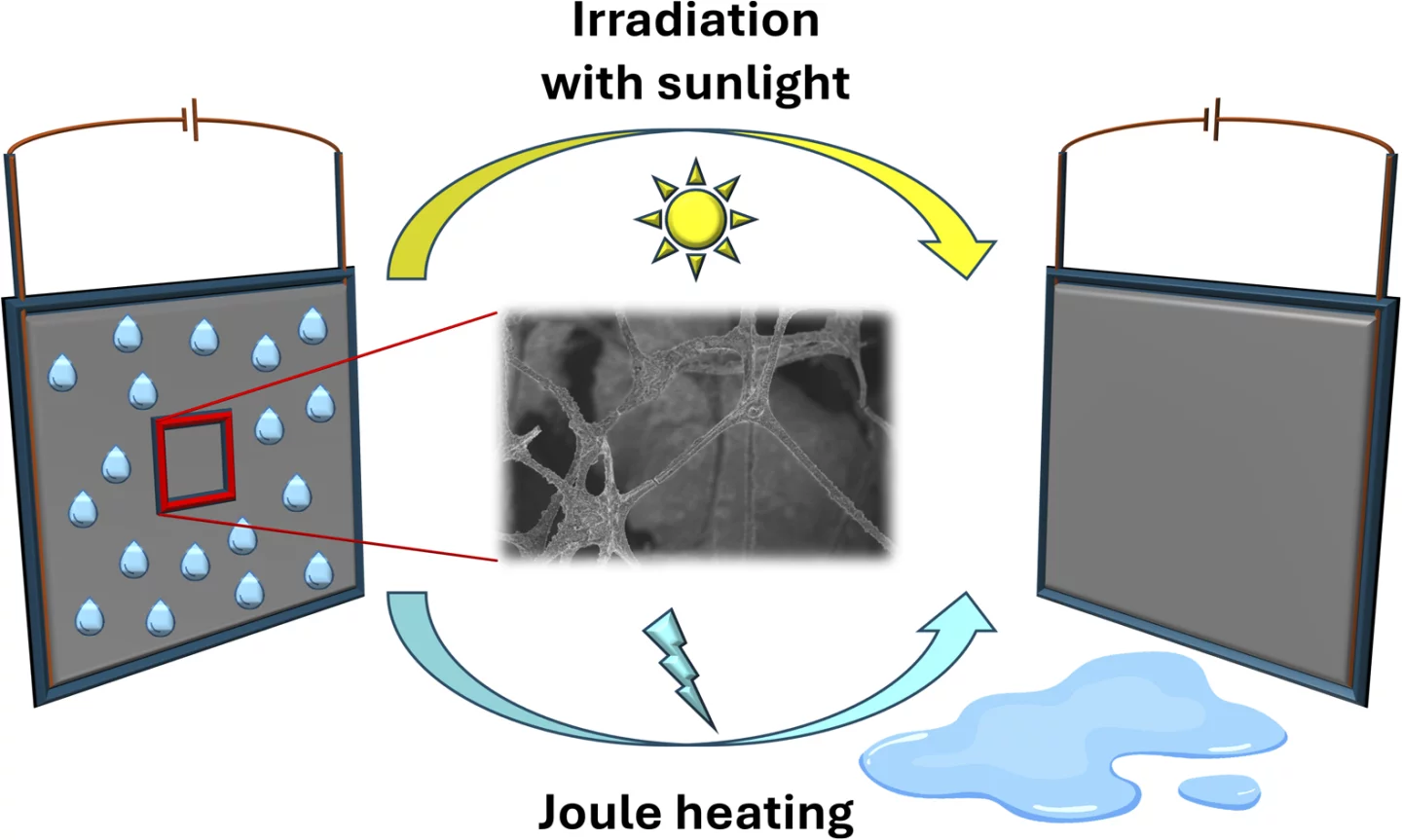
Kiel University
But what matters most here isn’t the chemistry itself; it’s scaling the material up for real use. “We discovered CAU-10-H around 15 years ago, and since then its potential applications have been investigated around the world,” says Stock, who has been conducting research on MOFs for more than two decades.
With backing from Kiel University’s validation fund, the team has now produced about 30 kg (66 lb) of the material – roughly 60 times more than any previous lab batch – at an estimated cost of US$12 to $14 per kilogram. “This brings practical applications of our materials within reach,” says Stock. “We have shown that they not only work in the laboratory but can also be produced on an economically viable scale.”
That jump from grams to kilograms is exactly what trips up most promising lab materials before they ever reach the real world. CAU-10-H, by contrast, now has a factory price tag and a scaling plan. The next test will be real-world deployments. If those confirm the lab numbers, CAU-10-H could become a key piece of the MOF revolution, pulling drinking water from the air wherever the rain no longer falls.
Source: Kiel University

